
EleutherAI's Pythia-70M Gives Researchers 154 Snapshots of a Learning AI
EleutherAI's smallest Pythia model keeps pulling nearly a million monthly downloads because it exposes every training checkpoint for interpretability work.
Takeaways
- Pythia-70M-deduped is the smallest model in EleutherAI's Pythia Scaling Suite for interpretability research.
- Ships 154 checkpoints per model as Hugging Face branches, including dense log-spaced early steps.
- Trained on the deduplicated Pile with identical data order across all 8 sizes from 70M to 12B.
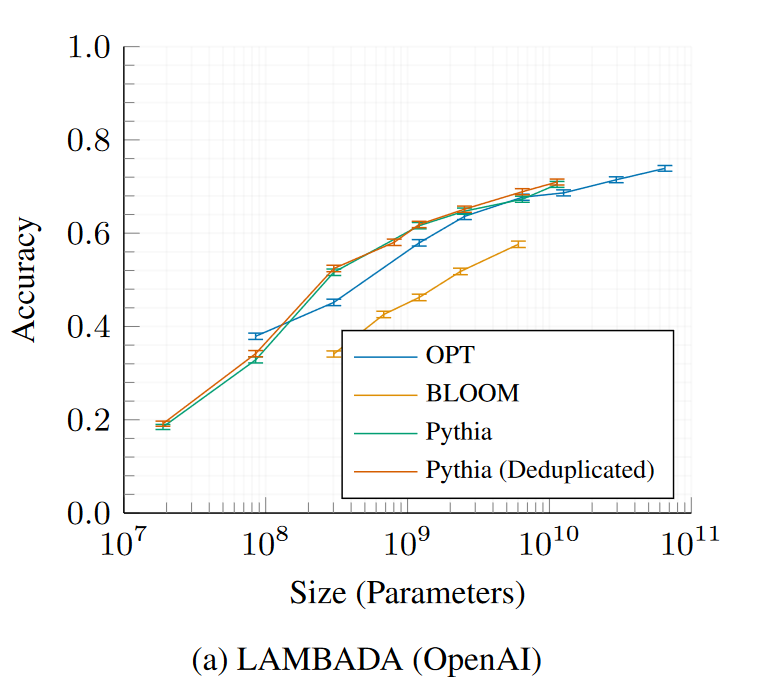
- Matches or beats OPT and GPT-Neo on LAMBADA, PIQA, WinoGrande, ARC-Easy and SciQ at equivalent sizes.
- Apache 2.0 licensed, runs on Transformers, vLLM, SGLang and Docker; not instruction tuned.
- See the Pythia paper and GitHub repo for training code and configs.
The Pythia-70M-deduped checkpoint from EleutherAI is the smallest member of the Pythia Scaling Suite, weighs in at around 96M total parameters, and pulls hundreds of thousands of downloads a month. Its staying power has almost nothing to do with generation quality and everything to do with what it lets you observe inside a language model as it learns.
A microscope, not a chatbot
The Pythia Scaling Suite is a collection of models built to facilitate interpretability research. It contains two sets of eight models at sizes 70M, 160M, 410M, 1B, 1.4B, 2.8B, 6.9B, and 12B. For each size there are two variants: one trained on the Pile, and one trained on a globally deduplicated version of that dataset. All eight sizes see identical tokens in identical order, which lets researchers isolate the effect of scale without confounding it with data shuffling.
EleutherAI hosts 154 intermediate checkpoints per model as Hugging Face branches, so you can watch a circuit form step by step. The set includes an initial step0, ten log-spaced checkpoints at steps 1, 2, 4 through 512, and 143 evenly spaced checkpoints from step1000 to step143000. That density near initialization is what distinguishes Pythia from most published training runs, which release only final weights.
What the 70M variant actually is
Pythia-70M-deduped is a GPT-NeoX-style decoder transformer with 6 layers, a hidden size of 512, and 8 attention heads. It shares a tokenizer with GPT-NeoX-20B and was trained on the globally deduplicated Pile, an 825 GiB English text corpus assembled by EleutherAI. Each model processed 299,892,736,000 tokens total, with checkpoints saved every 2,097,152,000 tokens, amounting to just under 1 epoch on the full Pile and roughly 1.5 epochs on the deduplicated version.
The current retrained suite fixed several inconsistencies from the original v0 release:
- All model sizes now train with a uniform batch size of 2M tokens. Previously the 160M, 410M, and 1.4B models used 4M-token batches.
- Flash Attention is used throughout the retrained suite.
- Extra early checkpoints were added at steps 0, 1, 2, 4, 8, and so on up to 512.
- Learning rate schedules are unified so every model decays to 10 percent of its peak LR.
Honest performance expectations
At 70M parameters, this model produces grammatical English and completes short phrases, but carries no instruction tuning and no RLHF. It will not respond to prompts the way a product like ChatGPT does. On standard zero-shot benchmarks the suite holds up well despite never optimizing for downstream performance: published evaluation plots against OPT and BLOOM on LAMBADA, PIQA, WinoGrande, ARC-Easy, and SciQ show Pythia tracking or beating both alternatives across the full size range.
Getting it running
The model is Apache 2.0 licensed. Pull any of the 154 checkpoints by specifying a revision when loading:
from transformers import GPTNeoXForCausalLM, AutoTokenizer
model = GPTNeoXForCausalLM.from_pretrained(
    "EleutherAI/pythia-70m-deduped",
    revision="step3000",
    cache_dir="./pythia-70m-deduped/step3000",
)
tokenizer = AutoTokenizer.from_pretrained(
    "EleutherAI/pythia-70m-deduped",
    revision="step3000",
)
It runs out of the box with vLLM, SGLang, and Docker Model Runner. The Hugging Face ecosystem already includes 229 adapter models, 57 finetunes, and 21 quantizations built on top of it.
Where it fits in a research workflow
The Pythia collection appears in a large fraction of mechanistic interpretability papers because it combines matched scaling, identical data ordering, and dense checkpointing under a permissive license. Researchers studying when induction heads form, how specific facts get memorized, or how deduplication shapes what a model learns consistently reach for the Pythia paper and this checkpoint family as their baseline.
Pythia-70M-deduped specifically suits several concrete use cases:
- A tiny model that fits on a laptop CPU for tokenizer probing or activation-patching experiments.
- A controlled baseline for ablations against the non-deduped Pythia-70M twin to isolate the effect of duplicate training data.
- A cheap target for reproducing training dynamics research end to end, since the training code and configs are public.
- A quick sanity check when scaling an experiment across the 70M-to-12B ladder.
The model card's deployment warnings are worth reading before plugging it into anything user-facing. Treat it as a research instrument and it earns its download count.