
EchoLabs Shrinks OpenAI's CLIP 3.6x With HelixCode Without Losing Accuracy
EchoLabs shrinks OpenAI's CLIP ViT-L/14 by 3.6x with its HXQ codec, extending vector-quantized compression to vision without losing accuracy.
 Pro
Takeaways
- EchoLabs released clip-vit-large-patch14-hxq, a 447 MB compressed CLIP ViT-L/14
- 3.6x smaller than FP32 baseline with Top-1 accuracy on CIFAR-100 essentially unchanged
- Uses HelixCode vector quantization: 256 entry codebook plus uint8 index matrix per layer
- No calibration data required, and the compressed weights execute directly
- Same codec now covers Transformers, SSMs, Hybrids, MoEs and Vision, via one pip install
- Fine tunable via LoRA adapters on each HelixLinear layer, Apache 2.0 licensed
A new drop from EchoLabs pushes the HelixCode compression codec into vision territory for the first time. The team took OpenAI's widely used CLIP ViT-Large/14 and squeezed it from 1.6 GB down to 447 MB, with zero-shot accuracy nudging up rather than down.
CLIP ViT-L/14 sits inside a huge chunk of the stack that people still ship today, from image search and moderation pipelines to conditioning signals for diffusion models. Shrinking it without a calibration dataset makes it easier to deploy on smaller GPUs or CPUs without babysitting a quantization run.
What actually shipped
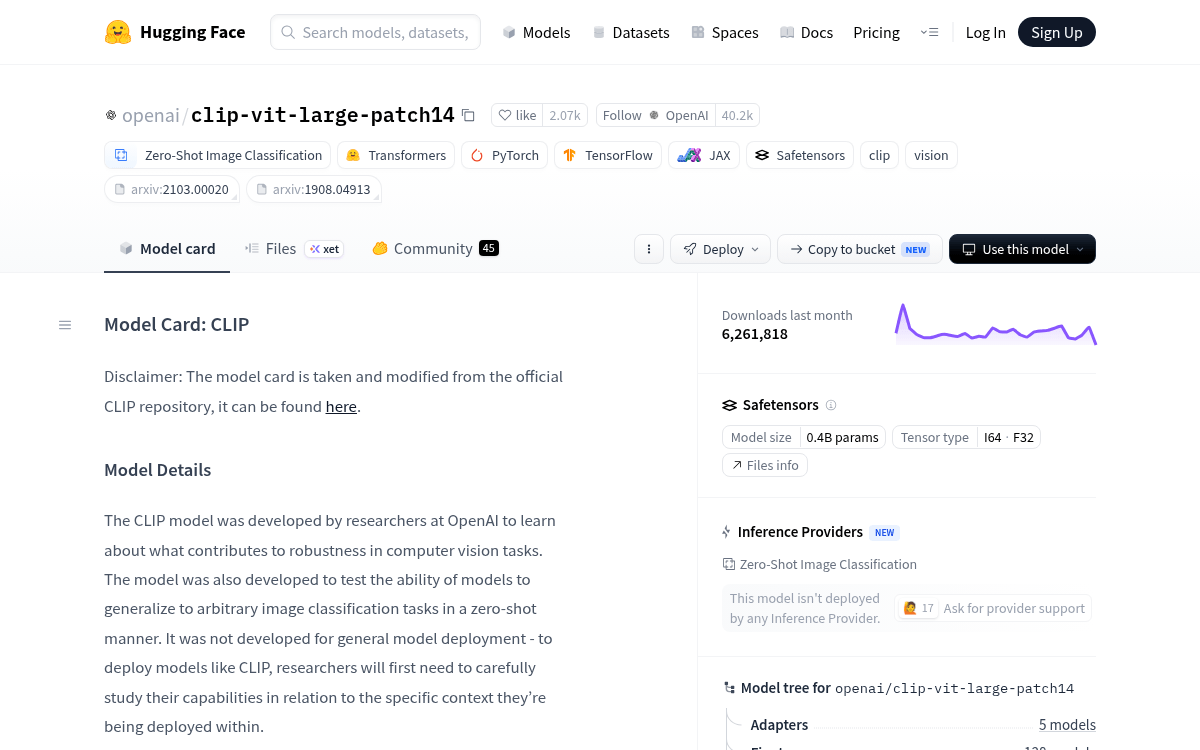
The model card describes CLIP ViT-Large/14 (text plus vision dual encoder) compressed from 1.6 GB to 447 MB, with zero-shot classification accuracy matching the dense baseline, no calibration data, and the same codec that compresses Transformers, SSMs, Hybrids, and MoEs. In practice both the vision tower and the text tower are quantized in one pass with a single tool.
On CIFAR-100 zero-shot classification the compressed model reports Top-1 of 72.75% versus 72.48% for the dense FP32 baseline, and Top-5 of 91.64% versus 91.41%. The team frames the small positive deltas as noise, which is the honest read. The important claim is that nothing broke.
- Size: 1.6 GB to 447 MB, a 3.6x reduction
- Eval VRAM: 3,412 MB to 2,266 MB
- Compressed modules: 218 HelixLinear layers across both encoders
- Architecture: unchanged CLIP ViT-L/14 plus text transformer
- License: Apache 2.0, inherited from the original OpenAI weights
Inside the codec
HelixCode is a vector quantization scheme rather than the more familiar per-tensor integer quantization. Each weight matrix gets swapped for a 256 entry float32 codebook, a uint8 index matrix that says which codebook row each weight points to, and optional sidecar corrections for outlier values. Because the indices are one byte and the codebook is tiny relative to the matrix, you get big savings on any layer with enough weights to amortize the codebook.
Two design choices stand out. First, the compressed form is executable directly, so there is no decompression pass before a forward call. Second, the codebooks are fit from the weights alone, so you do not need a calibration set of representative inputs, which is a common source of pain in post training quantization workflows like GPTQ or AWQ.
Only the linear layers get compressed. Token, position, and patch embeddings, along with layer norms and biases, stay at full precision. That split is sensible because embeddings are small in parameter count but sensitive to rounding, while the 218 attention and MLP linears are where the bytes actually live.
Using it
Loading works through a small shim that registers the quantizer with the standard Hugging Face classes:
pip install "helix-substrate[hf]"import helix_substrate # registers the HXQ quantizer
from transformers import CLIPModel, CLIPProcessor
from PIL import Image
model = CLIPModel.from_pretrained("EchoLabs33/clip-vit-large-patch14-helix")
processor = CLIPProcessor.from_pretrained("EchoLabs33/clip-vit-large-patch14-helix")
image = Image.open("photo.jpg")
inputs = processor(text=["a photo of a cat", "a photo of a dog"],
images=image, return_tensors="pt", padding=True)
probs = model(**inputs).logits_per_image.softmax(dim=-1)The model runs on any CUDA GPU or on CPU. Fine tuning is supported through LoRA adapters that attach to each HelixLinear layer while the compressed weights stay frozen, which is a reasonable path if you want to specialize the encoder for a downstream retrieval or classification task.
Beyond CLIP
The bigger story is the codec generalizing across model families with the same install. EchoLabs lists Helix Substrate results on transformers like TinyLlama and Qwen 1.5B to 14B with perplexity within noise, pure state space models like Mamba 130m and Mamba2 1.3B, hybrids like Zamba2, and the OLMoE mixture of experts model with a HellaSwag delta of minus 0.16 percent. CLIP is the fifth architecture family they have knocked over with one tool.
Most quantization tooling today is architecture specific. Bitsandbytes, GPTQ, AWQ, and their forks all have quirks around attention variants, MoE routers, or SSM kernels. A single codec that treats any nn.Linear the same way, with no calibration set and no architecture patches, is a cleaner story for teams that ship a mix of encoders, decoders, and multimodal models.
Caveats before you swap
Reported evaluation is CIFAR-100 zero-shot only, which is a coarse signal for a model that people mostly use for retrieval, captioning conditioning, and open vocabulary detection. If you rely on CLIP embeddings for nearest neighbor search at scale, re-measure recall at your own k on your own corpus before swapping the checkpoint in. The compression ratios across the companion models also vary widely, from 1.6x on Qwen 2.5 3B to 4.0x on TinyLlama, so do not assume the CLIP 3.6x number transfers to whatever backbone you actually care about.