
E-MIMIC's Tiny Italian AI Rewrites Gendered Text and Hits 2.75M Downloads
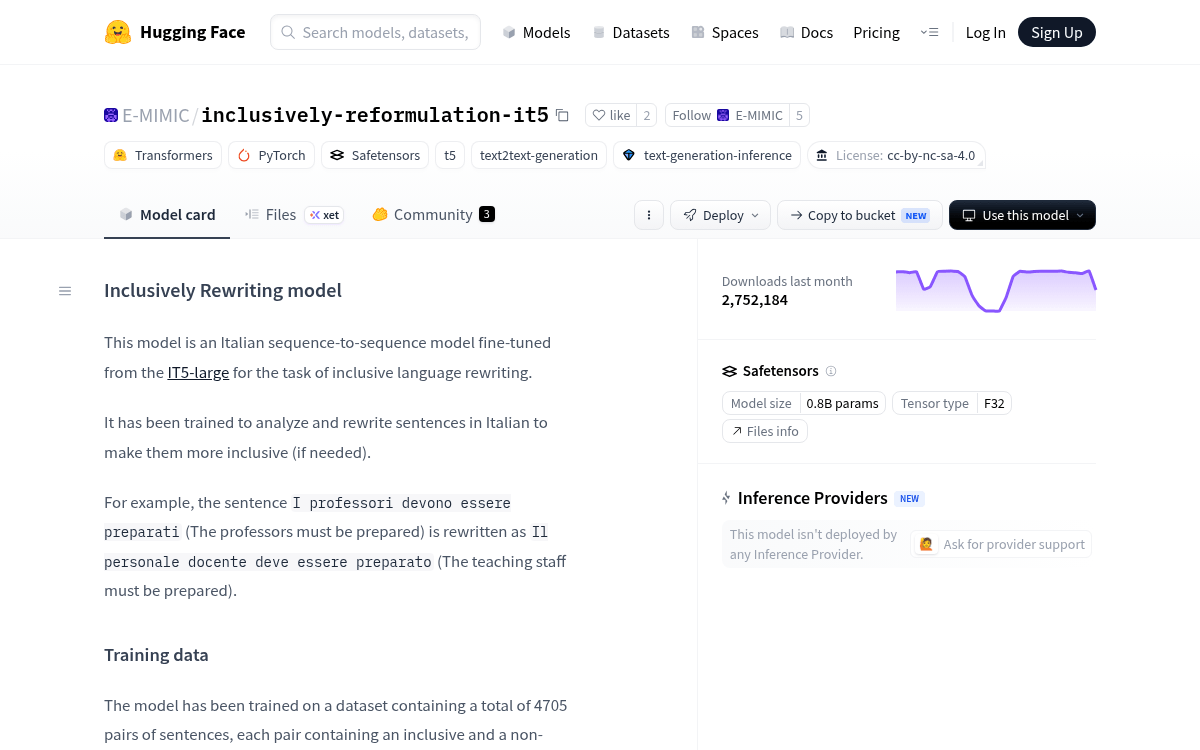
A niche Italian T5 fine-tune for rewriting gendered sentences into inclusive form has quietly racked up 2.7 million downloads on Hugging Face.
 Pro
Takeaways
- Italian T5 fine-tune for rewriting gendered sentences into inclusive form has crossed 2.75M downloads.
- Built on IT5-large (0.8B params), released under CC-BY-NC-SA 4.0, non-commercial only.
- Trained on 3,839 expert-annotated sentence pairs from Italian administrative documents.
- Scores 80.79 BLEU, 87.47 ROUGE-2, with 69.5% of rewrites judged fully correct by humans.
- Pure seq2seq design means no few-shot prompting; used as the standard baseline in Italian GNR benchmarks.
- Backed by an ACM TIST paper and a PKDD 2023 demo track publication.
A small Italian sequence-to-sequence model has quietly become one of the most-downloaded specialized text rewriters on Hugging Face. E-MIMIC/inclusively-reformulation-it5 is a fine-tune of IT5-large built to detect gendered or non-inclusive Italian sentences and rewrite them into neutral equivalents. It has now crossed 2.75 million downloads despite being a research artifact with just two likes on the hub.
The model tackles a problem that most English-first LLMs sidestep. Italian is a grammatical-gender language, where nouns, articles, and adjectives all carry masculine or feminine marking. Gender-neutral rewriting reformulates text to eliminate unnecessary gender specifications while preserving meaning, a particularly tricky task when grammar itself forces a choice. The usual shortcut, defaulting to the masculine plural, is exactly the pattern researchers want to move away from in formal writing.
What the model actually does
Given a gendered Italian sentence, the model outputs a rewritten version that avoids masculine or feminine forms for human referents. The canonical example from the model card: I professori devono essere preparati ("The professors must be prepared") becomes Il personale docente deve essere preparato ("The teaching staff must be prepared"). Rather than swapping suffixes, it reaches for a collective noun that sidesteps gender entirely.
Usage is standard transformers seq2seq, with no special tokenizer tricks required:
from transformers import AutoTokenizer, AutoModelForSeq2SeqLM
tok = AutoTokenizer.from_pretrained("E-MIMIC/inclusively-reformulation-it5")
model = AutoModelForSeq2SeqLM.from_pretrained(
    "E-MIMIC/inclusively-reformulation-it5", device_map="auto"
)
src = "I professori devono essere preparati"
ids = tok(src, return_tensors="pt").input_ids.to(model.device)
print(tok.decode(model.generate(ids)[0], skip_special_tokens=True))
The checkpoint weighs in at 0.8B parameters, ships in PyTorch and safetensors, and is released under cc-by-nc-sa-4.0, so commercial use is off the table without permission from the authors.
How it was built
The base is IT5-large, part of a family of encoder-decoder transformers introduced to fill a real gap for monolingual Italian tasks such as summarization, question answering, and reformulation. On top of that base, the E-MIMIC team fine-tuned on a hand-annotated corpus of Italian administrative documents.
The training recipe is straightforward supervised fine-tuning on paired sentences:
- Data: 4,705 inclusive/non-inclusive sentence pairs, split 3,764 / 470 / 471 for train / val / test, plus 75 rule-generated synthetic pairs added to training.
- Hyperparameters:
max_length=128, batch size 8, learning rate 5e-5, 500 warmup steps, 25 epochs with AdamW. - Selection: best checkpoint chosen by validation BLEU.
- Annotation: pairs were labeled by linguistic experts, and the dataset itself is not publicly released.
The broader project pairs this rewriter with a separate detection classifier. In the authors' evaluation, the best detection model correctly classifies 89% of sentences, while the best reformulation model produces 73% fully correct rewrites. On the held-out test set, the released checkpoint scores 80.79 BLEU and 87.47 ROUGE-2 F1, with 69.5% of human-judged rewrites marked fully correct and 13.2% incorrect. Adding the 75 synthetic examples measurably reduced the error rate versus training without them.
Where it wins, where it struggles
The model is good at the exact task it was trained on: short, formal Italian sentences from administrative contexts, where the reformulation strategy tends to involve collective nouns (personale docente, il corpo studentesco) or passive and impersonal constructions. It makes a clean baseline because it does one thing and needs no prompt engineering.
The limits are equally clear. It is a pure seq2seq system, not instruction-tuned, so it was never compatible with few-shot prompting. Evaluation involves feeding gendered sentences directly and comparing outputs, with the checkpoint serving as a baseline in generation experiments. That leaves no style control, no negative constraints, and no in-context examples. Recent work benchmarking modern LLMs against it treats the checkpoint as the incumbent to beat rather than the ceiling.
Why the download count is interesting
2.75 million downloads against two likes suggests the model is being pulled into pipelines rather than starred by humans. That fits the profile of a task-specific tool wired into writing assistants, moderation systems, or evaluation harnesses for Italian NLP, likely re-downloaded on every CI run or container rebuild.
The number also reflects how thin the shelf still is for Italian-specific generation. There is essentially one dedicated model for Italian gender-neutral rewriting, and this is it. Recent research describes Inclusively as a fine-tuning of it5-large and the only dedicated model for Italian GNR, treating it as the baseline for their experiments. If you are building anything that touches formal Italian text, whether a proofreader for public-sector documents, a data-cleaning step for a downstream classifier, or a comparison point for your own fine-tune, this is the checkpoint to reach for first. For a full description of the methodology and evaluation, the authors published the underlying research in ACM Transactions on Intelligent Systems and Technology.