
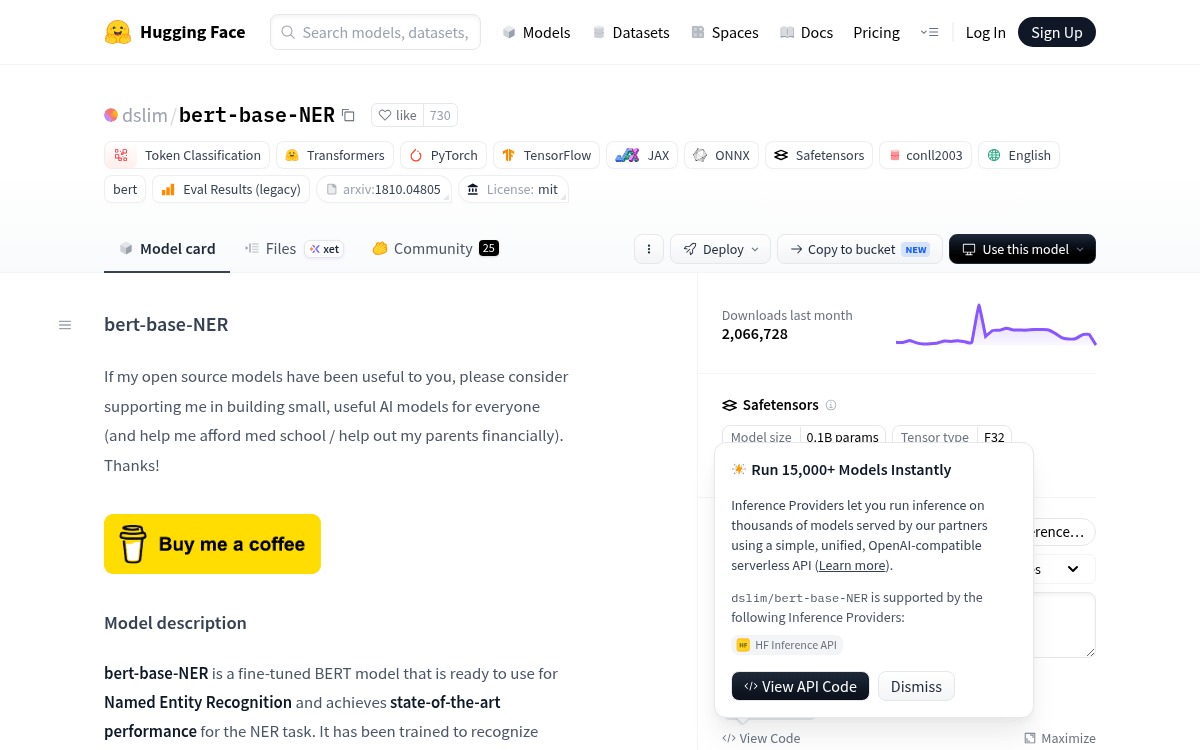
dslim's Tiny 110M bert-base-NER Quietly Hits 2M Monthly Downloads
A compact 110M parameter BERT fine-tuned on CoNLL-2003 keeps racking up millions of downloads by solving one narrow task extremely well.
 Pro
Takeaways
- bert-base-NER is a 110M parameter BERT fine tuned for four entity NER
- Trained on CoNLL-2003 Reuters news data with person, org, location, misc labels
- Reports 91.3 F1 on the CoNLL-2003 test set, 95.1 on dev
- Runs via the Transformers
pipelineAPI in three lines of Python - Ships in PyTorch, TensorFlow, JAX, ONNX, Safetensors under an MIT license
- Siblings include distilbert-NER at 66M and bert-large-NER at 340M
While the industry chases trillion parameter frontier models, a fine tuned bert-base-NER checkpoint from developer dslim keeps quietly clocking over two million monthly downloads on Hugging Face. For a lot of production pipelines, a 110M parameter encoder trained on a two decade old news dataset is still the right tool for the job.
The model is a bert-base-cased checkpoint fine tuned for token classification. It recognizes four entity types: location (LOC), organization (ORG), person (PER), and miscellaneous (MISC). It ships in PyTorch, TensorFlow, JAX, ONNX, and Safetensors formats, so it drops into almost any inference stack.
Why a small NER model still wins
Named entity recognition is the plumbing of a huge amount of NLP work: pulling structured signals like company names, people, and places out of raw text. You can absolutely ask GPT-4 or Claude to do it, but at scale you are paying for a lot of capability you do not need. A dedicated token classifier runs in milliseconds on a CPU, gives you deterministic span offsets, and never hallucinates a fictitious entity.
That is the niche this checkpoint owns. Given a sentence, it labels each token as person, org, location, misc, or nothing. The output is a list of spans with character offsets you can feed straight into a database, search index, or redaction pipeline.
The training recipe
Fine tuning was done on the English portion of CoNLL-2003, the canonical academic benchmark for this task. The annotation scheme distinguishes between the beginning and continuation of an entity, so back to back entities of the same type stay separated in the output. Training ran on a single NVIDIA V100 with the hyperparameters recommended in the original BERT paper.
CoNLL-2003 is built from Reuters newswire articles annotated with the four entity types above. That origin shapes what the model is good and bad at, which is worth keeping in mind before you point it at your own text.
What the numbers look like
On the CoNLL-2003 test set, the reported metrics are:
- F1: 91.3
- Precision: 90.7
- Recall: 91.9
Dev set F1 climbs to 95.1. The maintainer notes that these test scores trail the official Google BERT results, which used document level context and experimented with a CRF head. If you need every last point of accuracy, the larger bert-large-NER variant or a CRF layer on top will squeeze more out.
Three lines to production
The checkpoint works with the standard Transformers pipeline abstraction with essentially no setup:
from transformers import pipeline
nlp = pipeline("token-classification", model="dslim/bert-base-NER")
print(nlp("My name is Wolfgang and I live in Berlin"))
You get back a list of dicts with the entity label, confidence score, and character span. For cleaner output, pass aggregation_strategy="simple" to merge subword tokens into whole entity strings. Simple groups consecutive tokens sharing a label into one entity. First does the same, but preserves word integrity by using the label predicted for the first token in a word.
Where it falls over
The training data is the constraint you have to design around. The dataset covers entity annotated news articles from a specific span of time, so it does not generalize evenly across domains. The model also occasionally tags subword tokens as entities, and post processing may be needed to clean those up.
Practically, that means:
- It shines on formal English text like news, reports, and long form articles.
- It struggles with tweets, chat logs, code, and other domains it never saw during training.
- Only four coarse entity types, so no dates, money, products, or diseases out of the box.
- Subword artifacts require an aggregation strategy or a post processing pass.
- English only, though dslim ships uncased, DistilBERT, and BERT large siblings for different tradeoffs.
Picking the right variant
The dslim family covers the usual size versus speed tradeoff:
| Model | Parameters | Best for |
|---|---|---|
| distilbert-NER | 66M | Latency sensitive CPU inference |
| bert-base-NER | 110M | Balanced default |
| bert-large-NER | 340M | Higher accuracy on GPU |
If you are building a document ingestion pipeline, a redaction service for PII, a search index that needs entity facets, or a knowledge graph populator, this checkpoint is worth trying before you reach for an LLM. It is MIT licensed, endpoint compatible, and deployable on Azure, AWS, or your own hardware. The download counter suggests a lot of teams have already made that call.