
Dropbox's Whisper Large v3 Turbo Hits 1.4M Downloads With 6x Speed Boost
Dropbox's CTranslate2 port of OpenAI's Whisper Large v3 Turbo hits 1.4M downloads, delivering 4x faster inference with roughly 1.5GB VRAM.
 Pro
Takeaways
- Dropbox published a CTranslate2 conversion of Whisper Large v3 Turbo, now past 1.4M downloads.
- Turbo prunes the decoder from 32 to 4 layers, cutting parameters from 1.55B to 809M.
- Faster-Whisper backend delivers roughly 5-6x speedup and about 1.5GB VRAM at INT8.
- Scores 13.40% WER on YouTube-commons vs 13.20% for full V3, at 129.5x real-time.
- Weaknesses: no translation task, degraded Thai and Cantonese, hallucinations during silence.
- MIT licensed, drop-in via SYSTRAN/faster-whisper, ideal for self-hosted ASR and voice agents.
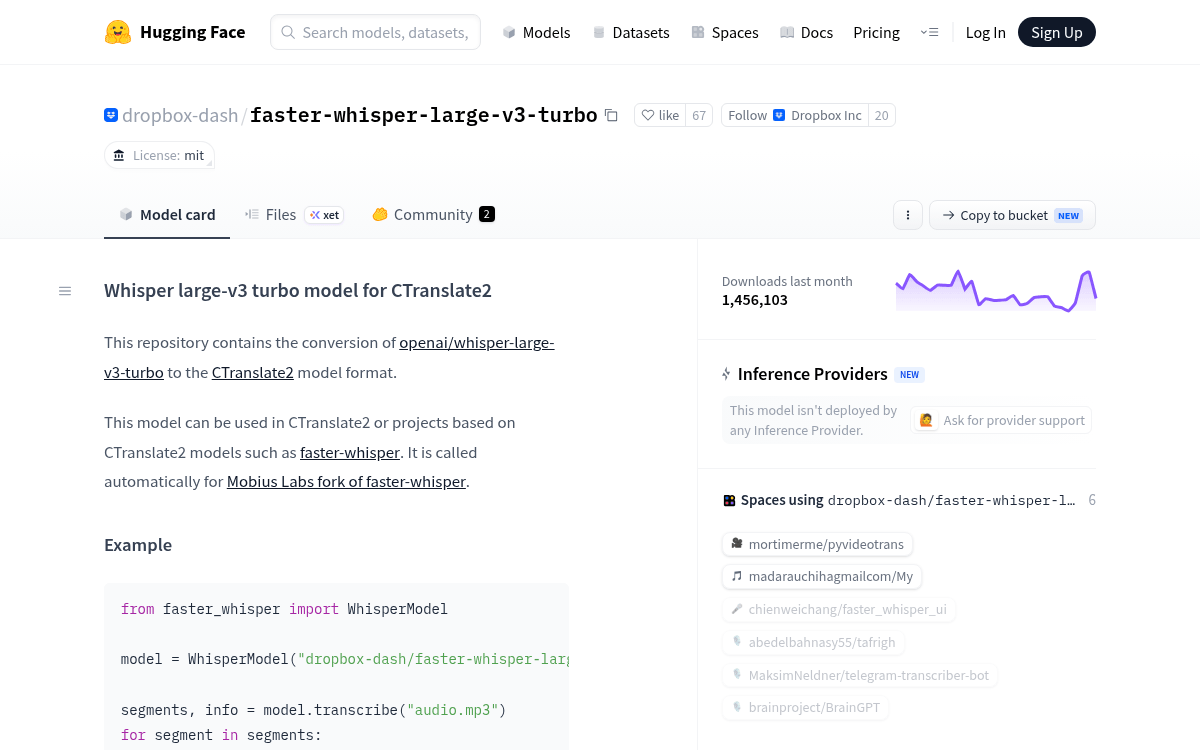
A quiet Hugging Face repository from Dropbox has become one of the most downloaded speech recognition assets on the platform. The Dropbox conversion of OpenAI's Whisper Large v3 Turbo into the CTranslate2 format used by the popular faster-whisper library has racked up more than 1.4 million downloads as teams look for a drop-in way to squeeze more throughput out of the same weights.
The upstream model is already a heavy optimization. Whisper large-v3-turbo trims the decoder to 4 layers, matching the tiny model and down from 32 in the large series. That pruning cuts the parameter count from 1,550M to 809M, while the encoder, which does the heavy lifting, remains identical to large-v3. The Dropbox repo wraps those pruned weights in a runtime built for fast transformer inference.
Why the CTranslate2 wrapper matters
CTranslate2 is what turns a plain PyTorch checkpoint into something that runs closer to the metal. Faster-Whisper is a Python wrapper around CTranslate2-converted Whisper models, and CTranslate2 itself is OpenNMT's high-performance inference engine for transformers, providing custom CUDA kernels, INT8/FP16 quantization, fused operations, and SIMD-optimized CPU code. You get the same Whisper accuracy with significantly better throughput and lower memory.
Stacked on top of the decoder-pruned Turbo weights, the effect compounds. Faster-Whisper delivers consistent 5-6x speedups across tested GPUs, and an RTX 3090 processes a full hour of audio in under a minute with the large-v3 model, fast enough for real-time transcription of multiple concurrent streams. Memory is the other headline: community benchmarks show Turbo using about 1.5 GB VRAM at int8, which leaves plenty of room to co-locate an LLM on the same card.
Three lines to transcribe
The repo is designed to be called by the SYSTRAN faster-whisper library or the Mobius Labs fork. Once you install faster-whisper, pointing it at the Dropbox repo id is enough to pull the weights and start transcribing:
from faster_whisper import WhisperModel
model = WhisperModel("dropbox-dash/faster-whisper-large-v3-turbo")
segments, info = model.transcribe("audio.mp3")
for segment in segments:
    print("[%.2fs -> %.2fs] %s" % (segment.start, segment.end, segment.text))
Weights ship in FP16, and you can flip to INT8 at load time through CTranslate2's compute_type flag if you want to trade a sliver of accuracy for less VRAM. The repo is MIT licensed, so commercial use is fair game.
Where Turbo shines and where it stumbles
On accuracy, Turbo lands remarkably close to its parent. On the YouTube-commons long-form evaluation, Turbo scores 13.40% WER against V3's 13.20%, while running at a 129.5x real-time factor versus 55.3x. The soft spots are worth knowing before you deploy:
- Turbo was fine-tuned only on multilingual transcription data, excluding translation data, and is not expected to perform well on that task. For speech-to-English translation, stay on large-v3.
- Across languages Turbo performs similarly to large-v2, with larger degradation on some languages such as Thai and Cantonese.
- Hallucination during silence is a known failure mode: Whisper's decoder keeps generating tokens even when no speech is present, particularly at temperature 0. A VAD filter in front of the pipeline is the standard mitigation.
Where it fits in a stack
The practical use cases line up with the speed and memory profile:
- Batch transcription of podcasts, meetings, and video archives, where a single consumer GPU can chew through hours of audio in minutes.
- Near real-time captioning and voice input, especially with VAD filtering to skip silent sections for lower latency.
- Multi-model serving, where the small VRAM footprint lets you run ASR alongside an LLM for voice agents or meeting summarizers.
- Edge and self-hosted deployments that need OpenAI-quality transcription without paying per minute.
The broader signal is that the community has largely settled on a two-part recipe for production Whisper: OpenAI's decoder-pruned Turbo weights plus a CTranslate2 backend. For most batch transcription workloads, Turbo is now the default choice when you control the infrastructure. The Dropbox conversion is not novel research, but it is a well-maintained, MIT-licensed entry point to that recipe, and the download counter suggests a lot of transcription pipelines are quietly pointing at it.