
dreamlike.art's Dreamlike Photoreal 2.0 Delivers Studio Photos Without API Bills
A Stable Diffusion 1.5 fine-tune that pushes photorealism hard, with a modified license that restricts hosting but permits small-team commercial use.
 Pro
Takeaways
- Dreamlike Photoreal 2.0 is a 0.9B parameter Stable Diffusion 1.5 fine-tune focused on photorealistic output.
- Ships as 2.13GB
.ckptand.safetensors, runs on a single consumer GPU in fp16. - Trained at 768x768, works best with non-square aspect ratios and the keyword "photo" in the prompt.
- Modified OpenRAIL-M license bans hosted inference and finetuning without explicit permission.
- Commercial use of outputs allowed only for teams of 10 or fewer members.
- Rated 5 stars by over 3400 users on Civitai, with strong community adoption.
A photorealistic Stable Diffusion fine-tune is climbing the Hugging Face trending charts again, and it is worth a look if you are building anything that needs believable photo output without paying an API bill. Dreamlike Photoreal 2.0 is a compact 0.9B parameter checkpoint from dreamlike.art that trades the generalism of base Stable Diffusion for a specific aesthetic: crisp, camera-like images that respond well to prompt keywords borrowed from photography.
A photo-tuned SD 1.5 in a 2.13GB file
Under the hood Dreamlike Photoreal 2.0 is a straightforward fine-tune of Stable Diffusion 1.5, keeping the same CLIP text encoder and UNet plumbing, with weights nudged toward high quality photographs. Prompts that already work in the SD 1.5 ecosystem transfer cleanly.
The checkpoint ships in both the legacy .ckpt format and .safetensors, each around 2.13GB, so it fits comfortably on a single consumer GPU with torch.float16. You get a specialized model that runs on the same hardware you already use for SD 1.5, without touching SDXL-sized VRAM budgets.
Plugging it into diffusers
Usage is identical to any other Stable Diffusion pipeline. The official snippet from the model card:
from diffusers import StableDiffusionPipeline
import torch
model_id = "dreamlike-art/dreamlike-photoreal-2.0"
pipe = StableDiffusionPipeline.from_pretrained(model_id, torch_dtype=torch.float16)
pipe = pipe.to("cuda")
prompt = "photo, a church in the middle of a field of crops, bright cinematic lighting, gopro, fisheye lens"
image = pipe(prompt).images[0]
image.save("./result.jpg")
A few practical knobs matter more than usual with this checkpoint:
- Adding the word photo to your prompt pushes generations further toward photorealism.
- Training resolution was 768x768, so stick to 768x768, 640x896, 896x640, or similar. It also holds up at 768x1024 and 1024x768.
- Non-square aspect ratios help on some prompts. Vertical for portraits, horizontal for landscapes.
- The model has a strong NSFW bias. Add
nude, nakedto the negative prompt to avoid it.
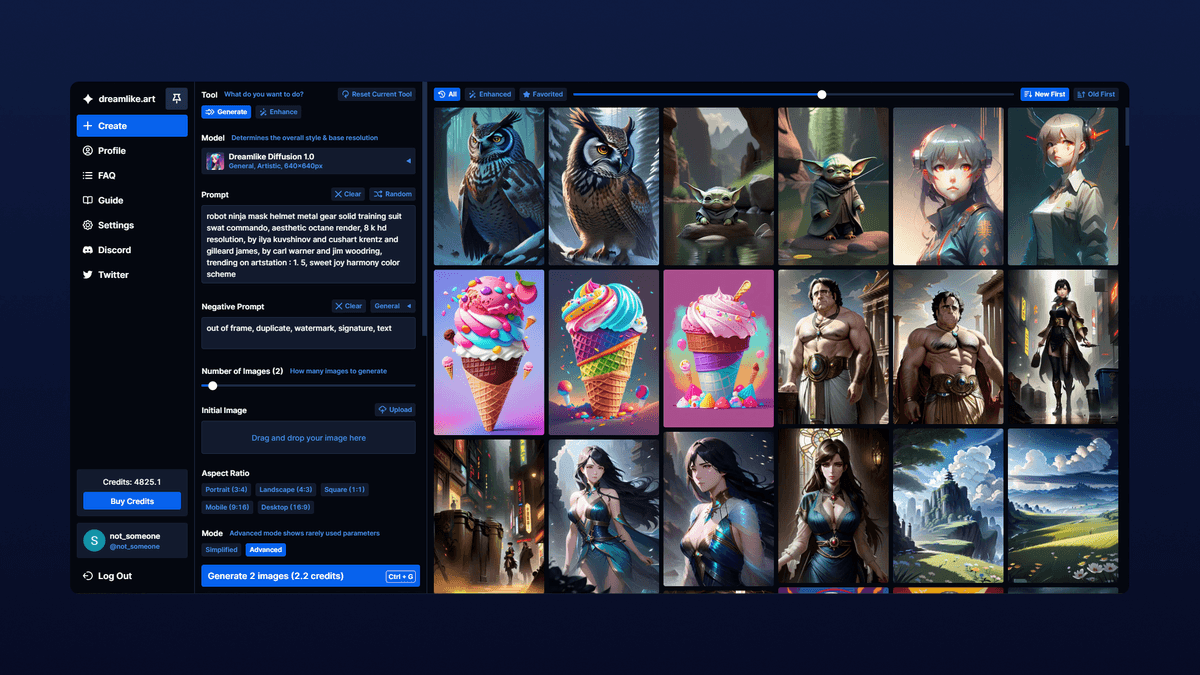
If you would rather not run it locally, dreamlike.art hosts it for free, and it is one click away in tools like Draw Things and DiffusionBee via the Hugging Face import links.
Where it shines, where it stumbles
The strong points match the name. It nails skin, lighting, and camera-style compositions, especially portraits and landscapes at the resolutions it was trained on. Detail holds up well at 768px, and shallow depth-of-field prompts render convincingly without extra LoRAs. On Civitai, it currently sits at a 5 star rating from over 3400 users, a reasonable proxy for how consistently it delivers on prompts in the wild.
The weaknesses are the usual SD 1.5 ones, plus a few of its own. The NSFW bias is real and needs negative prompting on anything involving people. There is no native ControlNet or SDXL-level compositional control, so complex multi-subject scenes and text-in-image tasks still fail. Because the fine-tune leans hard into photography, prompts asking for stylized illustration or anime drift back toward realism unless you push with style tags.
The license is the catch
Slow down here before shipping anything. The model is licensed under a modified CreativeML OpenRAIL-M license. The important clauses, paraphrased from the model card:
- You are not allowed to host, finetune, or run inference with the model or its derivatives on websites or apps without emailing contact@dreamlike.art for permission.
- You can freely host the model card and files, as long as no inference or finetuning happens on your service.
- Output images can be used commercially only in teams of 10 or fewer.
- Redistributed weights must carry the same modified license.
Translation: a solo developer or small studio generating assets is fine. Wrapping it in a SaaS or baking it into a product with a hosted inference endpoint requires explicit permission from dreamlike.art first. This is stricter than the standard OpenRAIL-M license attached to base Stable Diffusion, and it is the reason a lot of downstream deployments prefer more permissive checkpoints.
Why it still matters
Photorealistic SD 1.5 fine-tunes remain a workhorse for image generation pipelines even as SDXL and newer diffusion transformers dominate headlines. They are cheap to run, easy to LoRA on top of, and their behavior is well understood. Dreamlike Photoreal 2.0 is one of the reference points in that category, and the Civitai listing shows a steady community around it with adapters and finetunes built on top. If your workload is batch image generation for mockups, stock-style photos, or synthetic training data, benchmark it against your current SD 1.5 setup before assuming you need a bigger model.