
dreamlike.art's Dreamlike Diffusion Turns Stable Diffusion Into a Surreal Art Machine
A Stable Diffusion 1.5 fine-tune from dreamlike.art trades photorealism for a painterly, surreal aesthetic and ships under a modified OpenRAIL license.
 Pro
Takeaways
- Dreamlike Diffusion 1.0 is a Stable Diffusion 1.5 fine-tune from dreamlike.art focused on painterly, surreal art.
- Use the trigger word
dreamlikeartin prompts to strengthen the style effect. - Weights ship as a 2.13GB checkpoint on Hugging Face, loadable via diffusers.
- Recommended resolutions are 640x640, 512x768, or 768x512, with non-square aspect ratios preferred.
- Modified OpenRAIL license blocks monetized hosting but allows commercial output use for teams of 10 or fewer.
- Sibling model Dreamlike Photoreal 2.0 covers the photorealism use case.
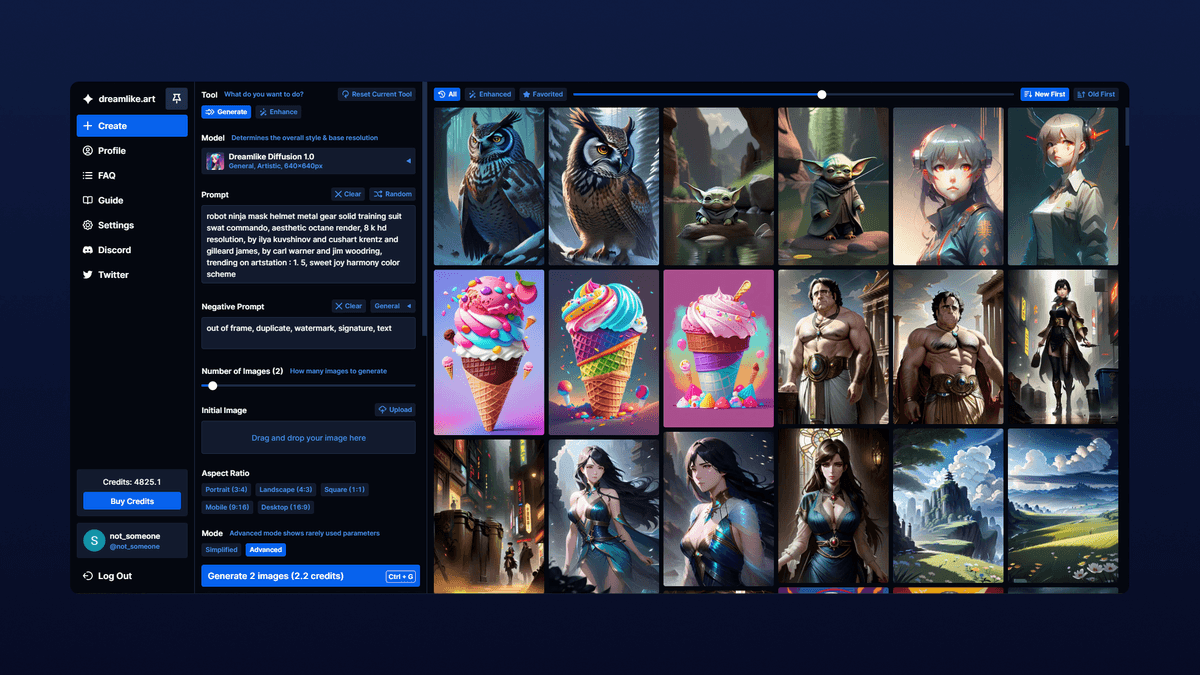
A new open-weights checkpoint called Dreamlike Diffusion 1.0 is climbing Hugging Face's trending charts, pulling in over a thousand likes and thousands of downloads. The architecture is nothing new: it is Stable Diffusion 1.5, fine-tuned by dreamlike.art on curated artwork to push generations toward a painterly, surreal look rather than the flatter default aesthetic that ships with base SD 1.5.
What actually shipped
The release is a single 2.13GB .ckpt file (with a safetensors variant) that drops into any Stable Diffusion pipeline. Because the checkpoint inherits the SD 1.5 architecture, prompts carry over directly, with the token dreamlikeart available when the style needs to come through more strongly. That trigger word is the main knob for dialing the fine-tune's influence up or down.
Loading it looks like any other diffusers workflow:
from diffusers import StableDiffusionPipeline
import torch
model_id = "dreamlike-art/dreamlike-diffusion-1.0"
pipe = StableDiffusionPipeline.from_pretrained(model_id, torch_dtype=torch.float16)
pipe = pipe.to("cuda")
prompt = "dreamlikeart, a grungy woman with rainbow hair, concept art, sharp focus, vivid colors"
image = pipe(prompt).images[0]
image.save("./result.jpg")
Prompting quirks worth knowing
The model card is unusually specific about resolution and aspect ratio, which matters more here than with most SD checkpoints:
- Non-square aspect ratios work better for some prompts.
- For a portrait photo, try a 2:3 or 9:16 aspect ratio.
- For a landscape photo, try a 3:2 or 16:9 aspect ratio.
- Use slightly higher resolution for better results: 640x640px, 512x768px, 768x512px, etc.
Pushing above the SD 1.5 native 512x512 gives noticeably crisper detail without the duplicated-heads failure mode that plagues base SD 1.5 at higher resolutions, since the fine-tune shifts the distribution toward more coherent large-canvas compositions.
Strengths and blind spots
Training on curated art rather than photography gives the checkpoint a distinctive surreal style, and it handles prompts calling for fantastical, imaginative scenes well, along with those blending realism and stylized elements. Practically, that makes it a strong pick for:
- Concept art and mood boards for games or film
- Book covers, album art, and editorial illustration
- Fantasy characters, environments, and creature design
- Stylized portraits with painterly lighting
Where it falls down is anything that needs photorealism, product-accurate rendering, or clean typography. For those cases, dreamlike.art points users to a sibling checkpoint, Dreamlike Photoreal 2.0, tuned in the opposite direction.
The license is the catch
Developers should slow down here. The weights ship under a modified CreativeML OpenRAIL-M license with real commercial restrictions. Specifically, you can't host or use the model or its derivatives on websites, apps, and similar surfaces from which you earn, will earn, or plan to earn revenue or donations without contacting the authors first.
The output side is more permissive: you are free to use outputs from the model or its derivatives for commercial purposes in teams of 10 or fewer. A solo illustrator or a small studio can sell art made with the checkpoint, but a SaaS company cannot spin it up as a generation endpoint without permission. Any redistribution of weights has to carry the same restrictions forward.
How to try it without a GPU
If running the pipeline locally is not an option, the model card links straight to Google Colab and Kaggle notebooks, plus a hosted Gradio Space. It also imports into Mac-friendly local apps like Draw Things and DiffusionBee with one click, and dreamlike.art itself offers free web-based generation using the same weights.
Why this release matters
Dreamlike Diffusion sits in the same lineage as models like Openjourney and Anything V3, where the real leverage comes from curated fine-tuning data rather than new architecture. Base SD 1.5 is a generalist that mostly produces the average of its training set. A focused fine-tune on a smaller, higher-quality art corpus reshapes that average toward something visually distinctive, and the weights are small enough to run on a single consumer GPU. For anyone building creative tooling on top of open diffusion models, checkpoints like this remain a cheap, hackable alternative to a closed API, provided the license fits the use case.