
DistilRoBERTa Cuts RoBERTa's Size by 35% While Keeping 95% of Its Power
A compact RoBERTa distillation with 82M parameters runs twice as fast as its teacher while keeping roughly 95% of GLUE performance.
 Pro
Takeaways
- DistilRoBERTa base is a 6-layer, 82M-parameter distillation of RoBERTa base.
- Runs roughly 2x faster than the teacher while keeping about 95% of GLUE performance.
- Pretrained on OpenWebTextCorpus with roughly 4x less data than RoBERTa.
- Trained with a combined loss: KL distillation, masked language modeling, and hidden-state alignment.
- Best for classification, NER, QA, and embedding backbones where latency and cost matter.
- Apache-2.0 licensed, case-sensitive, and inherits pretraining biases documented in the model card.
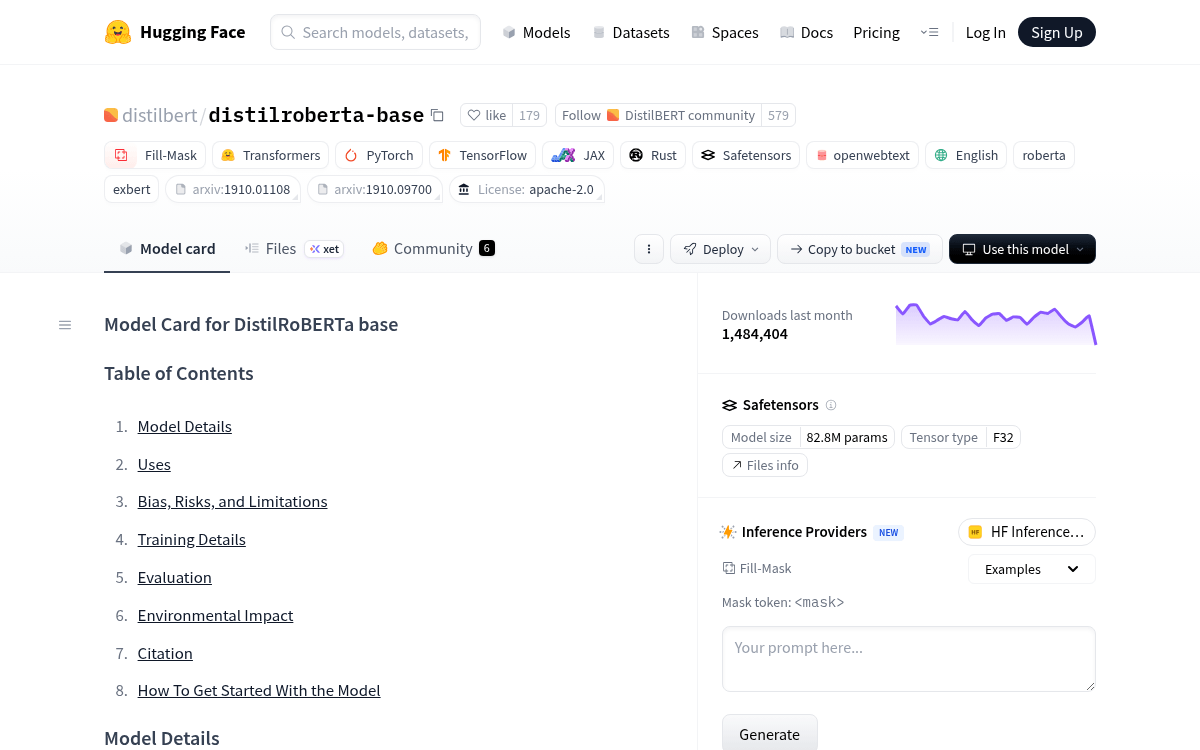
Encoder models quietly power a huge chunk of production NLP, and DistilRoBERTa base remains one of the most downloaded small transformers on the Hub, with well over a million monthly pulls. It is a distilled version of RoBERTa base that trims the parameter count while holding onto most of the quality, which is the tradeoff a lot of classification, tagging, and embedding workloads actually want.
Half the layers, most of the accuracy
DistilRoBERTa uses knowledge distillation from a 12-layer RoBERTa teacher to a 6-layer student, cutting parameters by roughly 35% with minimal quality loss. The student has 6 layers, 768 hidden dimensions, and 12 attention heads, totaling 82M parameters versus 125M for RoBERTa base. On average it runs about twice as fast as the teacher.
Quality retention is the real headline. DistilRoBERTa reaches 95% of RoBERTa base's performance on GLUE at 65% of the size. Published GLUE test scores from the model card:
- MNLI: 84.0
- QQP: 89.4
- QNLI: 90.8
- SST-2: 92.5
- CoLA: 59.3
- STS-B: 88.3
- MRPC: 86.6
- RTE: 67.9
How the distillation was done
Pretraining used OpenWebTextCorpus, a reproduction of OpenAI's WebText dataset and roughly four times less data than the teacher saw. Distillation itself combines three training signals rather than a single cross-entropy loss:
- Knowledge-distillation loss: KL divergence between the teacher's and student's output probability distributions at a set temperature.
- Masked language modeling: standard BERT/RoBERTa-style masked token prediction, using cross-entropy between predicted and true tokens at masked positions.
- Hidden-state alignment: either mean squared error or cosine similarity between layerwise outputs of teacher and student per batch.
The student ends up mimicking the teacher's soft output distribution and its internal representations, not just the ground-truth labels. That is why you can chop half the depth and still land within a few points on most benchmarks.
What it is actually good at
The published checkpoint is a fill-mask model that you almost never use raw. The card explicitly warns against using it to generate factual claims about real people or events, since it was not trained for that. The practical path is fine-tuning it as an encoder for downstream tasks.
Empirically, the model delivers strong downstream results on sentiment analysis, cybersecurity text, and low-resource language tasks while roughly halving inference latency. A task-specific distillation on SST-2 reached 92% accuracy, against 94.8% for RoBERTa base at 125M parameters, which is a solid trade at nearly twice the throughput.
Common production sweet spots:
- Sequence classification (sentiment, intent, moderation, spam)
- Token classification (NER, span tagging)
- Extractive question answering over short contexts
- Backbone for sentence embedding models where latency matters
Where it falls short
Distillation costs some representational depth, and it shows up on nuanced tasks. In emotion analysis, the student retains general-purpose language understanding but is less sensitive to subtle affective cues, so it handles high-frequency emotions like joy, sadness, and anger well while stumbling on ambiguous ones like anticipation or confusion.
The model also inherits the biases of its pretraining corpus. The card itself shows that filling The man worked as a <mask> and The woman worked as a <mask> produces starkly gendered occupation distributions, so any classifier built on top needs bias evaluation before it goes near users.
Dropping it into code
The checkpoint is Apache-2.0 licensed and runs anywhere the transformers library works, including CPU-only boxes. Minimal usage:
from transformers import AutoTokenizer, AutoModelForMaskedLM
tokenizer = AutoTokenizer.from_pretrained("distilbert/distilroberta-base")
model = AutoModelForMaskedLM.from_pretrained("distilbert/distilroberta-base", device_map="auto")
For a downstream classifier, swap in AutoModelForSequenceClassification and fine-tune on your labeled data. The original DistilBERT paper covers the distillation recipe in detail if you want to replicate it on a different teacher.
Why it still shows up in stacks
Large decoder-only LLMs get the attention, but plenty of real workloads are single-label classification over short text at high QPS, where an 82M encoder on CPU beats a 7B decoder on GPU on both cost and latency. DistilRoBERTa is the default reach for that shape of problem: small enough to serve cheaply, strong enough to fine-tune to task-specific parity with much larger models, and boring enough that it will keep running in your stack without surprises.