
DavidAU's Qwen3.6-27B Heretic Drops Refusals from 99 to 4
A community fine-tune strips refusals from Qwen3.6-27B, then republishes the model as calibrated GGUF quants that hold 94 percent of full-precision accuracy at Q4.
Takeaways
- DavidAU released a Heretic-abliterated, Unsloth-fine-tuned GGUF of Qwen3.6-27B under Apache 2.0.
- Refusals drop from 99/100 on the base model to 4/100, with KL divergence of 0.0469.
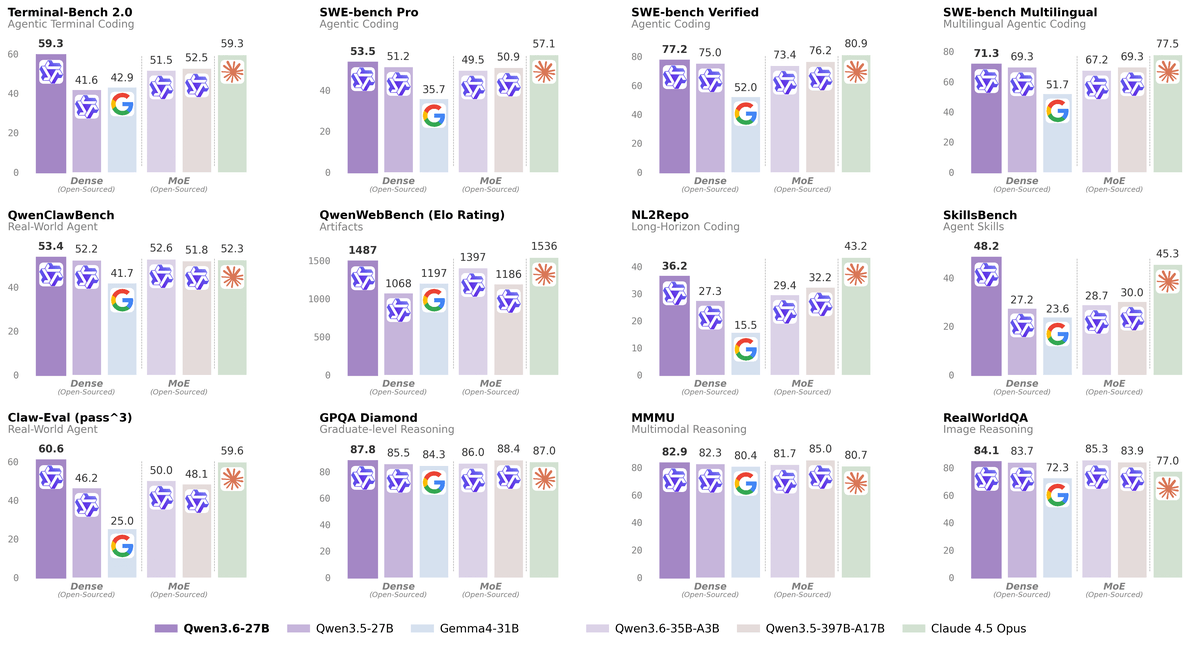
- Base Qwen3.6-27B matches Claude 4.5 Opus on Terminal-Bench 2.0 and beats the 397B Qwen3.5 MoE on coding.
- Dual-imatrix NEO/CODE calibration: Q4_K_S holds 94% top-token agreement with BF16, IQ2_M holds 83%.
- Runs on llama.cpp, Ollama, LM Studio, vLLM, and Unsloth; needs ~18 GB RAM at Q4.
- Native 262K context, extensible to 1M with YaRN, plus vision input via optional mmproj file.
A new community release takes Alibaba's Qwen3.6-27B, runs it through the Heretic abliteration process, adds a light fine-tune to claw back any lost quality, and ships the result as a stack of calibrated GGUF quantizations. The upload, Qwen3.6-27B-Heretic-Uncensored-FINETUNE-NEO-CODE-Di-IMatrix-MAX-GGUF by DavidAU, sits on top of one of the strongest open dense models available right now and turns it into something you can run locally with almost no refusal behavior.
The base model doing the heavy lifting
Qwen3.6-27B is the first dense open-weight model in the Qwen3.6 family, shipped under Apache 2.0 with weights that self-host on a single high-end GPU. On a series of agentic coding benchmarks, this 27-billion-parameter dense model edges past the much larger 397-billion-parameter Qwen3.5 mixture-of-experts model from earlier in the year and matches Claude 4.5 Opus on Terminal-Bench 2.0.
Its architecture is unusual for a model this size. Instead of stacking 64 identical self-attention blocks, Qwen3.6-27B uses a repeating pattern that mixes Gated DeltaNet linear attention with traditional Gated Attention, with three out of every four sublayers being linear-attention blocks that dramatically reduce KV-cache cost on long contexts. It ships a native 262,144-token context extensible to 1,010,000 tokens with YaRN scaling, which is what makes the model actually usable at long contexts on a workstation GPU.