
Coqui's XTTS-v2 Clones Any Voice in 17 Languages From 6 Seconds
Coqui's open-source voice cloning model reproduces any voice from a six-second clip across 17 languages, with streaming inference under 200ms.
 Pro
Takeaways
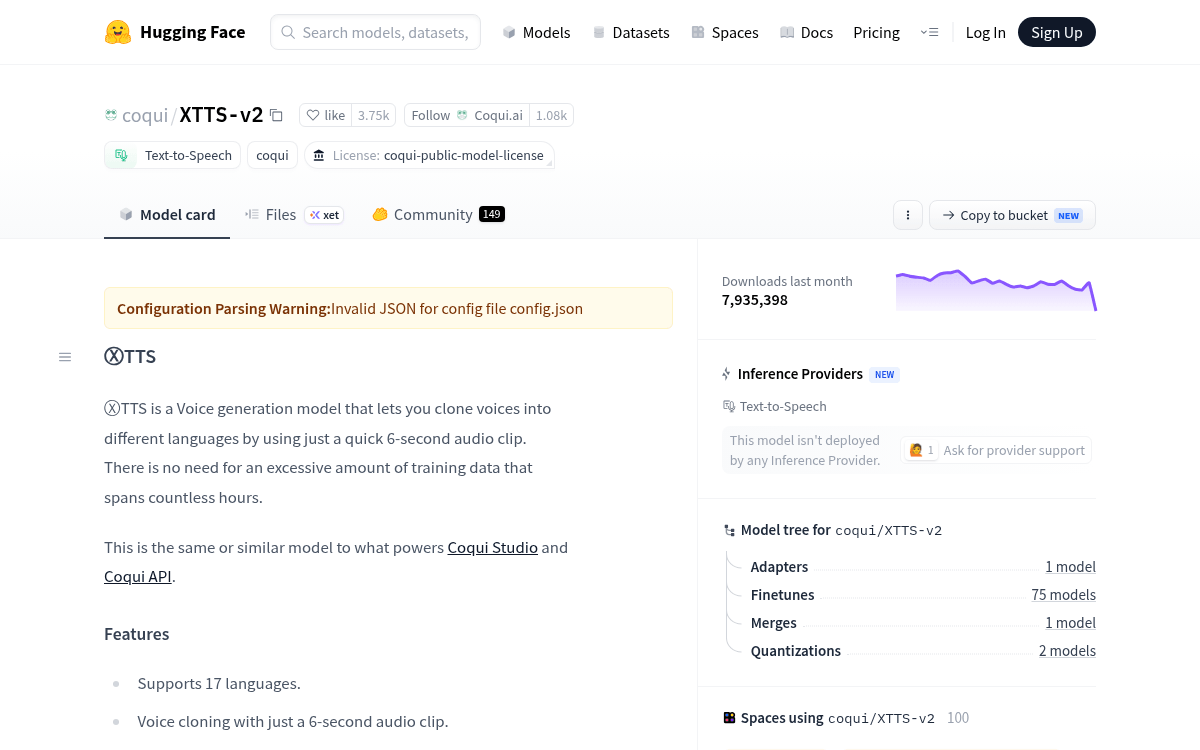
- XTTS-v2 clones any voice from a 6-second reference clip, zero-shot.
- Supports 17 languages including Hindi, Korean, Arabic, Chinese and Japanese.
- Cross-lingual cloning: English reference can generate Japanese output in the same voice.
- Streaming inference under 200ms latency for real-time voice agent use cases.
- Architecture: GPT-2 style autoregressive decoder plus Perceiver speaker encoder plus discrete VAE.
- Released under the restrictive Coqui Public Model License, maintained via community fork coqui-tts.
Voice cloning used to mean hours of recorded training data and a proprietary cloud API. XTTS-v2 from Coqui takes a different route: hand it roughly six seconds of reference audio and it will speak back in that voice, in any of 17 languages, running locally on your own GPU. The model has quietly become one of the most downloaded speech models on Hugging Face, with millions of pulls and a long tail of community fine-tunes built on top of it.
The six-second pitch
XTTS-v2 is a multilingual generative text-to-speech model designed for speech synthesis and zero-shot voice cloning, replicating a target speaker's voice from a reference clip as short as six seconds. Zero-shot is the interesting part here. There is no per-voice fine-tuning step, no dataset collection, no training loop. You point the model at a WAV file and it conditions generation on that speaker.
The headline capabilities:
- 17 languages, cloning from a 6-second clip, emotion and style transfer through the reference, cross-language cloning, and multilingual generation from a single voice.
- Streaming inference with under 200ms latency, which makes it viable for real-time voice chat and agent use cases.
- Cloning from either a single file or several files of the same speaker, with no runtime penalty for the multi-file case.
- 24kHz output and fine-tuning support through the Coqui TTS codebase.
What is actually inside
The architecture centers on an autoregressive GPT-2 style decoder that predicts discrete audio tokens. A Perceiver module extracts speaker characteristics from reference mel-spectrograms, and a discrete Variational Autoencoder handles audio representation. In plain terms: a small GPT predicts a sequence of audio tokens the way a language model predicts words, a VAE handles the compression between raw waveforms and those tokens, and a Perceiver squeezes the reference clip into a compact speaker embedding that steers the decoder.
Against v1, the newer release brings improvements in speaker conditioning and prosody, plus support for multiple speaker references and speaker interpolation. Multi-reference conditioning matters when a single clip is noisy or too short to capture pitch range. You can average several samples of the same speaker, or interpolate between two different speakers to invent a new voice.
Languages and coverage
The supported set covers English, Spanish, French, German, Italian, Portuguese, Polish, Turkish, Russian, Dutch, Czech, Arabic, Chinese, Japanese, Hungarian, Korean, and Hindi. Cross-lingual cloning is where this gets fun: feed the model an English reference and generate Japanese output that still sounds like the original speaker. The v2 release specifically added Hungarian and Korean over v1, along with stability and prosody improvements.
Wiring it up
The Python API is intentionally minimal. Install coqui-tts (the maintained fork on PyPI) and generate a cloned voice in a few lines:
from TTS.api import TTS
tts = TTS("tts_models/multilingual/multi-dataset/xtts_v2", gpu=True)
tts.tts_to_file(
    text="It took me quite a long time to develop a voice.",
    file_path="output.wav",
    speaker_wav="/path/to/reference.wav",
    language="en",
)
The model needs Python 3.10+ and 4GB RAM, with 8GB and an NVIDIA GPU recommended for real-time speed. A consumer GPU handles it comfortably. There is also a lower-level API exposing XttsConfig and model.synthesize() if you want to tune conditioning length or sampling parameters.
Where it fits, and where it does not
Realistic use cases are the ones where a hosted API is either too expensive or a non-starter for compliance reasons: audiobook and podcast production, dubbing pipelines that need speaker consistency across languages, in-game NPC dialogue, accessibility tooling, and streaming voice agents. The sub-200ms streaming latency is the key enabler for the last category, where the model is often paired with an LLM backend like Mistral or Zephyr in Coqui's demo space.
The catches are worth naming. XTTS-v2 ships under the Coqui Public Model License, which restricts commercial use and is not OSI-approved, so anything past personal projects requires reading the CPML terms carefully. Coqui as a company shut down operations, so the original repository is unmaintained; the community has largely moved to the fork published as coqui-tts on PyPI, with prebuilt wheels now available for macOS and Windows alongside Linux. As with every capable voice cloner, the ethical surface area around consent and deepfakes is real, which is part of why the license reads the way it does.
For teams building speech features that cannot send audio to a third-party API, XTTS-v2 remains the most capable freely downloadable option, and the 75+ community fine-tunes on Hugging Face suggest it will keep being the base others iterate on.