
Community Urdu Speech Model Hits 1.5M Downloads With 16-Point WER Boost
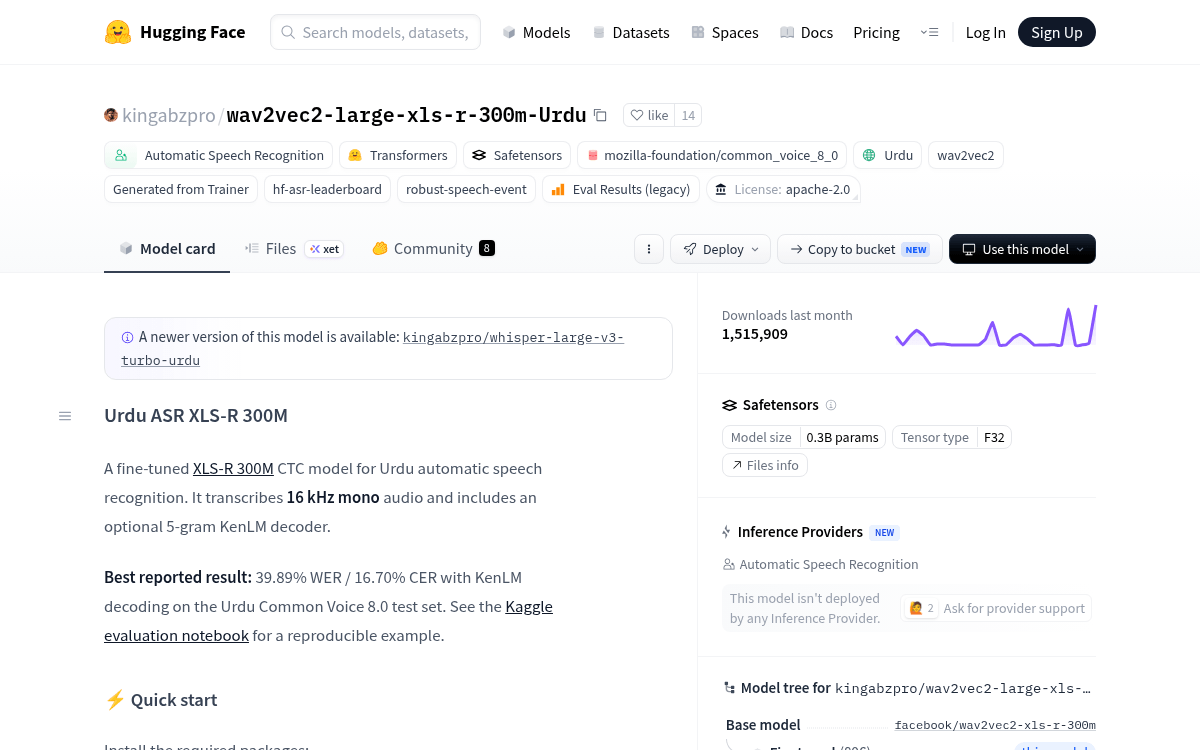
A community-maintained Urdu speech recognition checkpoint has crossed 1.5M downloads on Hugging Face and shipped a refreshed model card with reproducible KenLM decoding.
 Pro
Takeaways
- Community Urdu ASR checkpoint wav2vec2-large-xls-r-300m-Urdu passes 1.5M downloads with refreshed model card.
- Fine-tune of Facebook XLS-R 300M on Mozilla Common Voice 8.0 Urdu split.
- Reports 39.89% WER and 16.70% CER with bundled 5-gram KenLM decoder.
- Greedy CTC decoding without language model degrades to 56.07% WER on same test set.
- Trained 200 epochs, LR 1e-4, effective batch 64, Adam optimizer, 16 kHz mono audio.
- Apache 2.0 licensed; newer whisper-large-v3-turbo-urdu checkpoint available for higher accuracy.
An open-source Urdu speech recognition model that has quietly become one of the most-used low-resource ASR checkpoints on Hugging Face just got a refreshed model card. The Urdu XLS-R checkpoint, maintained by community contributor kingabzpro, has crossed 1.5 million cumulative downloads, with over a million pulls in the last month alone. The update ships a cleaner quick-start, a full 5-gram KenLM decoding pipeline, and a reproducible Kaggle evaluation notebook.
The weights themselves are not new. They come from a fine-tune of Facebook AI's XLS-R 300M, the multilingual speech backbone pretrained on 436k hours of unlabeled audio spanning VoxPopuli, MLS, CommonVoice, BABEL, and VoxLingua107. What changed is the tooling around it, which makes the checkpoint much easier to drop into a modern transformers stack.
What the numbers actually say
The model achieves a Word Error Rate of 39.89% with language model integration and a Character Error Rate of 16.7% on the Common Voice 8.0 test set. Without the language model, greedy CTC decoding yields 56.07% WER and 23.70% CER on the same split. That gap is the whole story of this release: bolt on the included 5-gram KenLM decoder and you claw back roughly 16 WER points at zero training cost.
For a 300M-parameter model targeting a low-resource language, those numbers are workable for prototyping but far from human-level. The card is refreshingly blunt about this and points users to a newer Whisper turbo Urdu checkpoint from the same author for higher accuracy.
Inside the training recipe
The recipe is a standard CTC fine-tune on the Urdu split of Mozilla Common Voice 8.0, but the hyperparameters are worth noting for anyone doing similar low-resource work:
- Base model:
facebook/wav2vec2-xls-r-300m - Learning rate: 1e-4 with linear schedule and 1,000 warmup steps
- Effective batch size: 64 (train batch 32, gradient accumulation 2)
- Optimizer: Adam with standard betas
- Training length: 200 epochs
- Audio input: 16 kHz mono
The training log shared in the card shows validation WER dropping from 1.0 at step 400 to around 0.56 by step 2,400, then plateauing. It is a useful reference point for anyone budgeting compute for a similar XLS-R fine-tune on 10 to 20 hours of transcribed audio.
Using it in practice
The refreshed card gives you a two-line pipeline call for basic transcription:
from transformers import pipeline
pipe = pipeline("automatic-speech-recognition",
                model="kingabzpro/wav2vec2-large-xls-r-300m-Urdu")
print(pipe("audio.wav"))
For the accuracy-critical path, the repo ships language_model/5gram.bin, unigrams.txt, and attrs.json, which plug into pyctcdecode's build_ctcdecoder to run beam search over the KenLM. The card walks through the token-filtering logic needed to align the tokenizer vocabulary with the decoder labels, a step that commonly trips up developers wiring n-gram decoding into a wav2vec2 checkpoint.
Why a download counter tells a story
Urdu sits in the awkward middle of the ASR world: hundreds of millions of speakers, yet very little clean transcribed audio compared to English or Mandarin. A 1.5M-download counter on a single community checkpoint is a decent proxy for how thin the alternatives are. The weights power several downstream Spaces on the Hub, including a real-time transcription demo and a virtual assistant, which suggests they are being picked up for actual product prototypes rather than leaderboard chasing.
The license is Apache 2.0, the weights are 1.26 GB, and there are no inference-provider fees since you self-host. For teams building Urdu voice interfaces, accessibility tools, or transcription pipelines on a budget, this is the path of least resistance, with Whisper-turbo-urdu waiting one line of code away when the WER budget gets tighter.