
Community Rescues Stable Diffusion v1-5 After RunwayML Pulled It Down
A community organization has published a full model card mirror of Stable Diffusion v1.5 on Hugging Face, preserving weights and integration paths.
 Pro
Takeaways
- Community mirror of Stable Diffusion v1.5 lives at stable-diffusion-v1-5/stable-diffusion-v1-5 on Hugging Face.
- Model card declares no affiliation with RunwayML and preserves the original training documentation verbatim.
- Ships hash-identical pruned and EMA-only safetensors, verifiable via the Comfy-Org archive.
- Works out of the box with Diffusers, ComfyUI, AUTOMATIC1111, SD.Next, and InvokeAI.
- Ecosystem already points 662 adapters, 396 fine-tunes, and 100+ Spaces at the new repo id.
- 0.9B parameter latent diffusion model, 512x512, trained on LAION-aesthetics v2 5+ for 595k steps.
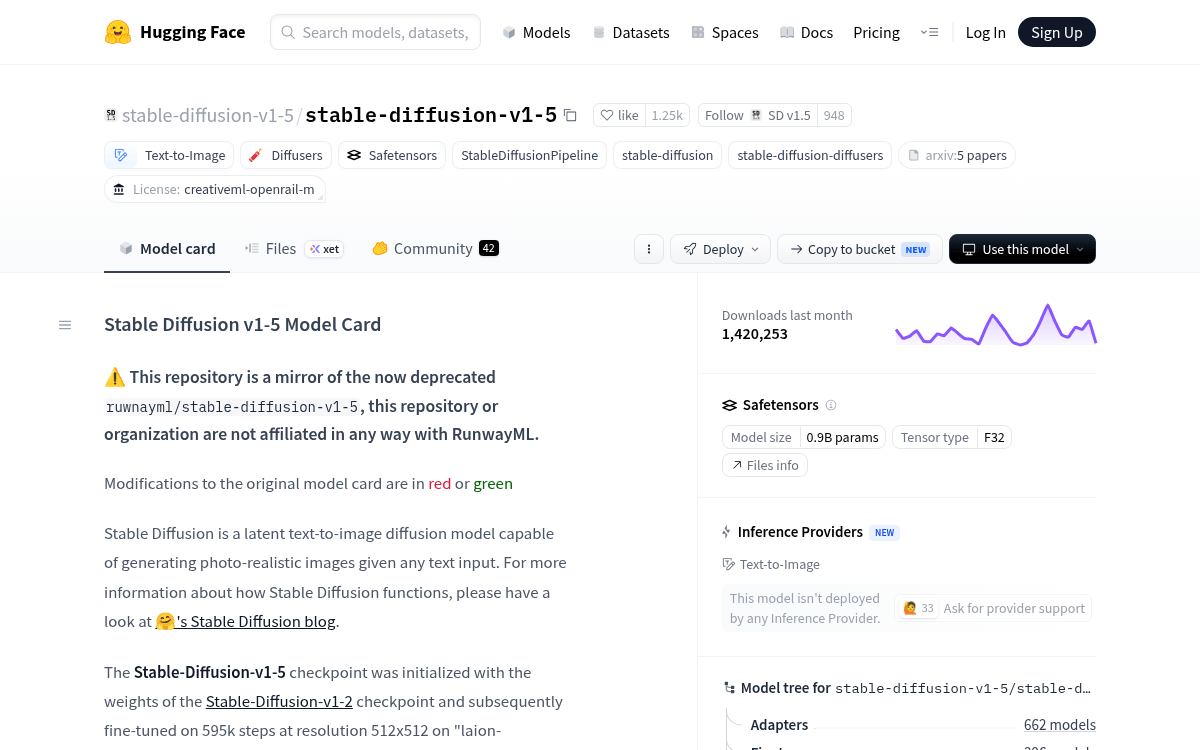
Stable Diffusion v1.5 now has an official-looking community home on Hugging Face. The stable-diffusion-v1-5 repository mirrors the model card and weights that used to live under the RunwayML namespace, and it is already sitting at over 1.4 million monthly downloads with more than 1,200 likes.
At the top of the page, the maintainers put up a warning that this is an archival re-upload of Stable Diffusion v1.5, originally hosted at huggingface.co/runwayml/stable-diffusion-v1-5 until RunwayML took down that page. A parallel Comfy-Org archive notes that the pruned emaonly file it hosts is hash-identical to the original weights uploaded by RunwayML, so downstream users can verify they are pulling the same bits they were before.
What the mirror actually ships
The repository preserves the two safetensors checkpoints developers have been building on for years: v1-5-pruned-emaonly.safetensors for lower-VRAM inference, and v1-5-pruned.safetensors, which keeps both EMA and non-EMA weights for fine-tuning. The model card also spells out the standard integration paths, listing Diffusers, ComfyUI, AUTOMATIC1111, SD.Next, and InvokeAI as supported runners. A one-liner in Python is enough to pull it:
from diffusers import StableDiffusionPipeline
import torch
pipe = StableDiffusionPipeline.from_pretrained(
    "stable-diffusion-v1-5/stable-diffusion-v1-5",
    torch_dtype=torch.float16,
).to("cuda")
image = pipe("a photo of an astronaut riding a horse on mars").images[0]
The training recipe, unchanged
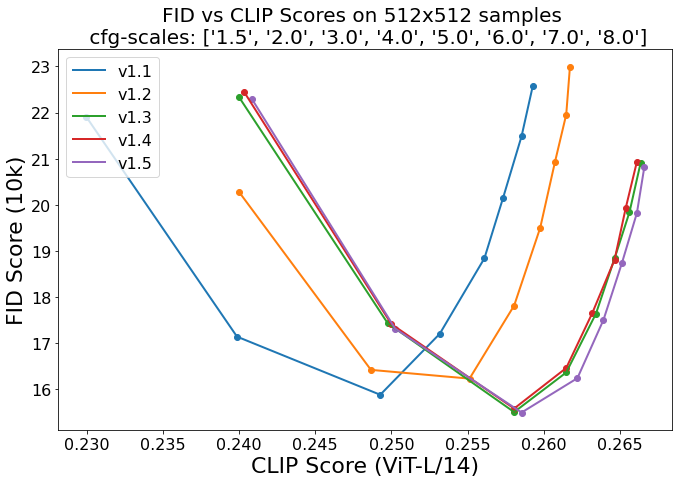
The card carries the original training notes from Robin Rombach and Patrick Esser. SD 1.5 is a latent diffusion model with roughly 0.9B parameters, built on the same recipe as its predecessors: a VAE that downsamples images by a factor of 8 into a 4-channel latent, a CLIP ViT-L/14 text encoder feeding a UNet through cross-attention, and a noise-prediction loss. The v1.5 checkpoint itself was initialized from Stable-Diffusion-v1-2 and fine-tuned for 595k steps at 512x512 on the laion-aesthetics v2 5+ subset, with 10% dropping of the text conditioning to improve classifier-free guidance sampling.
Training ran on 32 nodes of 8 A100s at batch size 2048, using AdamW and a constant 1e-4 learning rate after warmup. The card also carries an environmental disclosure of roughly 11,250 kg CO2 equivalent for the run, computed against 150,000 A100 hours on AWS US-East.
Known weaknesses, stated up front
The card is refreshingly candid about what SD 1.5 cannot do. The listed limitations include:
- No true photorealism, and legible text rendering is essentially impossible.
- Compositional prompts such as "a red cube on top of a blue sphere" tend to fall apart.
- Faces and hands are frequently mangled.
- English is a hard requirement. Because training used LAION-2B(en), white and western cultures are often set as the default, and non-English prompts perform significantly worse.
- The autoencoder is lossy, and some training images are memorized because the dataset was not deduplicated.
The card also stipulates that the intended deployment path pairs the weights with the Diffusers Safety Checker, which compares CLIP embeddings of generated images against a hidden list of NSFW concepts.
Why the mirror keeps the ecosystem alive
SD 1.5 is the model that most of the open-source image ecosystem was built on, and this mirror is what keeps that ecosystem loadable. The Hugging Face model tree already lists 662 adapters, 396 fine-tunes, and 12 quantizations pointing at this exact repo id as their base, plus over 100 Spaces using it directly. ControlNet, LoRA, IP-Adapter, and countless community workflows that hard-code a from_pretrained path can be redirected here with a one-line change.
For anyone still running an older SDXL, SD3, or Flux comparison pipeline, or maintaining a legacy production service, this is the drop-in destination. The Diffusers library, ComfyUI, and A1111 all treat the new repo id as a first-class replacement. As the Comfy-Org note puts it, the model is from 2022 and sits several generational upgrades behind current checkpoints, but it is being preserved for technical and accessibility reasons such as legacy testing. That framing captures the intent: a stable address for a foundational checkpoint that a large slice of the open image-generation stack still depends on.