
Community-Built wav2vec2 Russian Speech Model Hits 4M Downloads Without Big Tech
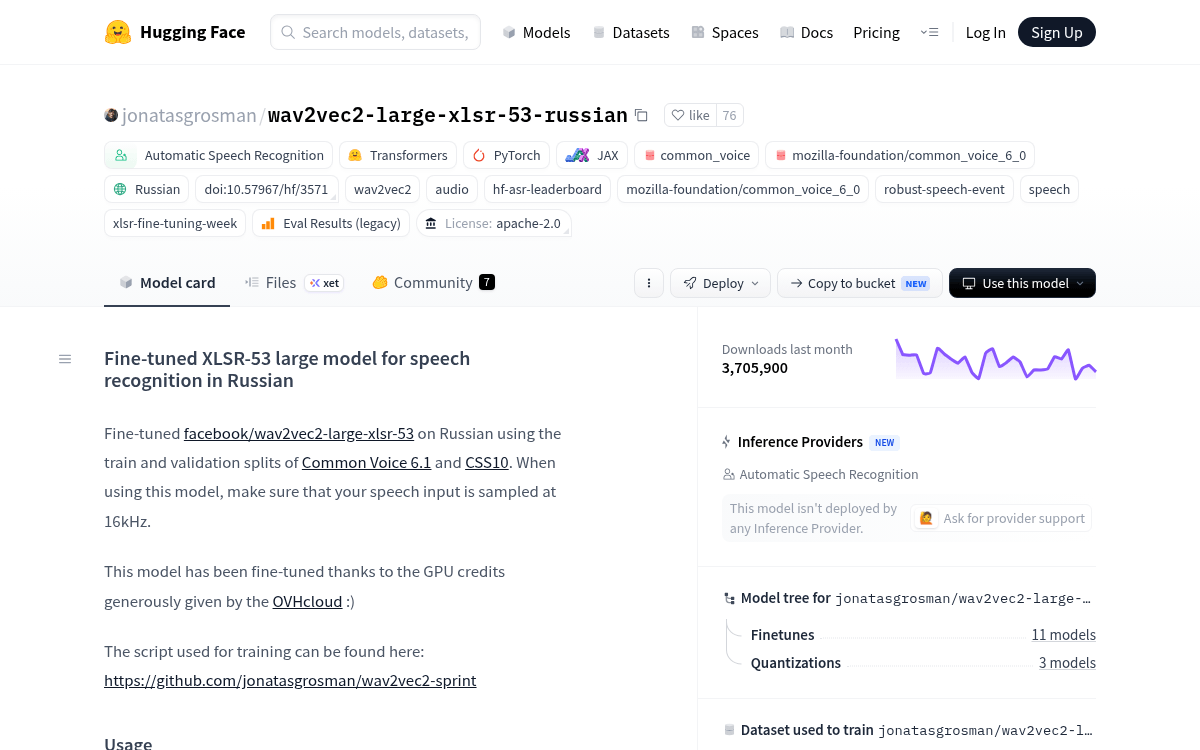
A community fine-tune of Facebook's XLSR-53 hits 3.7M downloads by delivering sub-14% WER Russian transcription with a tiny footprint and Apache-2.0 licensing.
 Pro
Takeaways
- wav2vec2-large-xlsr-53-russian hits 13.3% WER on Common Voice, 9.57% with a language model.
- Fine-tuned from facebook/wav2vec2-large-xlsr-53 on Common Voice 6.1 and CSS10 Russian.
- Apache-2.0 licensed, works with PyTorch, JAX, Transformers, and an ONNX build.
- Weak point: 40% WER on out-of-domain Robust Speech Event dev data.
- Requires 16 kHz mono audio input; outputs uppercase text without punctuation.
- Around 3.7M downloads, 26 Spaces, 11 downstream fine-tunes on the Hub.
A community fine-tune of Facebook's multilingual speech encoder is quietly one of the most downloaded Russian ASR models on the Hub, pulling in nearly four million downloads and powering dozens of Spaces. wav2vec2-large-xlsr-53-russian from Jonatas Grosman is a permissively licensed checkpoint that turns Russian audio into text without a hosted API or a giant Whisper variant.
The recipe is straightforward. The author fine-tuned facebook/wav2vec2-large-xlsr-53 on Russian using the train and validation splits of Common Voice 6.1 and CSS10. Training happened during the XLSR fine-tuning week on GPU credits from OVHcloud, with the sprint code available on GitHub.
The numbers that made it stick
On the Common Voice Russian test set, the model reports a Word Error Rate (WER) of 13.3% and Character Error Rate (CER) of 2.88% when running as a pure acoustic model. Adding a language model drops WER to 9.57% and CER to 2.24%, competitive with much heavier systems for clean, read-speech Russian.
The model card also publishes a much less flattering out-of-domain result: 40.22% WER on the Robust Speech Event dev data, falling to 33.61% with a language model. That gap is the honest signal of what you are buying.
Where it shines and where it breaks
- Strengths: clean, 16 kHz read speech in standard Russian, short utterances, and any pipeline that needs CTC-style transcription without an LLM in the loop.
- Weaknesses: noisy real-world audio, spontaneous speech, code-switching, and anything sampled at 8 kHz phone quality. The three-fold WER jump on the Robust Speech Event set makes this concrete.
- Practical caveat: the model is uppercase-only and outputs no punctuation, since the training transcripts were normalized. You will need a downstream restorer for anything user-facing.
The failure modes show up directly in the sample predictions on the model card, where clean sentences transcribe near-perfectly while a longer literary passage collapses into partial gibberish.
Using it in five lines
The path of least resistance is the standard Transformers pipeline, which pulls weights and processor automatically:
from transformers import pipeline
pipe = pipeline("automatic-speech-recognition",
               model="jonatasgrosman/wav2vec2-large-xlsr-53-russian")
print(pipe("audio.wav"))
For batch transcription of files on disk, the author's own HuggingSound wrapper handles resampling and chunking. Remember the input constraint: speech input must be sampled at 16 kHz.
Why it keeps getting downloaded
The checkpoint is Apache-2.0, works in both PyTorch and JAX, and already has an ONNX conversion for browser and edge inference via transformers.js. The model tree also lists 11 downstream fine-tunes and 2 quantized variants, so if you need a smaller or domain-adapted version, someone has probably already built it.
XLSR-53 is a wav2vec2 encoder pretrained on 53 languages, and fine-tuning it on a few thousand hours of a target language reliably produces a competent ASR model at roughly 300M parameters. This Russian variant is one of the most visible proofs of that recipe, alongside the same author's Spanish, Portuguese, French, German, and other checkpoints. It remains a sensible baseline when Whisper is overkill or when you need a self-hosted, on-prem transcriber with no phone-home behavior.
When to actually reach for it
- You need offline Russian transcription on a single GPU or even CPU with ONNX Runtime.
- You are building a voice interface where clean, close-mic 16 kHz audio is realistic, such as dictation, IVR menus, or controlled recordings.
- You want a starting point to fine-tune further on your own domain audio, since the base checkpoint is small enough to adapt cheaply.
- You need something under a permissive license that you can ship in a commercial product without negotiating terms.
If your audio is noisy call-center recordings or free-form conversation, benchmark it against Whisper large-v3 or a newer conformer-based system before committing. For the clean-audio case, the WER numbers and the near four-million download counter suggest the community has already voted on this one.