
Community-Built wav2vec2 Model Quietly Dominates Danish Speech Recognition With 900k Downloads
A community fine-tune of Facebook's XLS-R on 1,800 hours of Danish parliament speech quietly became one of the most downloaded Danish ASR models.
 Pro
Takeaways
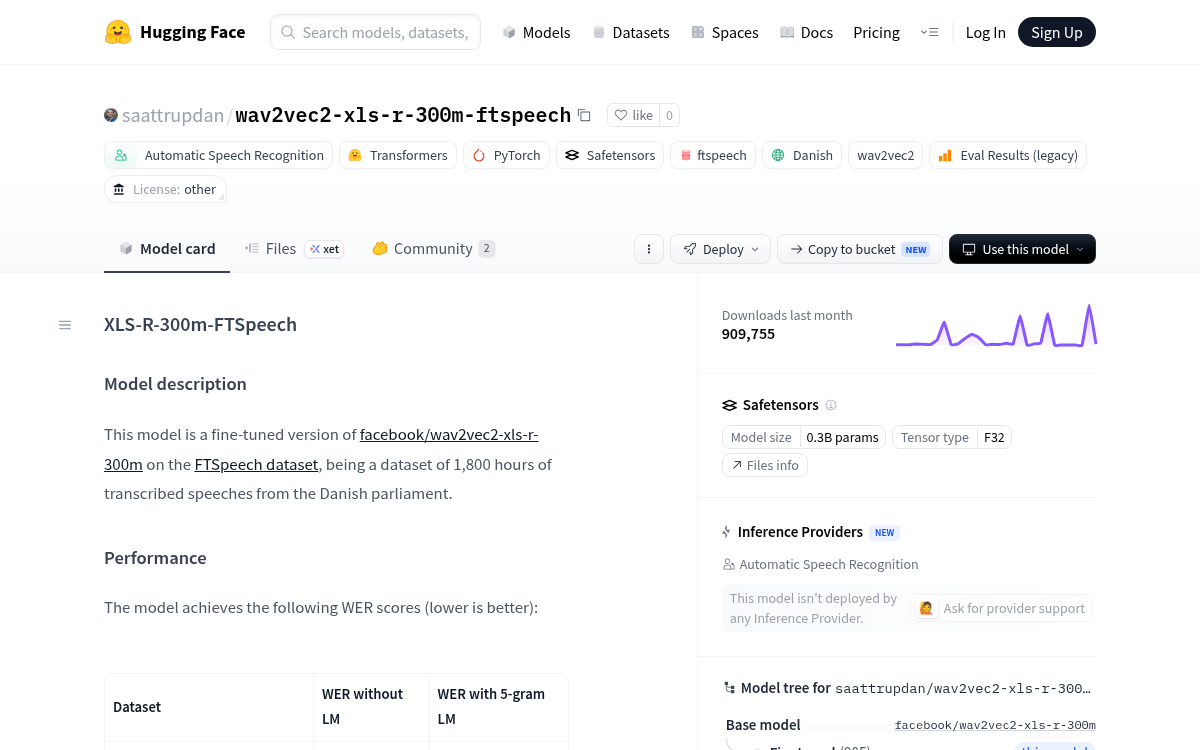
- Danish ASR model with 900k+ downloads, fine-tuned from XLS-R 300M.
- Trained on FTSpeech, 1,800 hours of Danish parliament speech from 434 speakers.
- Reaches 13.84 WER on Alvenir and 17.91 WER on Common Voice with 5-gram LM.
- Drop-in via Hugging Face
transformerspipeline, 16 kHz mono audio input required. - Custom Folketing license restricts reuse, not Apache-2.0 like the base model.
- Best for parliamentary and long-form Danish speech, weaker on noisy consumer audio.
Danish is one of those languages where off-the-shelf speech recognition tends to fall apart. Public corpora are small, mostly read-aloud, and rarely capture the messiness of real spontaneous speech. That gap explains why a community-built model, saattrupdan/wav2vec2-xls-r-300m-ftspeech, has cleared over 900k downloads on Hugging Face, with more than half a million in the last month alone.
The approach: take Facebook's multilingual XLS-R checkpoint and fine-tune it on FTSpeech, a large corpus of Danish parliamentary debates. The result is a 300M-parameter Danish ASR model you can drop into a transformers pipeline in two lines.
What's under the hood
The base is facebook/wav2vec2-xls-r-300m, Facebook's cross-lingual speech model trained on 436K hours of audio across 128 languages. It converts raw waveforms into frames, builds feature vectors through a CNN encoder, then feeds quantized representations into 24 transformer layers. Danish is among the 128 pretraining languages, giving the fine-tune a solid head start.
The fine-tuning data is FTSpeech, introduced in a 2020 Interspeech paper from IT University of Copenhagen. Built from recorded sessions of the Danish Parliament (the Folketing), it covers over 1,800 hours of transcribed speech from 434 speakers. That dwarfs earlier Danish corpora in duration, vocabulary, and spontaneity. Real speakers, hesitations, shifting topics — none of the scripted-prompt problems that plague read-aloud datasets.
The numbers that matter
Word error rate (WER) on two benchmarks, with and without a 5-gram language model on top of the CTC decoder:
| Dataset | WER (no LM) | WER (5-gram LM) |
|---|---|---|
| Danish Common Voice 8.0 | 20.48 | 17.91 |
| Alvenir ASR test set | 15.46 | 13.84 |
The original FTSpeech paper's classical Kaldi baseline hit 14.01 WER on in-domain data, so this fine-tune is competitive on parliamentary-style audio (Alvenir) but noticeably weaker on the more varied Common Voice recordings. That gap is a fair warning: parliamentary audio is an acoustically specific domain.
Dropping it into your stack
Integration is straightforward for anyone already using Hugging Face pipelines:
from transformers import pipeline
pipe = pipeline("automatic-speech-recognition",
                model="saattrupdan/wav2vec2-xls-r-300m-ftspeech")
print(pipe("my_danish_audio.wav"))
A few practical notes before you ship:
- Input audio must be 16 kHz mono, matching the wav2vec2 pretraining rate.
- The reported WERs use a 5-gram KenLM decoder. Greedy CTC decoding will score worse, so wire up a language model if the headline numbers matter to you.
- At roughly 0.3B parameters in F32, the model runs on a single consumer GPU and handles batch transcription jobs on CPU.
- Weights ship in both PyTorch and safetensors formats.
The licensing catch
The model card lists the license as "other" and points to the Danish Parliament's terms for reuse of Folketing broadcast material. That obligation flows from the training data, so any team considering a commercial deployment needs to read those terms carefully. The base XLS-R checkpoint is Apache-2.0, but the fine-tune inherits FTSpeech's restrictions.
Where it fits — and where it doesn't
Realistic use cases for this checkpoint include transcribing Danish political speech, interviews, or long-form monologue content close to the training distribution; bootstrapping a self-hosted Danish ASR pipeline where Whisper's Danish quality falls short; serving as a starting point for domain adaptation into call-center or medical Danish; and forced alignment for subtitle timing, since CTC models produce clean frame-level timestamps.
Noisy consumer audio and strong regional dialects underrepresented in parliamentary recordings will expose the model's limits quickly. The FTSpeech transcripts are also normalized without punctuation or casing, so any use case requiring either will need a hybrid setup with Whisper or a downstream text-restoration model.