
Community-Built wav2vec2 Japanese Speech Model Hits 10M Downloads on Hugging Face
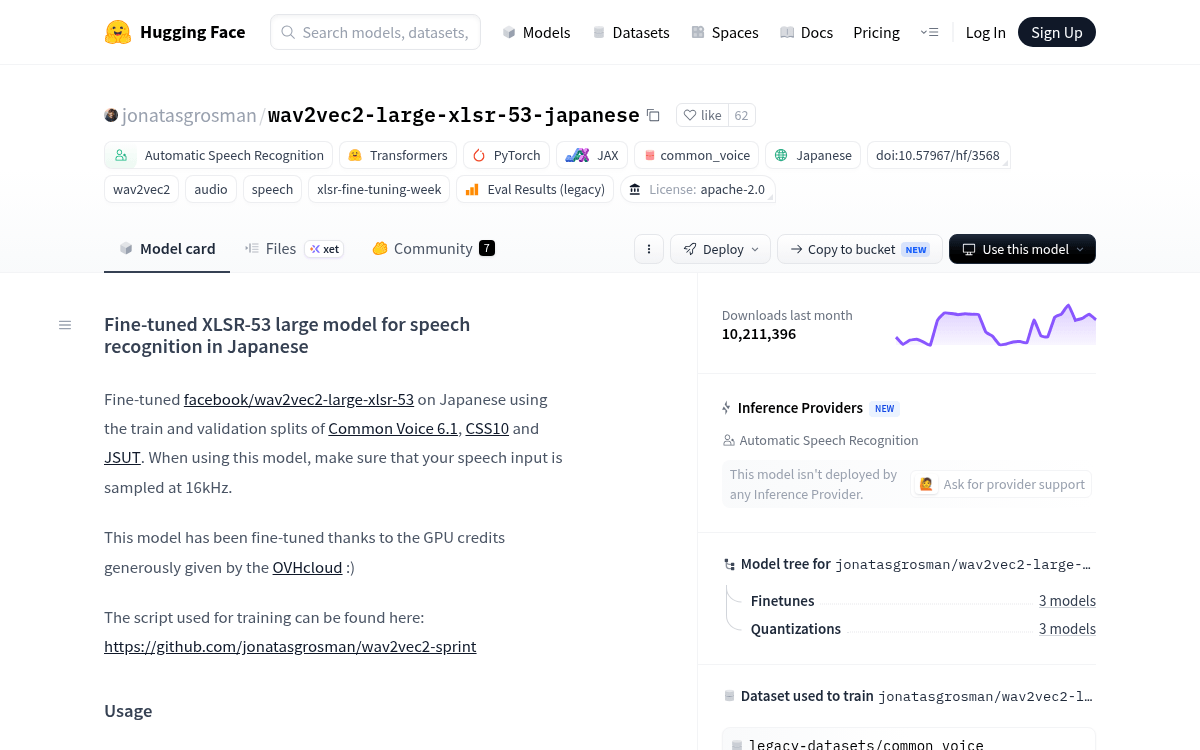
A community fine-tune of Facebook's XLSR-53 has quietly become the default open-weights choice for Japanese speech recognition, crossing 10M downloads.
 Pro
Takeaways
- wav2vec2-large-xlsr-53-japanese crosses 10M downloads on Hugging Face
- Fine-tuned from Facebook's XLSR-53 on Common Voice, CSS10, and JSUT Japanese data
- Reports 20.16% Character Error Rate on Common Voice Japanese test set
- Apache 2.0 licensed, works via Transformers pipeline or HuggingSound
- Requires 16kHz audio input, no built-in language model rescoring
- Training script open-sourced at wav2vec2-sprint repo
A community-built Japanese speech recognition model has become one of the most downloaded audio models on Hugging Face, with over 10 million cumulative pulls and more than 4,000 likes. The model, wav2vec2-large-xlsr-53-japanese from Jonatas Grosman, is a fine-tune of Facebook's cross-lingual XLSR-53 base that has become a default pick for teams building Japanese ASR pipelines without paying for a cloud API.
The base model, facebook/wav2vec2-large-xlsr-53, was pretrained across 53 languages using contrastive learning on raw waveforms. XLSR builds on wav2vec 2.0 by solving a contrastive task over masked latent speech representations and jointly learning a quantization of those latents shared across languages. In the original paper, cross-lingual pretraining significantly outperformed monolingual pretraining once the model was fine-tuned on labeled data. Grosman's contribution is the Japanese fine-tune on top of that backbone.
How it was built
The checkpoint was fine-tuned on Japanese using the train and validation splits of Common Voice 6.1, CSS10, and JSUT. Combining three corpora is deliberate. Common Voice supplies crowdsourced read speech with speaker variety, CSS10 adds single-speaker long-form audio, and JSUT contributes studio-quality Japanese recordings. The model expects speech input sampled at 16kHz.
The training script that produced the model lives at github.com/jonatasgrosman/wav2vec2-sprint, and everything ships under Apache 2.0, so you can put it in commercial products without licensing friction.
Why the WER looks broken
The reported metrics look strange at first glance: a Word Error Rate of 81.80 percent alongside a Character Error Rate of 20.16 percent on the Common Voice Japanese test set. That gap reflects a property of Japanese rather than a bug. Common Voice references contain no spaces, so any word-tokenization mismatch inflates WER dramatically. CER is the honest number here, and 20 percent character error is competitive for a single fine-tune with no language model rescoring.
Against peers evaluated with the same script, the model was the clear leader:
| Model | WER | CER |
|---|---|---|
| jonatasgrosman/wav2vec2-large-xlsr-53-japanese | 81.80% | 20.16% |
| vumichien/wav2vec2-large-xlsr-japanese | 1108.86% | 23.40% |
| qqhann/w2v_hf_jsut_xlsr53 | 1012.18% | 70.77% |
Dropping it into a project
The simplest path is the Transformers pipeline, which handles preprocessing, CTC decoding, and device placement in three lines:
from transformers import pipeline
pipe = pipeline("automatic-speech-recognition",
                model="jonatasgrosman/wav2vec2-large-xlsr-53-japanese")
text = pipe("audio.wav")
For more control, load the processor and CTC head directly and feed 16kHz float arrays via librosa or torchaudio. There is also a higher-level wrapper, HuggingSound, that batches file paths and returns transcriptions without touching tensors.
Where it shines and where it flails
The sample predictions on the model card tell a consistent story. Short, clean utterances close to the training distribution come out essentially perfect. The reference sentence about a shoe change (kutsu wo nuide) and one about baseball versus soccer transcribe verbatim. Long sentences with rare vocabulary, proper nouns, or spontaneous phrasing degrade fast, with character substitutions that preserve phonetics but break meaning.
Concrete strengths and limitations worth planning around:
- Strong on read speech at 16kHz with a single speaker, close to Common Voice or JSUT conditions
- No built-in language model, so homophone disambiguation depends entirely on acoustic context
- Untrained on conversational speech, code switching, or heavy dialects
- No punctuation or casing output, since CTC over a kana/kanji vocabulary produces raw character streams
- Friendly latency on CPU or a small GPU, since the architecture is a 300M parameter encoder rather than a seq2seq model like Whisper
Where it fits in the current stack
Whisper and newer multilingual ASR systems now beat this checkpoint on aggregate benchmarks, especially on noisy or spontaneous audio. The reason wav2vec2-large-xlsr-53-japanese still moves millions of downloads is practical: it is small, permissively licensed, self-hostable on a single GPU, and easy to fine-tune further on domain data. For batch transcription of clean Japanese audio, offline work in privacy-sensitive settings, forced alignment, or a starting point for a domain-specific fine-tune, it remains a reasonable default. Teams that need punctuation, timestamps, or robustness to noisy conversational audio will get more out of a Whisper variant, and will pay for it in model size and inference cost.