
Community-Built wav2vec2 Becomes the Go-To Open Vietnamese Speech Model
A Vietnamese speech recognition model built on wav2vec2 quietly crossed 1.25 million downloads, offering sub-7% word error rates on VLSP benchmarks.
 Pro
Takeaways
- Vietnamese wav2vec2 ASR model on Hugging Face passed 1.25M downloads.
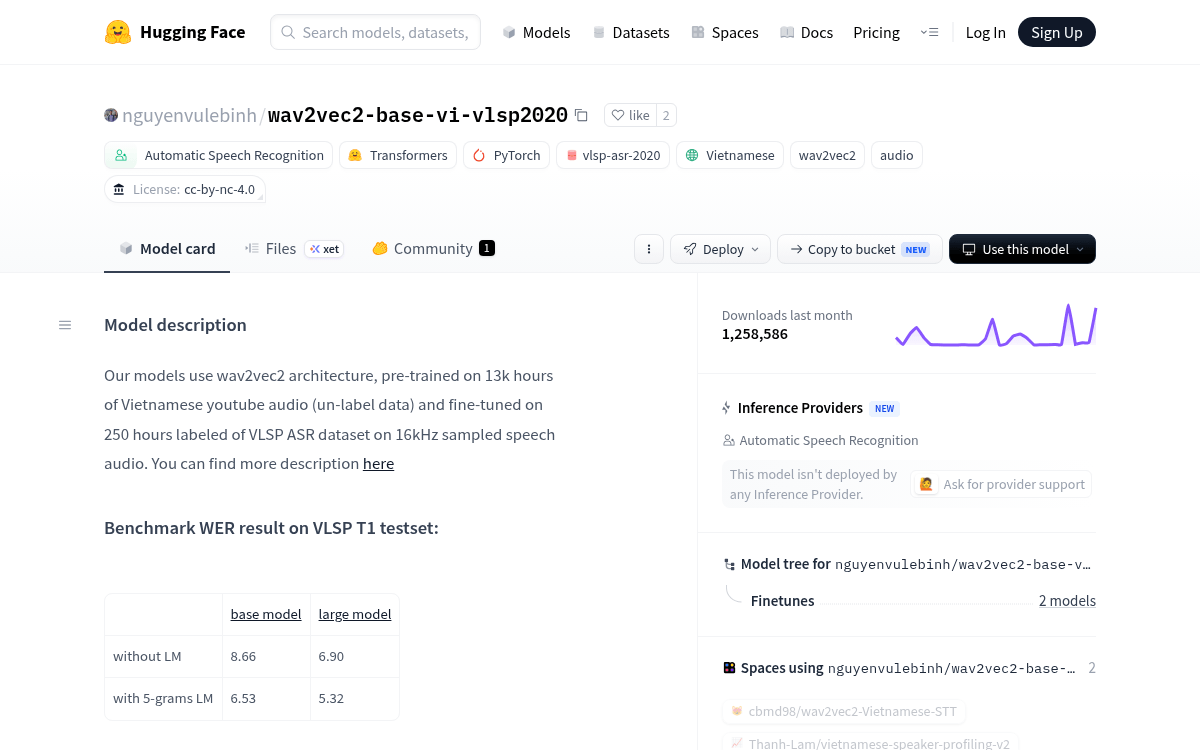
- Base model hits 8.66 WER greedy, 6.53 WER with 5-gram LM on VLSP T1.
- Large variant reaches 5.32 WER with LM, 317M parameters versus 95M base.
- Pretrained on 13k hours of Vietnamese YouTube audio, fine-tuned on 250 hours VLSP.
- Trained about 30 days on TPU v3-8, uses standard wav2vec2 CTC architecture.
- Licensed CC-BY-NC 4.0, non-commercial use only, blocks direct product deployment.
Vietnamese automatic speech recognition has long been an underserved corner of the open-source audio ecosystem, dominated by proprietary APIs and English-first research releases. A community-built wav2vec2 model targeting the VLSP 2020 benchmark has quietly become one of the most downloaded Vietnamese ASR checkpoints on Hugging Face, with usage patterns that suggest it is now the default choice for teams shipping Vietnamese speech pipelines.
The wav2vec2-base-vi-vlsp2020 checkpoint from Nguyen Vu Le Binh is a fine-tune of a self-supervised Vietnamese wav2vec2 backbone, distributed with a bundled KenLM decoder and a Colab notebook you can run against a sample utterance in a few minutes.
Reading the WER scoreboard
The checkpoint follows the standard wav2vec2 base recipe at roughly 95M parameters, pre-trained on 13k hours of unlabeled Vietnamese YouTube audio and fine-tuned on 250 hours of labeled VLSP ASR data at 16 kHz. On the VLSP T1 test set, the reported word error rates are:
- Base, greedy decoding: 8.66 WER
- Base with 5-gram LM: 6.53 WER
- Large, greedy decoding: 6.90 WER
- Large with 5-gram LM: 5.32 WER
Those are competitive numbers for a Vietnamese CTC model, and the two-point gap between greedy decoding and 5-gram rescoring is a useful reminder that language models still matter a lot for CTC systems even in the transformer era.
How it was built
Self-supervised pretraining ran on a large, diverse corpus scraped from YouTube: 13k hours spanning clean recordings, noisy environments, conversational speech, and multiple genders and dialects. That diversity is what makes the checkpoint useful in the wild rather than only on clean read speech.
The base model was trained for 35 epochs and the large model for 20, taking roughly 30 days on a TPU v3-8. Base weighs in at about 95M parameters and large at around 317M. After pretraining, the VLSP-tuned head adds a CTC layer trained on the labeled portion.
Getting it running
The simplest path is the Transformers pipeline, which handles feature extraction, model loading, and CTC decoding in one call:
from transformers import pipeline
pipe = pipeline(
    "automatic-speech-recognition",
    model="nguyenvulebinh/wav2vec2-base-vi-vlsp2020",
)
print(pipe("my_audio_16k.wav"))
For language-model boosted output, the repo ships a Wav2Vec2ProcessorWithLM configuration that pairs the acoustic model with a KenLM 5-gram. Decoding with pyctcdecode at a beam width of 100 is the recipe used in the reference notebook, and it is what produces the 6.53 WER figure rather than the greedy 8.66. Audio must be 16 kHz mono.
The licensing catch
Here is the part that is easy to miss. The ASR model parameters are released for non-commercial use only, under Creative Commons Attribution-NonCommercial 4.0 International. Prototypes, research work, and internal tools that never ship to paying users are fine. Anything headed for a commercial product means talking to the author or looking elsewhere. The 1.25M+ download counter suggests a lot of teams are using it, but the CC-BY-NC clause is binding.
Strengths and rough edges
Strengths are what you would expect from a diverse pretraining corpus: the model handles conversational Vietnamese, various dialects, and noisy input better than systems trained only on read speech. The bundled 5-gram LM helps recover from acoustic ambiguity in short utterances, which is where pure CTC tends to hallucinate.
The rough edges are also familiar. As a CTC model rather than a sequence-to-sequence system, it will not punctuate, capitalize, or format numbers for you. It expects 16 kHz audio. Domain-specific vocabulary, especially proper nouns and technical terms outside the VLSP domain, will need either a custom LM or additional fine-tuning to hit production quality.
Where it fits in a stack
Obvious use cases include transcription pipelines, voice-command frontends, captioning tools, and any Vietnamese audio labeling workflow that would otherwise depend on a paid API. It is also a reasonable starting point for further fine-tuning on domain audio, since the underlying self-supervised backbone is available separately as wav2vec2-base-vi and wav2vec2-large-vi without the VLSP head.
For a language historically underrepresented in open ASR releases, having a checkpoint that clears 6.53 WER on a public benchmark, ships with a working decoder, and integrates with the standard Transformers pipeline fills a real gap. The download numbers reflect that reality more than any leaderboard would.