
ComfyUI Ships LTX-2 With 4K 50FPS Audio-Video in One Pass
Comfy Org has repackaged Lightricks' open-source LTX-2 audio-video model for ComfyUI, shipping day-0 native workflows for text, image, and control-based video generation.
 Pro
Takeaways
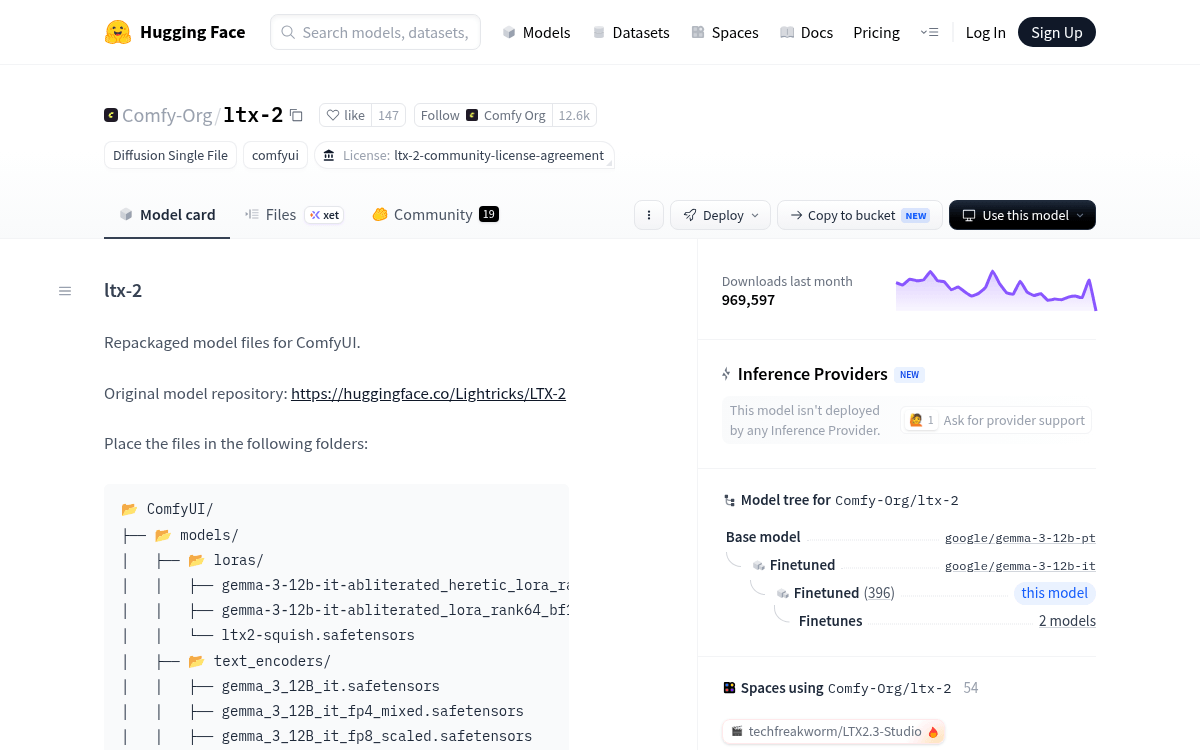
- Comfy Org published Comfy-Org/ltx-2, repackaged Lightricks LTX-2 weights for ComfyUI, at 969K+ downloads
- LTX-2 gets day-0 native support in ComfyUI with T2V, I2V, and control-to-video workflow templates
- Generates synchronized motion, dialogue, SFX, and music in a single pass at up to 4K and 50 FPS
- NVFP4 and NVFP8 checkpoints from NVIDIA deliver up to 3X speedup with 60% less VRAM
- Uses a Gemma 3 12B text encoder with fp8-scaled and fp4-mixed variants for consumer GPUs
- Free for non-commercial and sub-$10M organizations under the LTX-2 community license
The team behind ComfyUI has published Comfy-Org/ltx-2, a repackaged distribution of Lightricks' open-source LTX-2 audio-video model that plugs directly into the ComfyUI graph editor. The files are laid out as drop-ins for the standard ComfyUI folder structure, sparing users the usual weight-shuffling that comes with new video models. Downloads have crossed 969,000 on Hugging Face, a signal that a lot of local video creators were waiting for clean packaging.
The upstream weights come from Lightricks, but the story here is the packaging and the fact that LTX-2 works in ComfyUI on Day 0 without a third-party custom node pack. The model generates high-quality visual output while keeping resource use and inference speed reasonable for local hardware.
Inside the repo
Comfy-Org/ltx-2 repackages Lightricks/LTX-2 into the exact folder structure ComfyUI expects. Total footprint is roughly 62.4 GB across the main branch. The layout includes:
models/text_encoders/: a Gemma 3 12B instruction-tuned encoder in bf16, plus fp8-scaled, fp4-mixed, and mixed-precision variants for lower-VRAM setupsmodels/loras/: two abliterated Gemma LoRAs at rank 64 and anltx2-squish.safetensorseffect LoRA (trigger wordsquish it)- The diffusion model itself, exposed as single-file safetensors for ComfyUI's native loaders
Because everything is pre-sharded to match ComfyUI's directory conventions, the flow is basically: update ComfyUI, open a template, and let the pop-up fetch the pieces.
Joint audio and video in one pass
LTX-2 generates motion, dialogue, background noise, and music in a single pass, which is the joint audio-video generation part that competitors usually bolt on afterwards. Comfy Org shipped a handful of workflow templates on day one:
- Text-to-Video and Image-to-Video with synchronized audio
- Control-to-Video using Canny edges, depth maps, or pose skeletons as structural guidance
- Keyframe-driven generation for scripted shots
- Native upscaling and a prompt enhancer node
The headline capability is 4K output at 50 FPS with lip and beat-aligned audio when you supply a track. In practice, one hands-on writeup on a 24 GB RTX 4090 reported a 12-second 1080p test with moderate motion at about 7.5 minutes per tiled frame batch, with better consistency than expected. Throughput is slow, but motion coherence beats earlier open text-to-video baselines by a wide margin.
NVIDIA optimizations for local runs
Comfy Org, NVIDIA, and Lightricks pushed quantized checkpoints alongside the launch. NVFP4 and NVFP8 variants are available, and with the NVIDIA-optimized ComfyUI build, LTX-2 produces 4K video locally up to 3x faster with 60% less VRAM using NVFP4. That gap separates "technically runs" from "iterate on prompts without a coffee break." The FP8 variant of the Gemma 3 12B text encoder is what most 16 to 24 GB consumer GPUs will actually load.
Running it
The workflow is deliberately boring, which is the point:
- Update ComfyUI to a recent build (the LTX-2 loader and inference nodes appear on main)
- Open Template Library > Video and pick an LTX-2 workflow (T2V, I2V, or one of the control variants)
- Follow the pop-up to download the Comfy-Org/ltx-2 files into
ComfyUI/models/ - Run
The repo carries the LTX-2 community license. Weights are free for non-commercial use and for organizations under $10M revenue, with a commercial license required above that threshold.
Where it fits, where it strains
The obvious use cases are short-form social clips, storyboard-to-shot experimentation, and any pipeline that needs synchronized dialogue or SFX without a separate TTS and mixing pass. Control-to-video with Canny, depth, or pose opens the door for animators who already have blocking or motion references and want texture and lighting generated on top.
The rough edges are what you would expect from a first-generation open audio-video model. Early users on the launch thread hit device mismatch and tensor-shape errors on custom samplers that trace back to outdated custom nodes rather than the model itself. Frame count must be divisible by 8 plus 1, and width and height must be divisible by 32, so arbitrary resolutions get padded and cropped. The 22B-class parameter count also means you either sit on a 24 GB+ GPU or lean hard on the quantized encoder plus CPU offload path.
For anyone tracking the open video model race, the Comfy-Org packaging collapses the setup delta between "paper drops" and "I can prompt it tonight" to essentially zero. Closed video APIs have been sitting behind that practical bar for the past year.