
Comfy-Org's Wan2.2-Animate-14B Brings Character Animation Locally With 4.8M Downloads
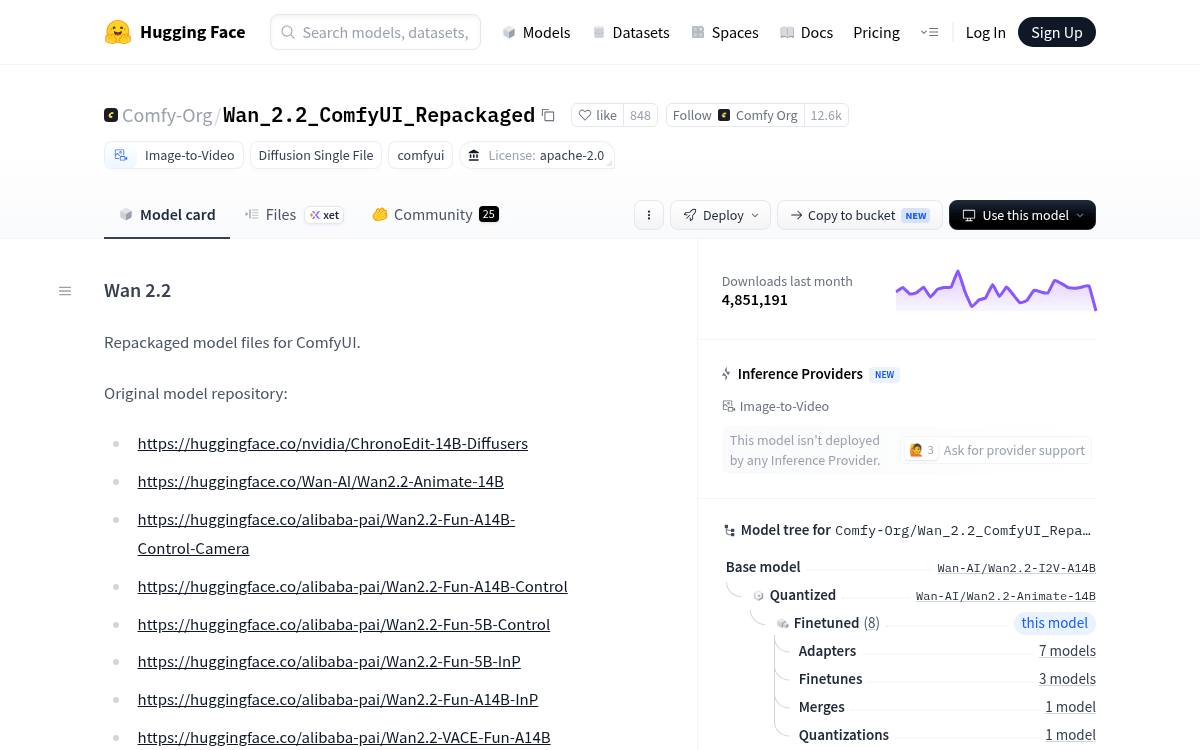
Comfy-Org packaged Alibaba's Wan2.2-Animate-14B and its full model family into ComfyUI-ready safetensors, hitting 4.8M downloads with native workflow support.
 Pro
Takeaways
- Comfy-Org published a repackaged Wan 2.2 model bundle for native ComfyUI use, at 4.8M downloads
- Includes Wan2.2-Animate-14B, I2V, T2V, S2V, TI2V-5B, Fun Control variants, and lightx2v 4-step distill LoRAs
- Animate model supports Mix mode (character replacement) and Move mode (motion-driven animation)
- Native ComfyUI templates replace third-party wrappers for the Wan Animate workflow
- Ships in bf16, fp8 scaled, and int8 convrot formats under Apache 2.0 for commercial use
- RTX A6000 48GB runs the 14B model at 720p unquantized; consumer GPUs need fp8 or GGUF
Character animation just got a lot less painful to set up locally. Comfy-Org has published a repackaged distribution of Alibaba Tongyi Lab's Wan2.2 model family, including the newly supported Wan2.2-Animate-14B, as single-file safetensors that drop directly into ComfyUI's folder structure. The repo has already crossed 4.8 million downloads, making it one of the most heavily pulled video model bundles on Hugging Face.
Comfy-Org has taken the original weights scattered across Wan-AI, Alibaba-PAI, and lightx2v repositories and consolidated them into a single tree with the exact filenames ComfyUI expects. The heavier lift is that the ComfyUI team also shipped native core node support, so Wan Animate 2 runs through official templates rather than requiring third-party wrappers.
What ships in the bundle
The repackaged repo covers the full Wan 2.2 lineup, not just the Animate checkpoint. If you have used ComfyUI before, the layout will be familiar: diffusion models, VAEs, text encoders, and LoRAs all pre-named to match the expected paths.
- Wan2.2-Animate-14B in bf16 and int8 convrot variants for character animation and replacement
- Wan2.2 I2V, T2V, and S2V 14B checkpoints in fp16 and fp8 scaled versions
- Wan2.2-TI2V-5B for lighter-weight text-and-image-to-video
- Wan2.2 Fun variants covering camera control, ControlNet-style conditioning, inpainting, and VACE
- Distillation LoRAs from lightx2v that cut inference to roughly 4 steps for both high-noise and low-noise stages
- umt5-xxl text encoder in fp16 and fp8, plus the Wan 2.1 and 2.2 VAEs
- NVIDIA's ChronoEdit-14B in fp16, bundled alongside the Wan files
Why the Animate checkpoint is the headline
Wan2.2-Animate-14B is a reference-driven character animation and replacement model. It uses an end-to-end framework that feeds driving videos directly into a redesigned Diffusion Transformer, reaching high-fidelity motion generation and strong identity preservation by eliminating intermediate motion extractors. Text-driven viewpoint control then decouples the output camera perspective from the driving video.
The ComfyUI native workflow exposes two modes: Mix (replace a character in a video with a character from a reference image) and Move (animate a character using motion from an input video). One model handles both the deepfake-style replacement case and the puppet-a-still-image case, with precise motion and expression replication in each direction.
Getting it running
The setup path is short if you already have ComfyUI on a recent version. Pull the files you need from the repo, drop them into the matching subfolders, and load a template. The official Wan2.2 Animate tutorial spells out the node graph, but the practical flow is roughly this:
- Update ComfyUI to a version that includes the new core nodes (older stable builds may be missing them)
- Download
wan2.2_animate_14B_bf16.safetensors(or the int8 variant for lower VRAM) intoComfyUI/models/diffusion_models/ - Grab
umt5_xxl_fp8_e4m3fn_scaled.safetensors,wan_2.2_vae.safetensors, and the relight LoRA into their respective folders - Load the Wan2.2 Animate template from the Templates panel, wire up a reference image and driving video, and queue the prompt
An optional WanAnimate2Cache node cuts generation time, worth enabling once you have a workflow that produces the output you want.
Hardware and quantization tradeoffs
The 14B MoE architecture is not friendly to consumer GPUs at full precision. ComfyUI has native Wan 2.2 support with official templates for text-to-video, image-to-video, and first-frame-to-last-frame workflows. An RTX A6000 with 48GB runs the 14B model at 720p without quantization, which no single consumer GPU can match. For anything smaller, you are picking between the fp8 scaled variants, the int8 convrot build shipped in this repo, or third-party GGUF quantizations.
The bundled 4-step lightx2v distillation LoRAs are the other big lever. Wan 2.2 uses a two-expert MoE with separate high-noise and low-noise diffusion models, so you load both LoRAs, one per expert, to get the speedup. Combined with fp8 weights, generation time for a short clip drops from minutes to tens of seconds on a well-provisioned GPU.
Where this lands in the video model race
The open-weights video space has been moving fast, with Wan, HunyuanVideo, LTX, and Mochi all iterating aggressively. The Animate variant adds a genuine competitor to closed products like Runway Act-One and the character-transfer features in commercial tools, with weights you can run locally and fine-tune. Wan2.2 Animate covers both character replacement and motion transfer inside video content, animates static character images using reference videos while capturing facial expressions and body movements, and can swap existing characters in videos while preserving the original environmental context and lighting.
Practical use cases where this pipeline earns its keep:
- Previsualization for animation and film, driving a character design with a rough acting reference
- Virtual production and VTubing, where you want expression transfer from a webcam feed to a stylized character
- Ad and social content, swapping a brand mascot or spokesperson into existing footage
- Dataset generation for downstream training, since you can produce matched pairs of driving and animated clips
The honest limitations
This is still a diffusion video model, and the usual caveats apply. Long clips drift, hands and fine props remain unreliable, and heavy occlusion in the driving video breaks pose estimation. Facial identity holds up well for front-facing references but degrades on extreme profile angles. Because Comfy-Org's release is a repackaging, any weaknesses in the underlying weights are inherited directly, including training biases toward certain body types and lighting conditions.
Licensing is the friendly part of the story: the repo ships under Apache 2.0, so commercial use is on the table without the usage restrictions attached to some other open video model families. For anyone who has been juggling manual downloads across half a dozen Hugging Face repos to get a Wan workflow running, having one canonical, ComfyUI-shaped distribution is the quiet productivity win here.