
Comfy-Org's Wan 2.1 Repackaged Hits 2.47M Downloads Making Video AI Accessible
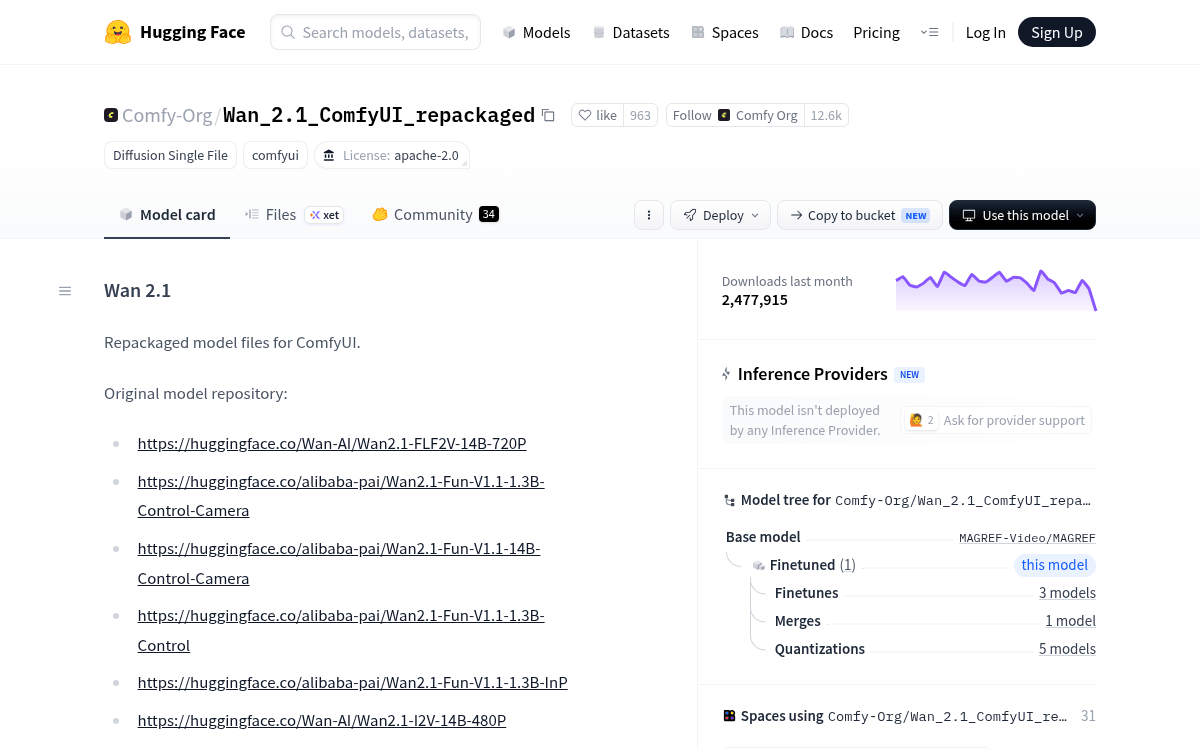
Comfy-Org's drop-in bundle of Wan 2.1 video weights has crossed 2.4M downloads, becoming the canonical way to run Wan inside ComfyUI.
 Pro
Takeaways
- Comfy-Org's Wan 2.1 ComfyUI bundle has crossed 2.47M downloads on Hugging Face
- Single repo covers t2v, i2v, flf2v, VACE, Fun Camera/Control/Inpaint, MAGREF variants
- Ships bf16, fp16, fp8_e4m3fn, and fp8_scaled precisions for both 1.3B and 14B sizes
- Folder tree maps directly onto ComfyUI's expected model directory layout
- Includes umt5-xxl text encoders, Wan 2.1 VAE, and InfiniteTalk model patches
- Comfy-Org also maintains a separate Wan 2.2 repackaged repo for newer variants
The ComfyUI team has quietly built one of the most downloaded video generation resources on Hugging Face by doing something unglamorous but useful: taking the sprawling Wan 2.1 model family and repackaging every checkpoint into a single, drop-in-ready folder structure for ComfyUI. The Comfy-Org/Wan_2.1_ComfyUI_repackaged repository has crossed 2.47 million downloads, making it a de facto distribution channel for open-source video diffusion.
Instead of hunting across multiple upstream repos, converting formats, and figuring out which tensor goes into which subfolder, you clone one repo and every file lands exactly where ComfyUI expects it. The repackaged files ship alongside example workflows at comfyanonymous.github.io/ComfyUI_examples/wan, so the whole setup is copy-paste from download to first generation.
Inside the bundle
Calling this a model undersells it. The repo is a full toolkit covering nearly every Wan 2.1 variant that has shipped, organized by the ComfyUI folder each file belongs in. The diffusion_models directory alone weighs in at roughly 457 GB across the checkpoints. The lineup includes:
- Text-to-video (t2v): 1.3B and 14B parameter versions
- Image-to-video (i2v): 14B in 480p and 720p variants
- First-last-frame-to-video (flf2v): 14B at 720p for generating motion between two keyframes
- VACE: 1.3B and 14B modules for structure-aware editing and scene control
- Fun Camera, Fun Control, Fun Inpaint: fine-tunes for camera trajectory control, ControlNet-style conditioning, and video inpainting
- MAGREF: 14B reference-guided variant
- InfiniteTalk patches: single and multi-speaker model patches for long-form talking-head generation
- Support files: umt5-xxl text encoders, the Wan 2.1 VAE, clip_vision_h, and an alpha-channel RGBA LoRA
Every checkpoint ships in multiple precisions. The 14B and 1.3B labels refer to parameter counts, with larger values needing more capable hardware. The bf16, fp16, and fp8 tags refer to numerical precision: bf16 may require Ampere-architecture GPUs or higher, and fp8 has the lowest precision and hardware requirements, though quality can suffer. The fp8_scaled variants are the sweet spot for consumer GPUs, letting a 14B image-to-video model fit on cards with as little as 12 GB of VRAM.
Why 2.47 million downloads?
Wan 2.1 itself was released by Alibaba under Apache-2.0, but the raw upstream weights are scattered across separate repositories per variant, often in diffusers format that ComfyUI cannot load directly. Comfy-Org's contribution is the packaging layer: consolidating, renaming, quantizing, and splitting tensors so a single directory tree mirrors ComfyUI's expected layout. That has turned this repo into the reference distribution tutorials and workflow authors point to. Workflow files for the official ComfyUI Wan 2.1 tutorials pull from Comfy-Org/Wan_2.1_ComfyUI_repackaged, and third-party pipelines like VACE-based world generation grab the repackaged Wan 2.1 VACE Module 14B weights from the same release.
What developers get
If you want to run open video diffusion locally, this repo removes almost all of the setup friction. The folder tree in the model card maps one-to-one onto a ComfyUI install:
ComfyUI/models/
  diffusion_models/  # wan2.1_t2v_14B_fp8_scaled.safetensors, etc.
  text_encoders/     # umt5_xxl_fp8_e4m3fn_scaled.safetensors
  vae/               # wan_2.1_vae.safetensors
  clip_vision/       # clip_vision_h.safetensors
  loras/             # wan_alpha_2.1_rgba_lora.safetensors
  model_patches/     # wan2.1_infiniteTalk_*.safetensors
Practical use cases now covered by a single download source include text-to-video generation, image animation, keyframe interpolation between two stills, camera-path-controlled shots, ControlNet-style pose or depth conditioning, video inpainting, RGBA alpha-channel output for compositing, and lip-synced talking heads via the InfiniteTalk patches.
The hardware tax
Even the fp8 14B checkpoints are 16 GB+ files, and running 720p image-to-video at reasonable clip lengths pushes past 16 GB VRAM quickly. Community reports show it can work on modest GPUs. One user with a 3060 12GB and 16GB of system RAM got Wan I2V running with LoRA nodes and a tiled VAE decode, but was limited to about 4 seconds at 608 by 400 using the fp8 model. For higher resolution or longer clips, you either need a 24 GB+ card or you switch to the GGUF quantized branches maintained by other community members.
Version is the other thing to check. Comfy-Org already maintains a separate Wan 2.2 repackaged repo that covers newer variants like Wan 2.2 Animate, S2V, and TI2V-5B. Anyone starting a new project today should compare both repos before committing to a checkpoint, since 2.2 introduces audio-driven and animation-specific models that were never part of the 2.1 lineup.
The broader signal here is how open video diffusion actually gets adopted. Raw weights on Hugging Face are necessary but not sufficient. Packaging, folder conventions, and workflow examples are what turn a research release into something a hobbyist can run on a Sunday afternoon, and the download numbers on this repo are the clearest evidence yet that the ComfyUI ecosystem has become the default runtime for open video generation.