
Comfy-Org Rescued Stable Diffusion v1.5 Before 11.7M Downloads Were Lost
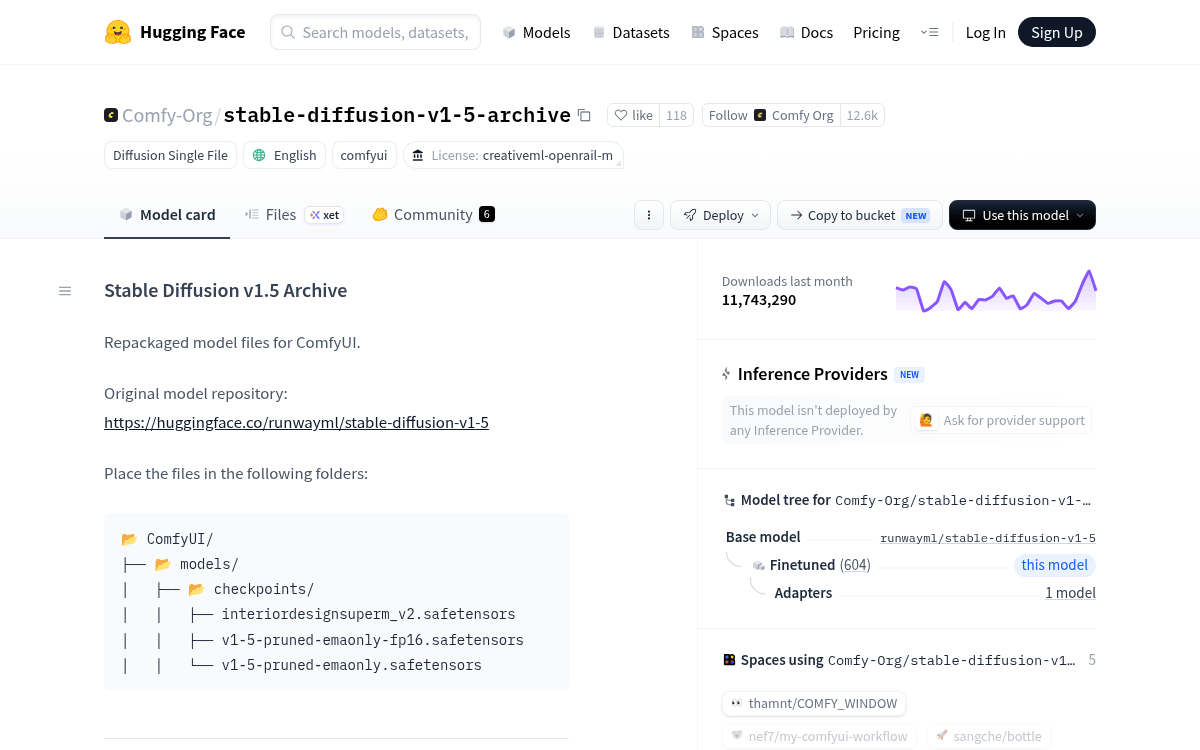
Comfy-Org preserved the original Stable Diffusion v1.5 weights on Hugging Face after RunwayML pulled the repo, keeping a foundational checkpoint alive.
 Pro
Takeaways
- Comfy-Org preserved Stable Diffusion v1.5 after RunwayML pulled the original Hugging Face repo.
- The archive hit 11.7M downloads and 4,261 likes, showing v1.5 still anchors much of the ecosystem.
- Ships hash-identical original weights plus a 2.13 GB FP16 variant with added metadata.
- Works out of the box with ComfyUI, Diffusers, Automatic1111, SD.Next, and InvokeAI.
- Still useful for legacy LoRAs, low-VRAM deployment, teaching, and reproducing benchmarks.
- Highlights how fragile open-weights supply chains are when one org delists a foundational checkpoint.
One of the most downloaded image models in open source history nearly vanished from public infrastructure. When RunwayML quietly delisted its Hugging Face repository for Stable Diffusion v1.5, a large chunk of the generative image ecosystem broke: tutorials pointed to a dead URL, ComfyUI starter workflows failed to load, and thousands of fine-tunes lost their canonical base. The Comfy-Org archive is the fix that emerged, and it has now crossed 11.7 million downloads with more than 4,200 likes.
A byte-for-byte rescue
The archive is a re-upload of Stable Diffusion v1.5, maintained by Comfy-Org, preserving the original 2022 weights from RunwayML after the source repository was taken down. The maintainers treated this as true preservation rather than re-derivation. The v1-5-pruned-emaonly.safetensors file is hash-identical to the checkpoint RunwayML originally published, and v1-5-pruned-emaonly-fp16.safetensors is that same model converted to FP16 with a metadata header added.
That distinction matters. If you are reproducing a paper, verifying a fine-tune, or auditing a downstream LoRA, you can point at a SHA-256 that matches the original release. If you just want to run inference on a smaller checkpoint, the FP16 variant weighs in at 2.13 GB and drops straight into modern workflows.
How to plug it in
The repo is set up for ComfyUI first, though the safetensors files work with any SD1.5-compatible runner. Drop the checkpoint into the standard folder:
ComfyUI/
  models/
    checkpoints/
      v1-5-pruned-emaonly-fp16.safetensors
After moving the file into ComfyUI/models/checkpoints/, refresh the node definitions and press run to execute the workflow. The same file loads in Diffusers, Automatic1111, SD.Next, and InvokeAI without modification, since it uses the original v1.5 architecture and CLIP text encoder.
What the model actually is
For anyone who has only worked with SDXL or SD3, a quick refresher on v1.5 helps. It is a latent text-to-image diffusion model that generates images from text prompts at 512x512 resolution using CLIP text encoding for guidance, fine-tuned for 595k steps on the laion-aesthetics v2 5+ dataset with 10% text-conditioning dropout to improve classifier-free guidance sampling. Classifier-free guidance is the trick where the model is occasionally trained without the text prompt so that, at inference time, you can push generations more strongly toward the prompt by extrapolating away from the unconditional prediction.
The licensing is unchanged: the checkpoint ships under the CreativeML OpenRAIL-M license, and the base_model chain in the model card traces back to CompVis Stable Diffusion v1.4.
Where it still earns its keep
Nobody is claiming this is state of the art. The model is from 2022 and sits several major generational upgrades behind current releases, preserved here for legacy testing and accessibility. The realistic use cases today are narrower than they were three years ago:
- Running the massive v1.5 fine-tune ecosystem, including thousands of LoRAs, ControlNets, and community checkpoints that assume this exact base.
- Low-VRAM and edge deployment, where a 2 GB FP16 UNet fits on hardware that cannot host SDXL or Flux.
- Reproducing academic results from papers that benchmark against v1.5 weights.
- Teaching and workflow tutorials, where the model is small enough to iterate on quickly.
- Regression testing for diffusion tooling that needs a stable, known-good checkpoint.
Its weaknesses are roughly everything current models are good at: prompt adherence on complex scenes, readable text in images, hands and anatomy, higher native resolutions, and photorealism at the level of SDXL or newer transformer-based diffusion models. For security patches and quality improvements, the model card recommends moving to Stable Diffusion 3.5.
Why the archive matters beyond nostalgia
The real story here is less about the model and more about supply-chain fragility in open weights. A single organization pulling a repo can silently break a huge fraction of the ecosystem downstream, because v1.5 is wired into Diffusers, the deprecated RunwayML GitHub repository, ComfyUI, Automatic1111, SD.Next, and InvokeAI. A hash-identical preserved checkpoint means every LoRA and ControlNet trained against those exact weights still resolves correctly.
The Comfy-Org maintainers have effectively taken on the role of long-term custodian for a piece of infrastructure that most of the community assumed would always be there. Download counts suggest they were right to bother: even in a world of newer, better models, over eleven million pulls says v1.5 is still doing real work.