
Comfy-Org Bundles FLUX.2 Klein 9B so Anyone Can Run It Locally
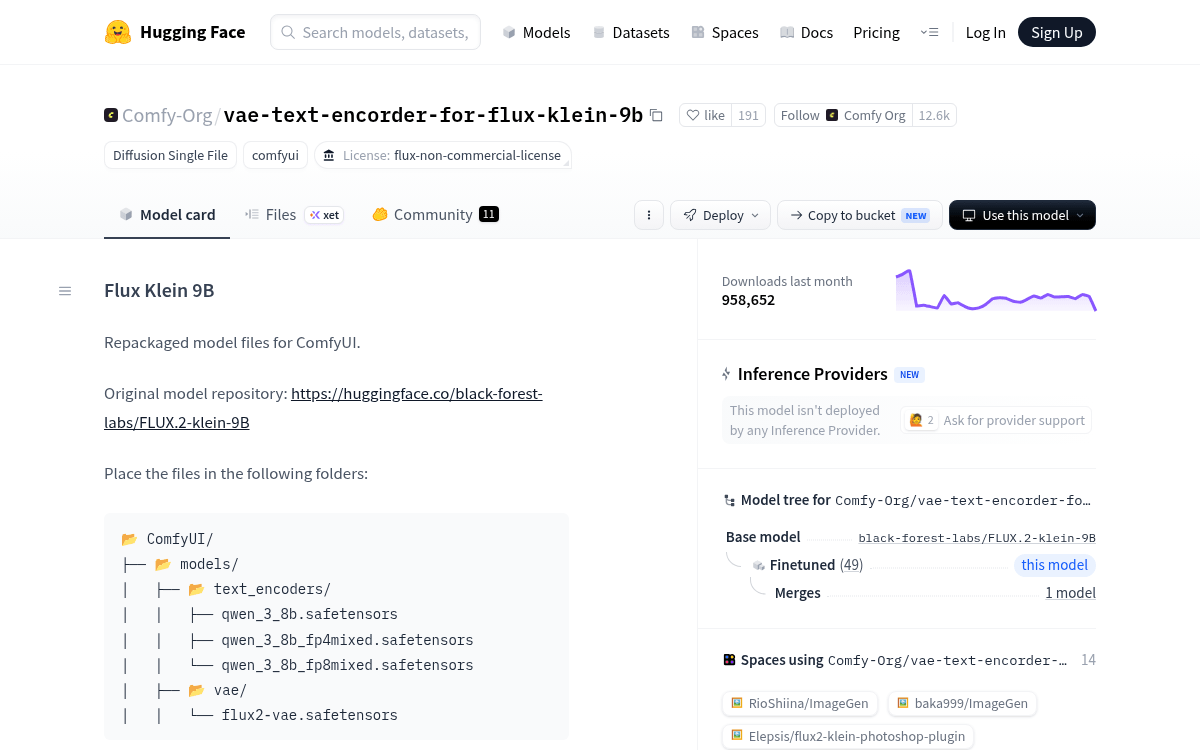
Comfy-Org bundled the FLUX.2 Klein 9B VAE and Qwen3-8B text encoder in FP4, FP8, and full precision so ComfyUI users can run it locally without hunting for parts.
 Pro
Takeaways
- Comfy-Org published a repackaged bundle of the VAE and Qwen3-8B text encoder for FLUX.2 Klein 9B
- Includes FP4, FP8, and full-precision Qwen3-8B encoder variants for different VRAM budgets
- Files drop directly into ComfyUI's expected folders and match the official Klein workflows
- Base FLUX.2 Klein 9B needs ~29GB VRAM at full precision, RTX 4090 or higher
- FP4 mixed quantization brings inference within reach of 16GB consumer GPUs
- Nearly 1M downloads make it the de facto local install path for Klein 9B
Running a modern flow transformer image model locally is rarely a single-download affair. You need the diffusion weights, a matching VAE, and usually a large language model acting as the text encoder, all placed in the correct folders with the correct filenames. The Comfy-Org repository on Hugging Face collapses that scavenger hunt for FLUX.2 Klein 9B into one bundle, and the community has already pulled it down nearly a million times.
What actually shipped
The repo is a repackaging job by the ComfyUI team, containing the auxiliary weights you need alongside the main FLUX.2 Klein 9B diffusion checkpoint from Black Forest Labs. The bundle includes:
flux2-vae.safetensors, the variational autoencoder that translates between latent space and pixel spaceqwen_3_8b.safetensors, the full-precision text encoderqwen_3_8b_fp8mixed.safetensors, a mixed FP8 quantizationqwen_3_8b_fp4mixed.safetensors, a mixed FP4 quantization for tighter VRAM budgets
Each file drops into a specific ComfyUI subdirectory. The text encoders belong in ComfyUI/models/text_encoders/ and the VAE goes in ComfyUI/models/vae/, alongside your chosen FLUX.2 Klein diffusion weights in diffusion_models/.
Why the encoder is the story
FLUX.2 Klein 9B has an unusual architecture for a small image model. It pairs a 9B flow model with an 8B Qwen3 text embedder and distills inference to four steps for sub-half-second latency. That Qwen3 encoder is roughly the size of a mid-tier standalone LLM, and its LLM-class capacity brings substantially better prompt understanding than smaller CLIP-based encoders, which is the primary reason Klein 9B handles complex, multi-clause prompts more accurately than competing small models.
The catch is VRAM. FLUX.2 Klein 9B occupies roughly 29GB at full precision and is accessible on RTX 4090 and above, which puts the vanilla configuration out of reach for most consumer setups once you add the 8B encoder on top. Comfy-Org's pre-quantized FP8 and FP4 encoder variants directly address this. Quantizing an 8B text model from BF16 down to FP4 is not trivial to do correctly on your own, and shipping known-good versions saves a lot of debugging.
Wiring it up in ComfyUI
Once the files are in place, ComfyUI can load a standard text-to-image graph: a Load Diffusion Model node for the FLUX.2 Klein checkpoint, a text encoder loader pointing at one of the Qwen3 files, a VAE loader for flux2-vae.safetensors, and a KSampler configured for the distilled model's short schedule. The distilled models perform best at exactly 4 steps with a CFG scale around 1.0 to 1.5. Anything higher breaks the image math.
The official ComfyUI Klein guide ships downloadable workflows for text-to-image, single-reference editing, and multi-reference generation that reference exactly these filenames. If you also want to run the 4B variant, that has its own separate text encoder file (qwen_3_4b.safetensors) but reuses the same flux2-vae.safetensors.
Picking a quantization
The three encoder files exist so you can trade VRAM for fidelity. Benchmarks from the wider FLUX.2 family give a useful reference point: quantized FP8 and NVFP4 variants, built with NVIDIA, provide up to 1.6 times speedup with about 40 percent VRAM reduction for FP8, and up to 2.7 times speedup with about 55 percent VRAM reduction for NVFP4 on RTX GPUs. Similar tradeoffs apply to the encoder.
- Full
qwen_3_8b.safetensors: best prompt fidelity, largest footprint. Use if you have headroom on a 48GB card. - FP8 mixed: near-lossless for most prompts, comfortable on 24GB GPUs alongside an FP8 diffusion checkpoint.
- FP4 mixed: the option that gets Klein 9B running on 16GB cards, at some cost to how well it parses very long or nested prompts.
The license fine print
Because this is a straight repackaging, it inherits the upstream terms. The repo is tagged with a flux-non-commercial-license, matching Black Forest Labs' distribution terms for the Klein weights. Research, personal projects, and internal experimentation are fine, but you cannot ship a commercial product on these exact weights without a separate agreement with BFL.
Afternoon of setup, or five-minute download
None of these files are algorithmically new. The value is logistical: a single Hugging Face repo that gives you three pre-quantized versions of an 8B text encoder plus the correct VAE, all named exactly the way ComfyUI's official workflows expect. The near-million download count on the repo suggests most people running FLUX.2 Klein 9B in ComfyUI are going through this bundle rather than assembling the pieces themselves, and it has become the de facto path for local inference on the model.