
Cognitive Computations' Dolphin 2.9.1 Drops Refusals With 4.6M Downloads
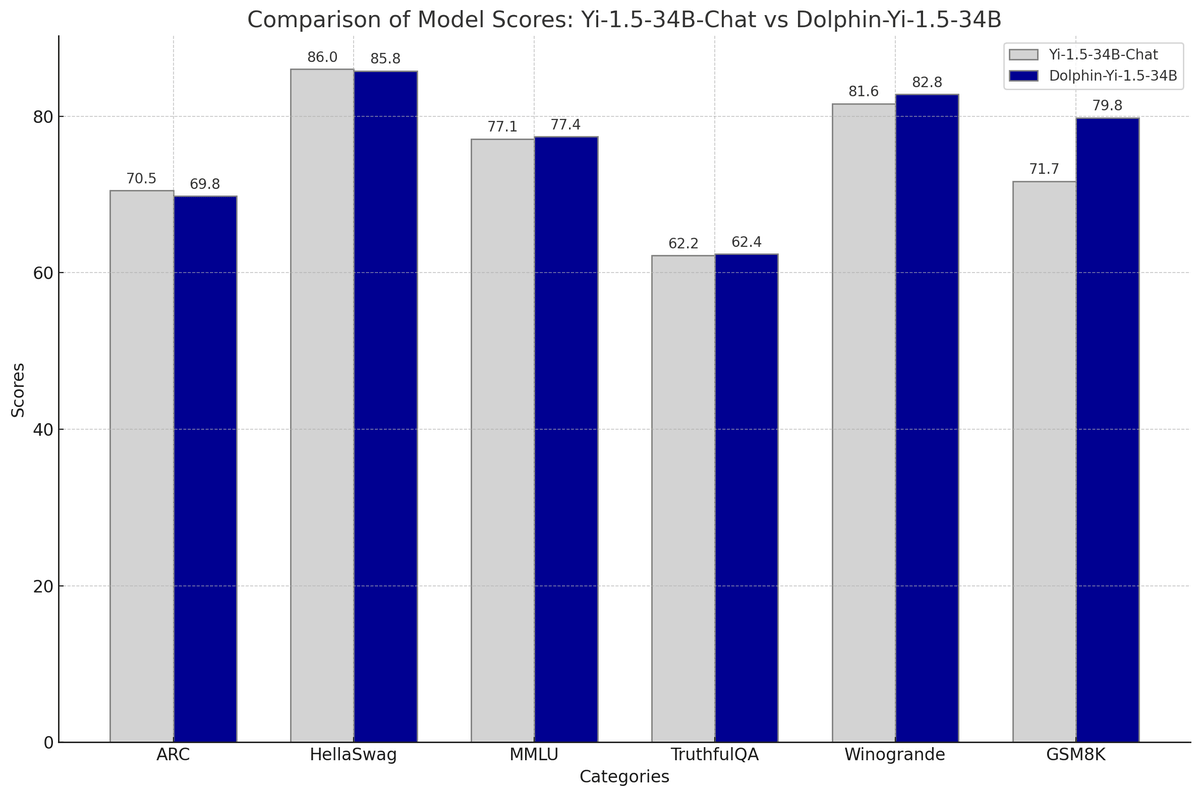
Cognitive Computations shipped a full-weight, uncensored fine-tune of Yi-1.5-34B that hits 77.4 MMLU with 8K context and ChatML formatting.
 Pro
Takeaways
- Full-weight 16-bit fine-tune of Yi-1.5-34B hits 77.4 MMLU with Apache 2.0 license
- Uncensored by design, with alignment expected to be added by the deployer
- ChatML prompt format, 8K context via rope theta 1,000,000, function calling support
- Trained on 8xH100 with Axolotl, DeepSpeed ZeRO-3, 3 epochs at LR 1e-5
- Over 4.6M Hugging Face downloads and multiple community GGUF and abliterated variants
- Available on Hugging Face, runnable via vLLM, SGLang, transformers, and Ollama
Cognitive Computations released Dolphin 2.9.1 Yi 1.5 34B, a full parameter fine-tune of 01-ai/Yi-1.5-34B that the team calls their strongest result to date. Curated and trained by Eric Hartford, Lucas Atkins, Fernando Fernandes, and Cognitive Computations, the checkpoint is a full 16bit fine-tune across all parameters and scores 77.4 on MMLU. It has accumulated over 4.6 million downloads on Hugging Face, making it one of the most pulled 34B fine-tunes in the open weights ecosystem.
What it is and how to run it
Dolphin is a text generation LLM built on the Llama architecture through Yi-1.5, released under Apache 2.0. The base carries a 4K context, but the team used a rope theta of 1,000,000 and full-weight fine-tuning at 8K sequence length. It works with the standard transformers pipeline, vLLM, SGLang, and Docker Model Runner, plus community GGUF quantizations for llama.cpp, Ollama, and LM Studio.
Prompting uses ChatML. A minimal vLLM launch looks like this:
pip install vllm
vllm serve "dphn/dolphin-2.9.1-yi-1.5-34b"
The uncensored trade-off
The headline feature is behavioral. Dolphin is uncensored: the team filtered the dataset to remove alignment and bias, which makes the model more compliant, and they advise implementing your own alignment layer before exposing it as a service since it will follow any request, including unethical ones. The posture is deliberate. Builders get a base that responds without the refusal patterns baked into most instruction-tuned models, with safety enforcement pushed to the application layer.
What it is good at
Dolphin covers instruction following, conversation, coding, and early agentic behaviors with function calling support. Reported benchmarks put it in a competitive spot for a 34B open model:
- MMLU: 77.5, HellaSwag: 85.5, ARC: 69.4, GSM8K: 73
- Roughly 69.2GB VRAM at native precision with 8K context
- Final training loss of 0.4425 after 3 epochs
How it was trained
The recipe is documented in the model card. Training ran on Axolotl 0.4.0 across an 8xH100 node from Crusoe Cloud, using DeepSpeed ZeRO-3 in bf16, flash attention, and sample packing. Key hyperparameters:
- Learning rate 1e-5, cosine schedule, 10 warmup steps
- AdamW 8-bit optimizer, weight decay 0.05
- Micro batch size 1, gradient accumulation 8, total batch size 64
- 3 epochs at 8192 sequence length
The data mix draws from instruction, code, math, agentic, and conversational sources including OpenHermes-2.5, Orca Math, m-a-p CodeFeedback, Samantha, ToolBench, and Agent-FLAN. Some of that data was generated from GPT-4, which shapes both the response style and the licensing footprint for downstream users.
Where it fits
The practical niche is builders who want a mid-sized open model that follows instructions without refusal patterns, and who plan to add their own guardrails. Common use cases:
- Local assistant and chat deployments where hosted APIs are off the table
- Coding help and multi-turn conversation on a single H100 or dual 48GB GPUs after quantization
- Agent prototypes that need function calling and tool use without hitting compliance refusals during evaluation
- Downstream fine-tuning targets, evidenced by community abliterated variants such as Dolphin-Yi-34B-Heretic that further reduce refusal behavior through targeted weight modification
The catch
Uncensored behavior means the model will comply with harmful prompts unless you filter inputs and outputs yourself. Dolphin is also a mid-2024 vintage Yi-1.5 checkpoint, so it lags newer 30B-class releases on reasoning and long context, and the 8K window is small compared to the 32K variant the team shipped afterward as Dolphin 2.9.3. Memory is the other gate: at bf16 you need roughly 70GB of VRAM, and even Q4 quants push a single 24GB card to its limit. For teams who want a permissive, instruction-tuned Yi checkpoint they can bend to their own alignment policy, those trade-offs are the point.