
CLASSLA's Croatian Speech Model Quietly Hit 971K Downloads Powering Dubbing Tools
A Croatian speech-to-text model quietly crossed 970k downloads, powered by 300 hours of parliamentary audio and a clever bootstrapping trick.
 Pro
Takeaways
- CLASSLA's Croatian ASR model on Hugging Face has crossed 970k downloads, powering 100+ Spaces
- Built by fine-tuning wav2vec2-xls-r-300m on 300 hours of parliamentary speech
- Achieves 7.61% WER and 2.34% CER on the ParlaSpeech-HR test set
- Training data was bootstrapped from Croatian parliament YouTube plus ParlaMint transcripts, 1,816 hours total
- Widely used inside SoniTranslate and other video dubbing pipelines for Croatian audio
- Successor project ParlaSpeech 3.0 now covers Croatian, Czech, Polish, and Serbian
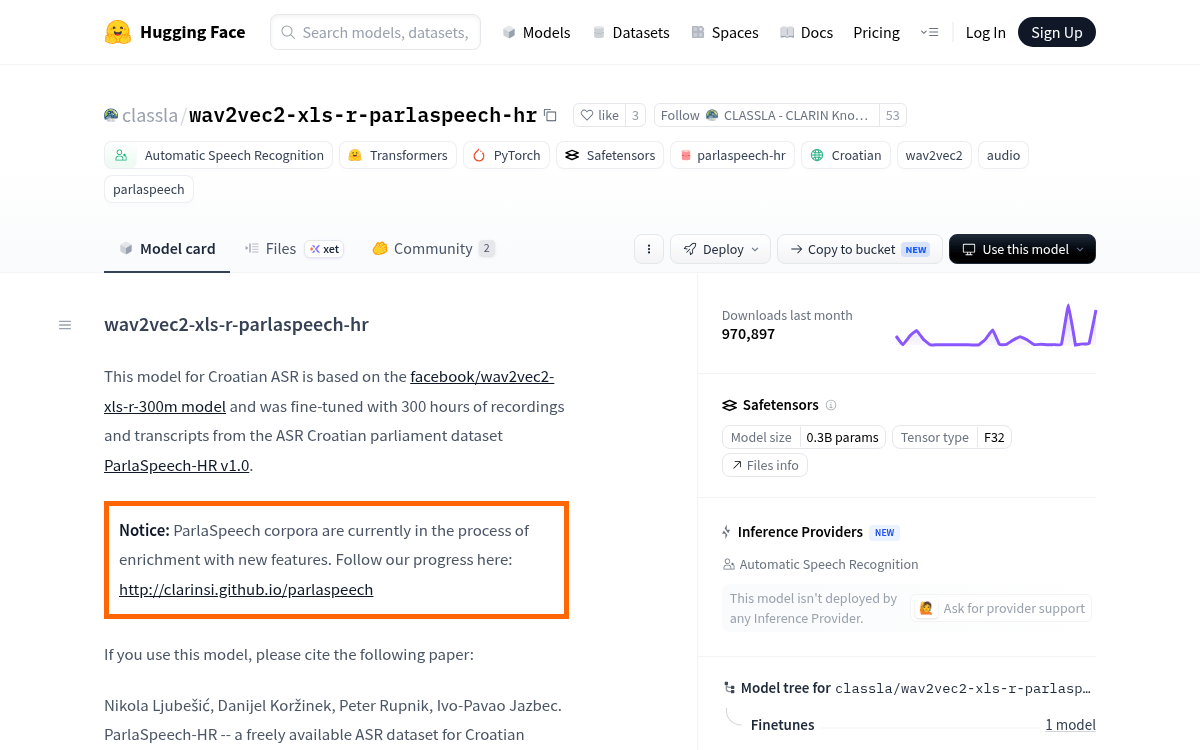
A Croatian automatic speech recognition model has quietly become one of the most-downloaded specialist ASR checkpoints on Hugging Face, racking up nearly 971,000 downloads. The wav2vec2-xls-r-parlaspeech-hr checkpoint from CLASSLA, the CLARIN Knowledge Centre for South Slavic Languages, is a fine-tune of Meta's multilingual wav2vec2 on hundreds of hours of Croatian parliamentary speech. Croatian has long been under-resourced for speech tech, and this model now sits behind a surprising number of video dubbing and translation pipelines.
What the model actually is
The checkpoint builds on facebook/wav2vec2-xls-r-300m, fine-tuned with 300 hours of recordings and transcripts from the ParlaSpeech-HR v1.0 dataset. The base is a 300M-parameter cross-lingual speech encoder pretrained on unlabeled audio from 128 languages. Adding a CTC head and fine-tuning on Croatian parliamentary audio turns it into a straightforward speech-to-text system.
Held-out numbers are respectable for a language with limited public ASR resources:
- Dev set: 3.35% character error rate, 10.46% word error rate
- Test set: 2.34% CER, 7.61% WER
Training was unremarkable in a good way, which makes it easy to reproduce: batch size 16, gradient accumulation of 4, 8 epochs, learning rate 3e-4, and 500 warmup steps.
Two lines to try it
Because it ships as a standard Wav2Vec2ForCTC checkpoint, it drops into the Transformers pipeline API without ceremony:
from transformers import pipeline
pipe = pipeline("automatic-speech-recognition",
                model="classla/wav2vec2-xls-r-parlaspeech-hr")
print(pipe("clip.wav"))
The model card also shows a manual path using Wav2Vec2Processor if you want direct control over logits and decoding. There is no hosted inference endpoint at the moment, so you run it yourself. The weights are Apache-flavored open, and the underlying dataset is licensed under Creative Commons Attribution-ShareAlike 4.0, meaning commercial use is fine if you attribute and share alike.
Bootstrapping a corpus out of parliament
The real story here is how the training data was built. Croatian had almost no aligned speech corpora, so the CLASSLA team used what does exist in abundance: parliamentary recordings on YouTube plus official transcripts. The accompanying paper describes producing the first large freely available Croatian ASR dataset, 1,816 hours in size, from parliamentary transcripts and recordings in the ParlaMint corpus.
The approach leans on a commercial ASR system for the initial rough alignment, then trains a multilingual transformer on that noisy output to re-align the full corpus more accurately. Use an off-the-shelf recognizer to stitch words to timestamps, train a small model on the messy result, then let the new model clean up its own training data on a second pass.
Two useful findings fell out of the process. Fine-tuning on normalized versus original transcripts made no measurable difference. Models pre-trained on a Slavic-only subset of raw speech outperformed those pre-trained on a wider set of languages, a small but useful signal for anyone building ASR for a specific language family: narrower multilingual pretraining can beat broader coverage.
Where it is actually being used
The 970k download figure is not academic curiosity. The checkpoint currently powers 100+ Hugging Face Spaces, most of them variants of SoniTranslate and other video dubbing tools that need to transcribe Croatian audio before translating or resynthesizing it. Practical fits include:
- Video subtitling and dubbing pipelines that support Croatian as a source language
- Meeting or interview transcription for Croatian-language content
- Preprocessing for downstream NLP on spoken Croatian, such as topic modeling or search
- Bootstrapping ASR for related South Slavic languages via further fine-tuning
The obvious weakness is domain. Training data was entirely formal parliamentary speech, so casual conversation, heavy dialect, noisy environments, and overlapping speakers all sit outside its comfort zone. For best-in-class quality on the same benchmark, the CLASSLA team points to wav2vec2-large-slavic-parlaspeech-hr-lm, which currently wins on CER and WER at the cost of a bigger footprint and an added language model.
What comes next
The ParlaSpeech corpus has kept growing. A v2.0 release is already out, and a ParlaSpeech 3.0 paper extends the recipe to Croatian, Czech, Polish, and Serbian, with richer annotations for filled pauses and primary stress. The wav2vec2-xls-r-parlaspeech-hr model itself is a stable v1 artifact, but the broader project is a template worth watching for anyone trying to build serious speech tech in a language where nobody has bothered to collect a proper dataset yet.