
CIDAS's CLIPSeg Hits 1.1M Monthly Downloads by Segmenting Images From Plain Text
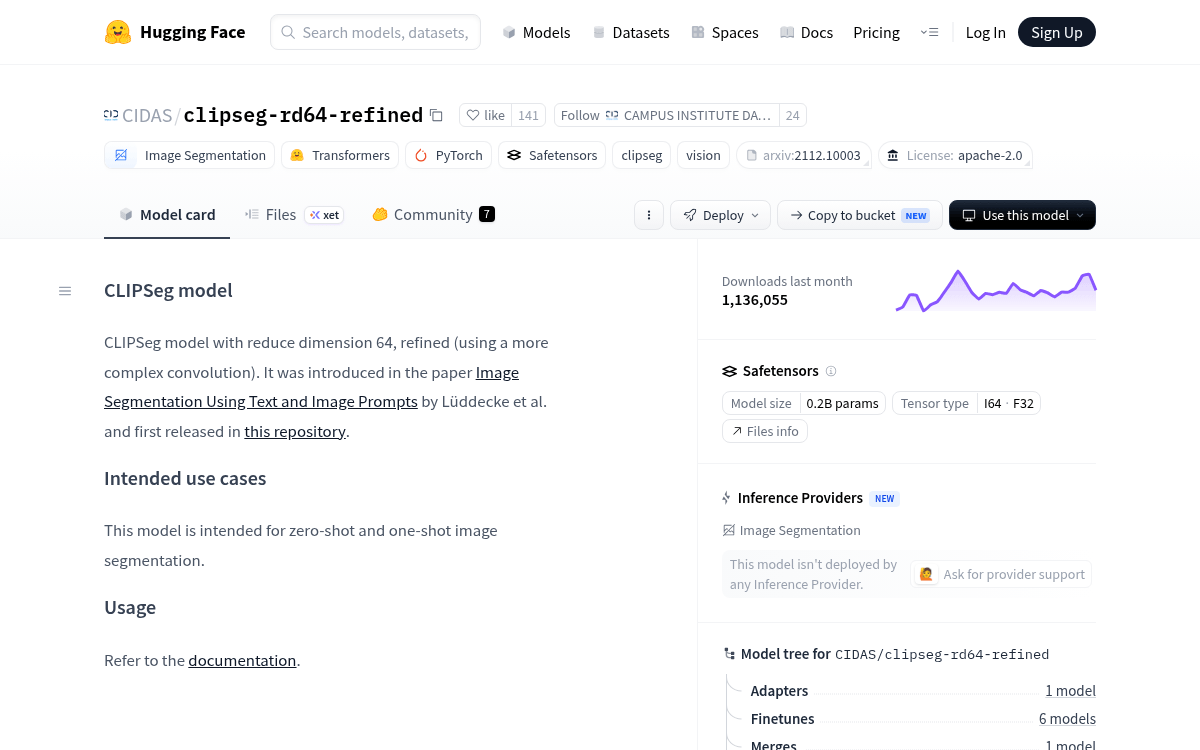
CLIPSeg turns natural language prompts into segmentation masks with a frozen CLIP backbone and a tiny decoder, no per-class training required.
 Pro
Takeaways
- CLIPSeg on Hugging Face passed 1.1M monthly downloads for text-prompted image segmentation.
- Frozen CLIP backbone plus a thin transformer decoder handles zero-shot and one-shot segmentation from text or image prompts.
- The
rd64-refinedvariant uses a more complex decoder convolution for sharper mask boundaries at 200M parameters. - Apache 2.0 licensed and integrated directly into Hugging Face Transformers since November 2022.
- Introduced in the CVPR 2022 paper by Lüddecke and Ecker at Göttingen’s CIDAS.
- Commonly paired with SAM as a text-to-mask proposal generator for inpainting, labeling, and open-vocabulary segmentation pipelines.
A four-year-old segmentation model just crossed 1.1 million monthly downloads on Hugging Face, and it is worth understanding why. CLIPSeg, released by the Campus Institute Data Science (CIDAS) in Göttingen, remains one of the simplest ways to get a segmentation mask out of an image using nothing but a text prompt. No fine-tuning, no bounding boxes, no class list to define up front.
Text in, mask out
The core idea from the underlying CVPR 2022 paper is deceptively small. The authors take a pre-trained CLIP model as a frozen backbone and train a thin conditional segmentation decoder on top, using CLIP's joint text-visual embedding space for conditioning. That lets the model accept either a text phrase or an example image as the query. Because CLIP already knows how to relate arbitrary phrases to visual concepts, the decoder only has to learn how to translate those internal activations into a pixel-level mask.
CLIPSeg targets three tasks in a single architecture: referring expression segmentation, zero-shot segmentation, and one-shot segmentation. That flexibility is why the model keeps showing up as a building block inside text-based inpainting demos, panoptic Segment Anything pipelines, and visual ChatGPT-style agents.
How the refined variant differs
The specific checkpoint trending here is clipseg-rd64-refined, a CLIPSeg model with reduce dimension 64 and a more complex convolution in the decoder, which yields sharper mask boundaries than the base rd64 weights. It weighs in at roughly 200M parameters and ships under Apache 2.0, so it drops into commercial projects without licensing headaches.
Usage through the Transformers library takes about two lines:
from transformers import AutoProcessor, CLIPSegForImageSegmentation
processor = AutoProcessor.from_pretrained("CIDAS/clipseg-rd64-refined")
model = CLIPSegForImageSegmentation.from_pretrained(
    "CIDAS/clipseg-rd64-refined", device_map="auto"
)
inputs = processor(
    text=["a cat", "the remote control"],
    images=[image, image],
    return_tensors="pt", padding=True,
)
logits = model(**inputs).logits  # one heatmap per prompt
You get back a per-pixel logit map for every prompt you pass in, which you can threshold, upsample, or feed into a downstream model.
What it is actually good at
CLIPSeg trades peak accuracy for reach. The authors report competitive performance across the three low-shot segmentation tasks, and the model generalizes to classes and expressions it has never seen a mask for. In practice that translates to a few concrete strengths:
- Segmenting open-vocabulary concepts like "the person on the left" or "the reflective surface" without retraining.
- Producing coarse masks fast enough to sit in front of a heavier model like SAM as a prompt generator.
- Accepting either a text description or a reference image and mask as the query.
- Running comfortably on a single consumer GPU because the CLIP backbone stays frozen.
Where it struggles is fine-grained boundaries, small objects, and cluttered scenes with multiple similar instances. The masks are lower resolution than what dedicated segmentation heads like Mask2Former or SAM produce, and it does not separate instances of the same class. For pixel-perfect edges or instance IDs, CLIPSeg is a first pass rather than the final answer.
Why it still wins downloads in 2026
The interesting question is why a pre-SAM, pre-Grounding-DINO model still pulls seven-figure download numbers. A few reasons stand out:
- It is tiny and cheap. 200M parameters, no prompt encoder tricks, no billion-mask training set to reproduce.
- Text prompts are first-class. Segment Anything needs points or boxes; CLIPSeg accepts free-form language directly.
- It composes well. The panoptic Segment Anything space and text-based inpainting demos use CLIPSeg to turn a phrase into a rough mask, then hand off to SAM for refinement.
- It is genuinely zero-shot. You can build a segmentation pipeline for a novel class from an arbitrary text query or a reference image with a highlight mask, with no additional training.
Where teams actually reach for it
Teams pull CLIPSeg off the shelf in a handful of recurring situations: text-driven image editing and inpainting, quick dataset labeling where you want a first-pass mask for a novel class, e-commerce workflows that need to isolate a product from its background, content moderation heatmaps, and lightweight proposal generation for larger segmentation systems. The original repository from Timo Lüddecke ships a Quickstart notebook that walks through both the text-prompt and image-prompt paths.
The broader lesson from CLIPSeg's staying power is that a small, task-specific head bolted onto a frozen foundation model can remain relevant for years after release, especially when the interface is as intuitive as "describe what you want segmented." Using CLIP-style embeddings as a semantic bridge into a downstream dense prediction task is now standard practice, and CLIPSeg is one of the cleanest reference implementations you can pip install today.