
Cardiff NLP's XLM-T Beats Per-Language Sentiment Models With One 1.1GB Checkpoint
A multilingual sentiment classifier trained on 198M tweets across 30+ languages has quietly crossed nearly a million downloads on Hugging Face.
 Pro
Takeaways
- Cardiff NLP's multilingual sentiment model is trending with ~995K monthly downloads on Hugging Face.
- Built on XLM-RoBERTa base, pretrained on ~198M tweets across 30+ languages.
- Fine-tuned on 8 languages (Ar, En, Fr, De, Hi, It, Sp, Pt) with three-class output.
- Considered state of the art among multilingual Twitter-specific sentiment models per follow-up benchmarks.
- Ships as a Hugging Face
pipelineand is integrated into the TweetNLP library. - Details in the XLM-T paper and the xlm-t GitHub repo.
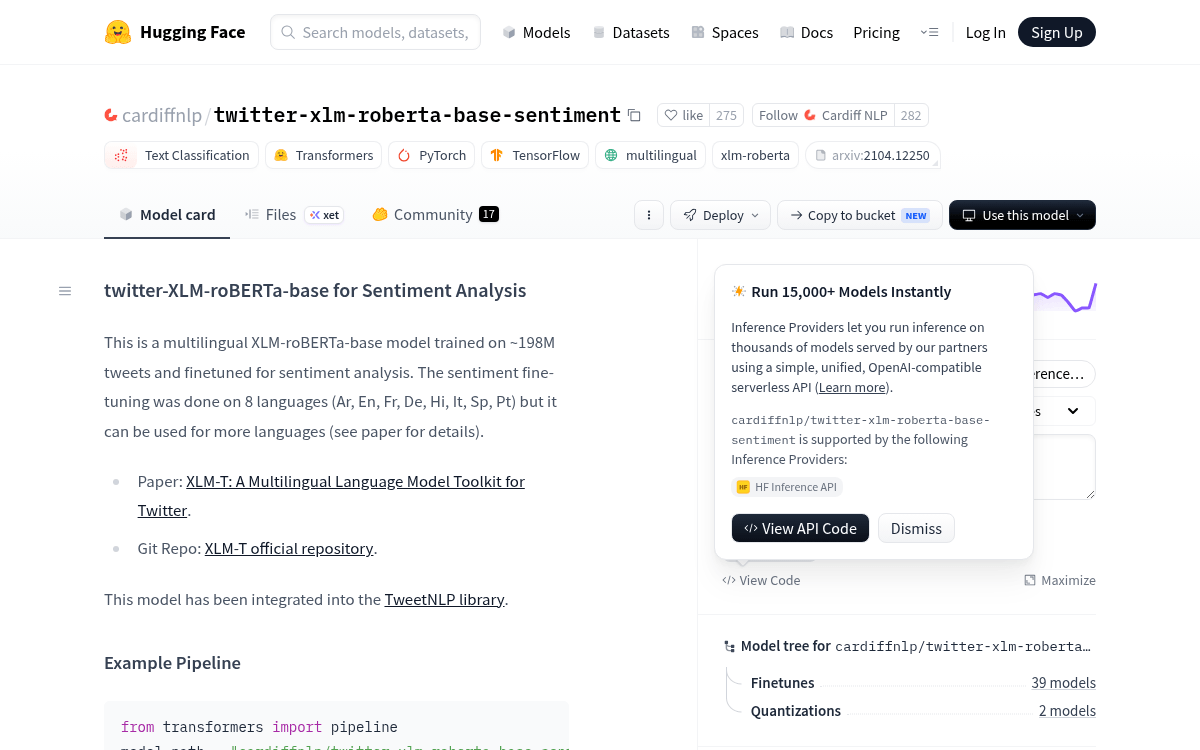
Sentiment analysis looks solved in English and stays painful in almost every other language. Cardiff NLP's twitter-xlm-roberta-base-sentiment model has become one of the go-to open-source answers to that gap, sitting at roughly 995K monthly downloads and 275 likes on the Hub. It is a compact three-class classifier that ships as a drop-in Transformers pipeline and handles social media text across dozens of languages.
What you're actually loading
The checkpoint is a multilingual XLM-roBERTa-base model pretrained on around 198M tweets and finetuned for sentiment analysis on eight languages: Arabic, English, French, German, Hindi, Italian, Spanish, and Portuguese. Thanks to the multilingual backbone, it generalizes reasonably to languages outside that set. The underlying architecture is XLM-R base, so roughly 270M parameters and a 1.11 GB PyTorch checkpoint.
The recipe comes from the XLM-T paper, which introduces a Twitter-specific multilingual LM built on XLM-R checkpoints and reports baseline results across settings including zero-shot. The authors also release starter code for analyzing, fine-tuning, and evaluating existing models, plus a unified evaluation suite in eight languages called the Unified Multilingual Sentiment Analysis Benchmark (UMSAB).
Five lines to a prediction
The model plugs straight into the Hugging Face pipeline API and returns one of three labels: Positive, Neutral, or Negative.
from transformers import pipeline
model_path = "cardiffnlp/twitter-xlm-roberta-base-sentiment"
sentiment_task = pipeline("sentiment-analysis", model=model_path, tokenizer=model_path)
print(sentiment_task("T'estimo!"))
# [{'label': 'Positive', 'score': 0.6600581407546997}]
One detail worth respecting: the model was trained with light preprocessing where usernames become @user and URLs become http. Skipping that step on raw tweets can nudge scores in unhelpful directions. The model card ships a full example that applies this normalization before tokenization.
Where it shines and where it wobbles
The classifier was built for short, noisy, emoji-laden social text, and that is where it holds up best. A follow-up study benchmarking multilingual Twitter models found that XLM-T, while slightly behind monolingual options like TimeLMs or BERTweet, remains the state of the art among multilingual Twitter-specific models. The AfriSenti benchmark tells a similar story for underrepresented languages: among models up to 270M parameters, XLM-T posts the best numbers, which underscores the value of domain-specific pretraining. It performs particularly well on Arabic and Portuguese dialects (arq, ary, and pt-MZ), where it beats AfriBERTa by 21.8, 14.2, and 13.0 F1 points respectively.
The trade-offs are the usual ones:
- English-only monolingual models like BERTweet still edge it out on English benchmarks.
- Training data was tweet-length, so long-form reviews or documents sit out of distribution.
- The label set is fixed at three classes, so aspect-based sentiment or emotion detection needs a different model or a downstream head.
- Larger models such as AfroXLMR-large beat it by a few F1 points on niche language families.
Why it keeps trending
The practical draw is that one 1.1 GB checkpoint replaces a matrix of per-language sentiment models. That maps neatly onto a handful of jobs:
- Social listening and brand monitoring across mixed-language feeds.
- Election, protest, or crisis-signal tracking where posts arrive in many languages at once.
- Content moderation pipelines that need a cheap negative-sentiment prior before routing to a heavier model.
- Bootstrapping labels for a downstream classifier when you have unlabeled multilingual text.
Cardiff NLP has also folded the model into the TweetNLP library, which wraps it alongside emotion, hate speech, and offensive language classifiers under a unified API. For teams that would rather not touch Transformers directly, that is usually the fastest path from install to prediction.
The bigger picture
Cardiff NLP's contribution was less about a novel architecture and more about domain-specific pretraining at scale. Multilingual language models dominate current NLP, but most analyses lean on clean benchmarks and task-specific corpora as their multilingual signal. XLM-T pushes evaluation into the messier reality of Twitter, and years after release, it remains one of the strongest off-the-shelf options for anyone who needs sentiment scores on noisy, multilingual, short-form text without paying per API call.