
Cardiff NLP's Twitter RoBERTa Hits 3.1M Monthly Downloads Crushing Formal Sentiment Models
A RoBERTa model fine-tuned on 124M tweets keeps topping sentiment analysis charts with 3M+ monthly downloads and hundreds of downstream forks.
 Pro
Takeaways
- Cardiff NLP's twitter-roberta-base-sentiment-latest passes 3.1M monthly downloads on Hugging Face.
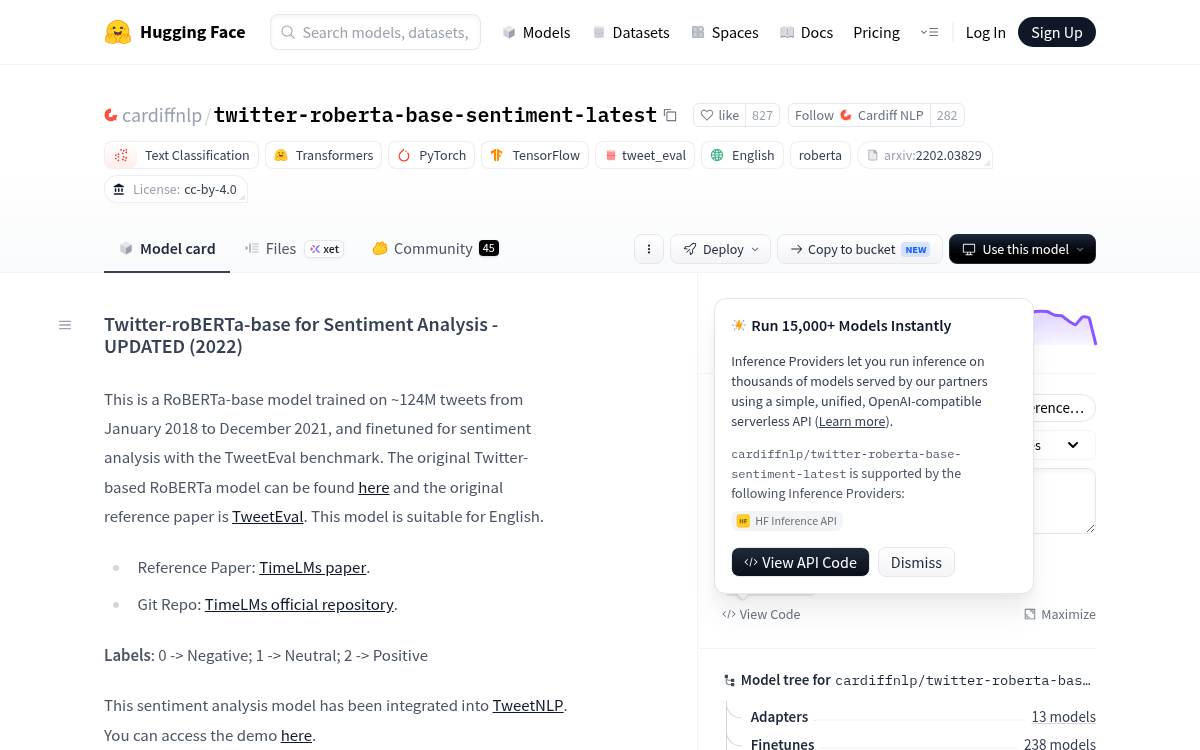
- RoBERTa-base trained on ~124M tweets from Jan 2018 to Dec 2021, fine-tuned on TweetEval.
- Three-class output: Negative, Neutral, Positive, with clean softmax probabilities.
- Part of the TimeLMs project studying language model degradation over time.
- Licensed CC-BY-4.0, ONNX export available, 238 community fine-tunes already published.
- Best for short English social text, weak on long-form, multilingual, or post-2021 slang.
Sentiment analysis looks trivial until you actually deploy it. Formal BERT-style models trained on Wikipedia stumble on hashtags, emojis, sarcasm, and abbreviated slang. That is why cardiffnlp/twitter-roberta-base-sentiment-latest has quietly become one of the most downloaded text classification models on Hugging Face, pulling in over 3.1 million downloads a month and spawning 238 fine-tunes and 13 adapter variants from the community.
A RoBERTa trained where language actually lives
The checkpoint comes from Cardiff NLP's TimeLMs project, which continuously trains language models on social media at regular intervals to study how models degrade and how discourse shifts over time. The sentiment-latest variant takes that base and finishes it off on a labeled classification task.
Under the hood, it is a RoBERTa-base encoder trained on roughly 124 million tweets spanning January 2018 through December 2021, then fine-tuned on the TweetEval benchmark for three-way sentiment classification. Outputs map cleanly to three labels:
0Negative1Neutral2Positive
Why teams still reach for a 125M-parameter encoder
Large language models can do sentiment analysis with a prompt, but that path is slow, expensive, and non-deterministic. A 125M-parameter encoder like this one runs on a single CPU in milliseconds, returns calibrated probabilities across all three classes, and costs nothing to self-host. The license is cc-by-4.0, which permits commercial use with attribution.
It is also purpose-built for the messy conventions of short-form social text. The recommended preprocessing normalizes mentions to @user and URLs to http, matching how the model was trained. That difference is what keeps @elonmusk from being treated as an out-of-vocabulary token instead of a mention slot.
Using it in a few lines
The fastest path is the Transformers pipeline API, which handles tokenization and softmax for you:
from transformers import pipeline
pipe = pipeline("text-classification",
                model="cardiffnlp/twitter-roberta-base-sentiment-latest")
print(pipe("Covid cases are increasing fast!"))
# [{'label': 'Negative', 'score': 0.7236}]
For the full probability distribution instead of a top-1 label, load the model directly and apply softmax to the logits. An ONNX export is also available in the repo weighing about 499 MB, which lets you push inference into browsers, mobile runtimes, or CPU-optimized serving stacks without dragging PyTorch along.
Where it shines, and where it flops
The strengths are narrow and real:
- Short, informal English text: tweets, product reviews, chat messages, Reddit-style comments.
- Emojis, hashtags, and mentions handled natively.
- Cheap enough to run over millions of documents in a batch job.
- Three-class output, so genuinely neutral content does not get forced into positive or negative.
The weaknesses matter too. It is English-only, so multilingual pipelines need a different checkpoint. Its worldview is frozen at late 2021, meaning post-2022 slang, new product names, and recent political figures show up as unfamiliar context. Long-form documents, financial filings, and formal prose sit outside its distribution, and it does not do aspect-based sentiment, so you cannot ask which entity in a sentence is being criticized.
The methodology under the checkpoint
The interesting contribution here is TimeLMs itself. Cardiff NLP released a whole family of quarterly-updated Twitter RoBERTa checkpoints so you can measure how much a model degrades as language drifts, rather than treating every pretrained model as timeless. The TimeLMs paper covers the methodology and benchmark scores, and the TimeLMs repository offers an interface better suited to comparing predictions and perplexity between models trained at different temporal intervals.
That framing has aged well. The idea that language models silently rot as vocabulary and discourse shift is now a mainstream concern in production ML, and having a public family of dated checkpoints to benchmark against remains rare. The sentiment-latest model is the practical output of that line of work.
Practical spots to plug it in
- Brand and campaign monitoring across social feeds.
- Support ticket triage, flagging angry messages for human review.
- Content moderation signals, especially combined with a toxicity classifier.
- Labeling weak-supervision data for training your own domain-specific classifier.
- Feature engineering for recommendation or ranking systems that care about affect.
If your text lives in tweets, chats, or reviews, this remains one of the strongest defaults you can grab off the shelf. If it lives in contracts, medical notes, or 2026 slang, look elsewhere or fine-tune on top.