
Bria's V-RMBG 3.0 Beats Every Video Background Rival at 9x Faster
BRIA's new autoregressive video background removal model targets flicker, halos, and unstable edges while running up to 9x faster than rivals.
 Pro
Takeaways
- New model: Bria launched V-RMBG 3.0, a video background removal model with temporal awareness.
- Architecture: Autoregressive design uses the previous frame's output as context, killing flicker and unstable edges.
- Benchmarks: 63%+ win rate over every major competitor, up to 9x faster, tested on 350+ clips.
- Rivals tested: Open-source MatAnyone 2 plus commercial services Cutout and Veed across six production shot types.
- Deployment: Cloud, BYOC, on-prem, and on-device, with streaming-native frame-by-frame processing.
- Drop-in upgrade: Same API, endpoints, parameters, and pricing as V2; weights and inference code available for self-hosted use.
Background removal has been a solved problem for still images for years. Video is another matter. Anyone who has tried to key out a talking head, a product demo, or a live commerce stream knows the failure modes: shimmering hair edges, halos around shoulders, masks that jitter frame to frame even when the subject is barely moving. Bria is taking a swing at that ceiling with V-RMBG 3.0, a video background removal model built on an architecture that processes footage with an explicit sense of time.
Why frame-by-frame keeps breaking
Most background removers, including many production systems, treat video as a stack of independent images. Run a strong image segmenter on every frame, stitch the alpha mattes back together, call it done. Because each frame is decided in isolation, the mask boundary wobbles slightly with every prediction. That wobble shows up as visible flicker, unstable edges, and halos around fine details like hair, motion blur, and semi-transparent surfaces.
Background removal has become load-bearing infrastructure in professional video pipelines, with the market projected to grow at a 15% CAGR through 2033. Avatar platforms, automated video editors, live recording studios, and live commerce operations all depend on it to ship visual assets at scale. If a pipeline has to route bad frames back to a human for touch-up, it stops being a pipeline.
The autoregressive fix
V-RMBG 3.0's core idea is to give the model memory. Each frame is still processed as an image, but the previous frame's output is fed in as context when generating the next mask. The model learns what the scene looks like over time and stops second-guessing itself between frames, which Bria says produces cleaner edges and stable masks across a full clip.
Two clarifications matter for anyone integrating this. Autoregressive here does not mean batched. And the model is streaming-native, so frames are processed one at a time, same as the previous version. The architectural change is that each frame now sees the last one's mask as prior context, which is what kills the frame-to-frame instability.
The numbers Bria is putting up
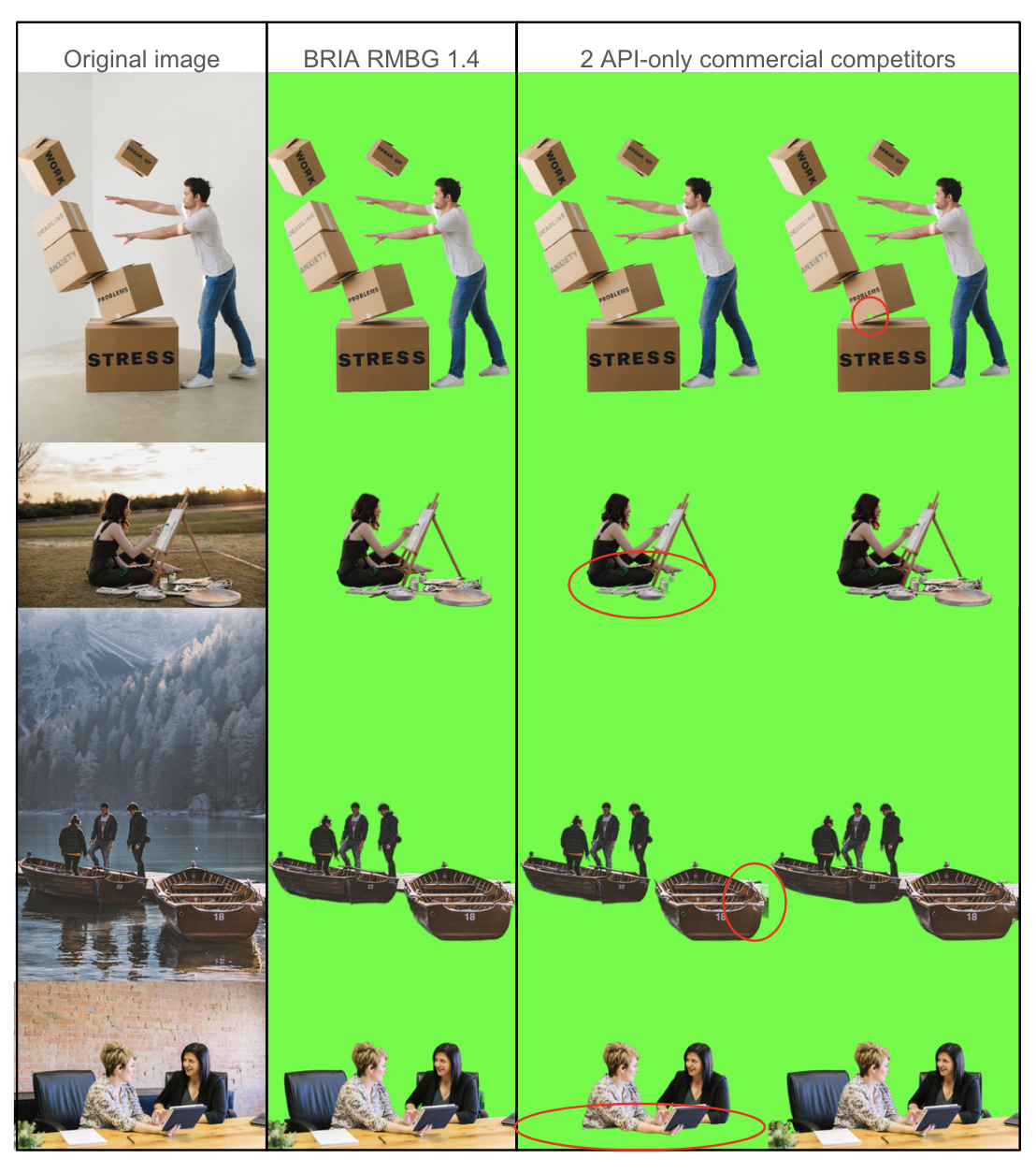
Bria ran V-RMBG 3.0 against both open-source and commercial competitors. In head-to-head benchmarks against every major competitor, V-RMBG 3.0 hit a 63%+ win rate on output quality preference and ran up to 9x faster than every competitor tested. For teams running high-volume or real-time pipelines, that speed gap is the difference between a model that fits the workflow and one that bottlenecks it.
The evaluation set is more grounded than most vendor benchmarks. The model was tested across more than 350 video clips covering the full range of production shot patterns:
- Talking head
- Seated host
- Podcast setup
- Product demo
- Live commerce
- Full-body
Comparisons include the open-source MatAnyone 2 alongside commercial services Cutout and Veed. Those shot types cover where most of the current pain lives for production teams.
What ships with it
A few deployment details are worth calling out for anyone building on top of it:
- Deployment flexibility. The model runs in the cloud, in bring-your-own-cloud setups, on-prem, and on-device. Local execution means no cloud round trip, no data leaving the machine, and no per-second cost for local processing. That opens up latency-bound real-time apps, offline and edge use, and privacy-sensitive content.
- Streaming-native processing. One frame at a time, with previous-frame context as the architectural improvement rather than batching.
- Drop-in upgrade. Same API key, endpoints, parameters, and pricing as V2. Customers on the previous version get the upgrade automatically with no integration work.
- Weights and inference code available. Accessible for self-hosted deployment, internal evaluation, and training-data and runtime audits that closed-source APIs cannot support.
That last point separates this release from the typical closed video API. Running the model locally and auditing its behavior matters in regulated industries where a black-box endpoint is a nonstarter.
Where V-RMBG 3.0 fits in Bria's stack
V-RMBG 3.0 is the video sibling of Bria's image background removal line, which most developers know from the widely used RMBG-1.4 model on Hugging Face and its successor RMBG-2.0. The RMBG family was trained on more than 15,000 high-resolution, manually labeled, fully licensed images balanced across gender, ethnicity, and people with different types of disabilities. RMBG-2.0 was built on the BiRefNet architecture enhanced with a proprietary dataset and training scheme. V-RMBG 3.0 carries that discipline into video, where the harder segmentation problems live.
Bria's positioning also leans on training data provenance. The models are trained on curated datasets spanning stock images, e-commerce, gaming, and advertising content, aimed at cases where content safety, licensed data, and bias mitigation are the deciding factors in procurement. For studios and enterprises worried about downstream IP exposure, that framing lines up with the same reason many production teams reached for RMBG in the first place.
Who should care
If you are shipping any of the following, V-RMBG 3.0 is worth benchmarking against whatever you use today:
- Avatar or virtual presenter platforms where flicker on hair and shoulders breaks the illusion
- Automated video editors that composite subjects onto new backgrounds without a human in the loop
- Live commerce and live recording studios where real-time throughput matters more than perfect single-frame masks
- On-device or offline video processing where cloud round trips are a nonstarter, either for latency or privacy reasons
The pitch is straightforward: a video background remover that treats time as a first-class signal, ships with weights so you can host it yourself, and lands as a drop-in for teams already on Bria's video background removal endpoints. If temporal stability has been the visible ceiling on your compositing pipeline, this release argues that ceiling should move.