
Black Forest Labs' FLUX.1-dev Now Runs on 8GB GPUs Thanks to GGUF
A community-made GGUF conversion of FLUX.1-dev shrinks the 12B parameter image model down to 4GB, opening it up to consumer GPUs through ComfyUI.
 Pro
Takeaways
- FLUX.1-dev-gguf packs Black Forest Labs' 12B image model into 4GB to 24GB quantizations.
- Runs through the ComfyUI-GGUF custom node, loaded from the standard unet folder.
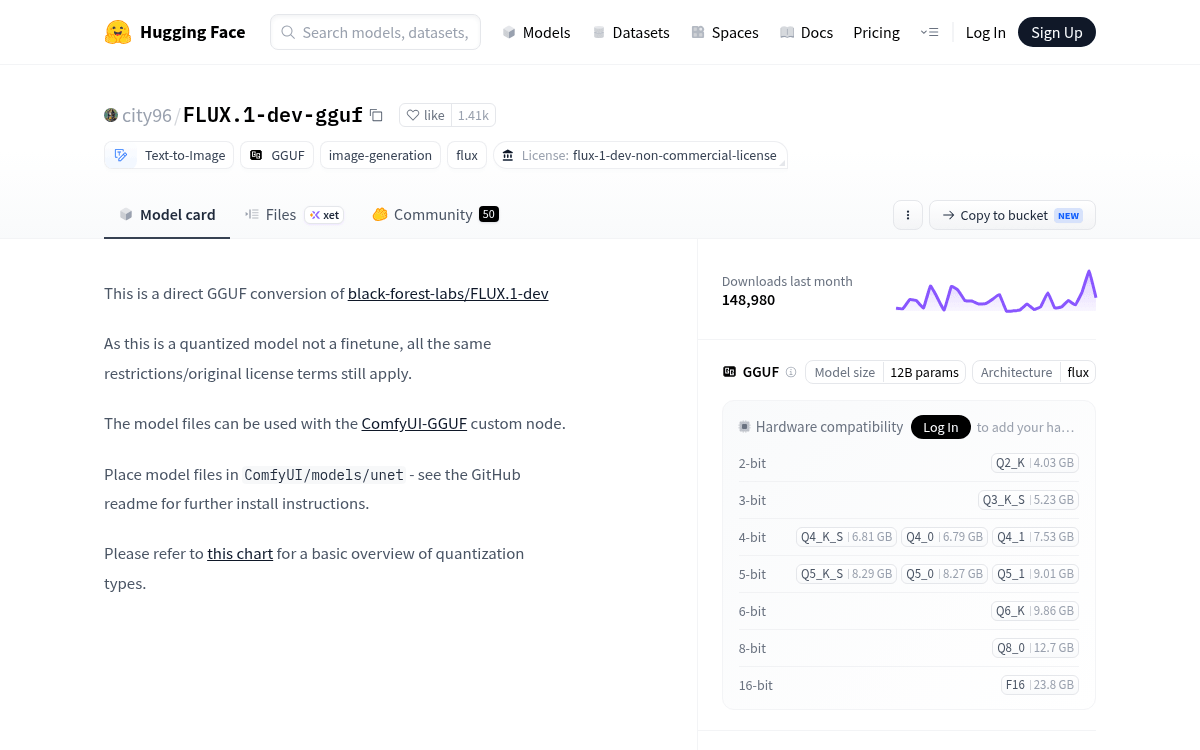
- Repository has 148,980 downloads and 1,409 likes on Hugging Face.
- Transformer-based diffusion models tolerate quantization far better than classic convolutional UNETs.
- Existing FLUX LoRAs and safetensors CLIP models work with the quantized loader nodes.
- Original FLUX.1-dev non-commercial license carries over unchanged since this is not a finetune.
Running Black Forest Labs' FLUX.1-dev locally usually means either a 24GB GPU or a lot of patience. A community port maintained by city96 has become the go-to workaround, packaging the 12B parameter text-to-image model into GGUF quantizations that fit on modest consumer hardware. The repository has crossed 148,000 downloads and 1,400 likes on Hugging Face, making it one of the most widely used quantized diffusion models available.
FLUX.1-dev-gguf is a direct quantization of the original checkpoint rather than a fine-tune, so the non-commercial dev license, the underlying weights, and the output quality ceiling all carry over. The only thing that changes is the numeric format the weights are stored in.
Why GGUF suddenly works for image models
GGUF started life in the llama.cpp world as a container for quantized language models. Diffusion models were traditionally excluded from that ecosystem because convolutional UNETs degrade badly under aggressive quantization: the conv2d layers amplify rounding errors across the denoising loop, and images fall apart at anything below 8-bit.
FLUX changes the math. It is a Diffusion Transformer, so its layers look much more like the attention and MLP blocks in an LLM than the residual conv stacks in Stable Diffusion 1.5 or SDXL. Those blocks tolerate integer quantization the same way Llama or Mistral weights do, which is the entire reason this port produces usable images at Q4 and below.
Picking a quant that fits your GPU
The repository ships every rung on the ladder from 2-bit up to full 16-bit:
Q2_Kat 4.03 GB, aimed at 6GB cards and heavy CPU offloadQ4_K_Sat 6.81 GB, the common sweet spot for 8GB GPUsQ5_K_Sat 8.29 GB, a small quality bump for 10-12GB cardsQ6_Kat 9.86 GB, near-lossless for most promptsQ8_0at 12.7 GB, effectively indistinguishable from the referenceF16at 23.8 GB, the unquantized baseline
Perplexity comparisons on the llama.cpp side measure how far a quantized model drifts from its baseline, with lower values meaning closer fidelity. For image models the perceptual hit is subtle above Q4, and most users find Q5 and Q6 hard to distinguish from full precision on typical prompts. Below Q4, small text, hands, and fine textures start showing visible artifacts.
Getting it running in ComfyUI
There is no separate inference engine to install. Model files load through the ComfyUI-GGUF custom node, which is a git clone plus a pip install against your ComfyUI Python environment:
git clone https://github.com/city96/ComfyUI-GGUF ComfyUI/custom_nodes/ComfyUI-GGUF
python -s -m pip install -r ComfyUI/custom_nodes/ComfyUI-GGUF/requirements.txt
Drop the .gguf weights into ComfyUI/models/unet and use the GGUF Unet loader found under the bootleg category in place of the standard checkpoint loader. LoRA loading is flagged as experimental but works with the built-in LoRA loader nodes, so the existing FLUX LoRA ecosystem slots straight into the quantized workflow without retraining.
The custom node also handles the text encoder side. Quantized T5 variants load through the CLIPLoader (gguf) nodes, which accept both GGUF and regular safetensors or bin files. That matters because the T5-XXL encoder alone can consume 9GB in fp16, and quantizing it is the second big VRAM win after the transformer itself.
Where the quants earn their keep
The practical use cases are straightforward:
- Running FLUX.1-dev on a 3060, 4060, or 8GB laptop GPU without offloading everything to system RAM
- Fitting FLUX plus a T5 encoder plus a LoRA into a single mid-range card
- Batch experiments where the F16 model is too slow but SDXL quality is not enough
- Local prototyping before deploying full precision inference on rented GPUs
Quantization primarily buys memory headroom, not raw throughput. Cards that already fit the full model will not see dramatic latency improvements, and Q2 or Q3 weights show visible quality drops on complex prompts. Community consensus lands on Q5 or Q6 as the balance point for production-grade output.
The bigger shift
The interesting signal is ecosystem convergence. The same file format the language model world standardized on now handles state-of-the-art image generation, because the underlying architecture is a transformer in both cases. Quantization tooling, calibration techniques, and loader infrastructure can be shared across modalities, and the newer DiT-based image and video models, including future FLUX variants and Hunyuan or Wan-style video generators, are likely to ship GGUF quants as a first-class distribution channel rather than a community afterthought.