
BigScience's BLOOM Covers 46 Languages Where Most Open Models Fail
BigScience's 176B-parameter multilingual model covers 46 natural and 13 programming languages, and remains one of the largest fully open LLMs ever released
 Pro
Takeaways
- BLOOM is a 176B-parameter open-access LLM built by the BigScience collaboration of hundreds of researchers
- Trained on the ROOTS corpus covering 46 natural languages and 13 programming languages
- Decoder-only transformer with ALiBi positional encodings, 70 layers, 112 heads, 14,336 hidden size
- Trained on 384 A100 80GB GPUs on France's Jean Zay supercomputer for about 3.5 months
- Released on Hugging Face under the RAIL License with behavioral use restrictions
- Still a reference point for low-resource multilingual coverage in open large language models
BLOOM sits in an unusual place in the open model landscape. It is one of the very few frontier-scale language models whose weights, training data lineage, engineering diary, and license are all fully public, and it was built by a distributed collaboration of hundreds of researchers under the BigScience umbrella rather than a single lab. The 176B-parameter checkpoint on Hugging Face remains a reference point for anyone comparing multilingual open LLMs.
The 30-second summary
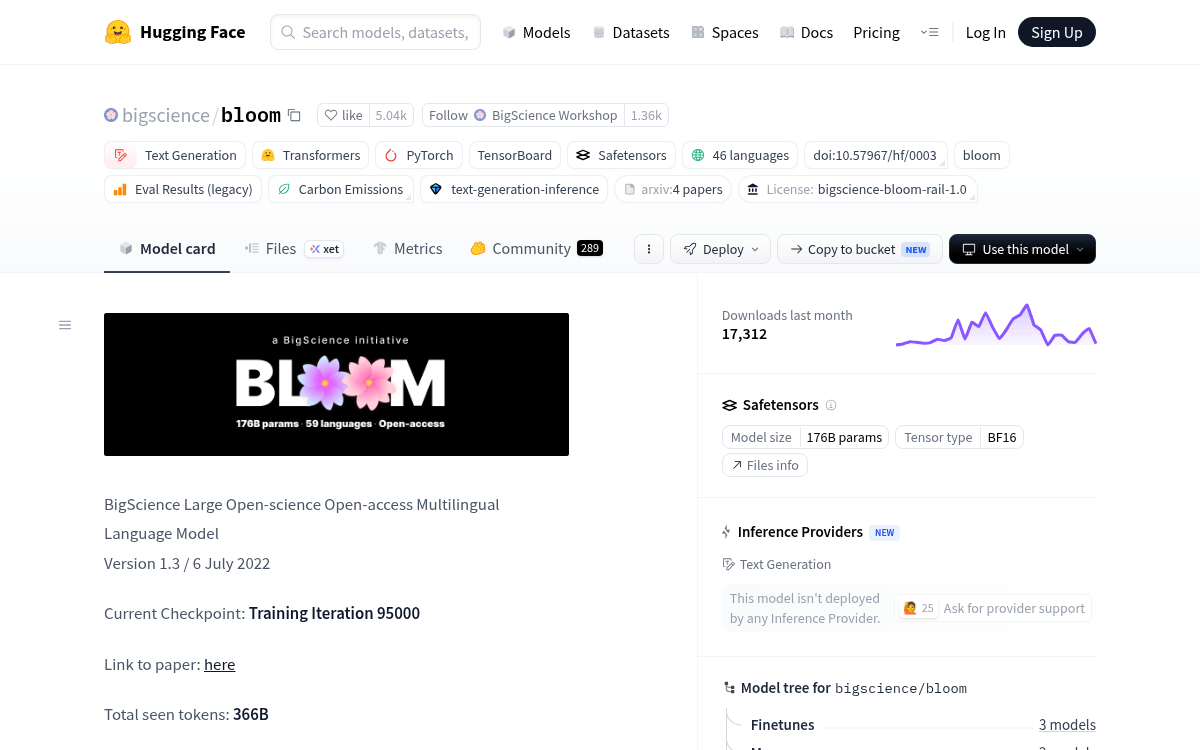
BLOOM is an autoregressive decoder-only transformer that generates text from a prompt, trained at industrial scale on a heavily curated multilingual corpus. The 176 billion parameter model covers 46 natural languages and 13 programming languages, developed and released by hundreds of researchers with compute provided through a French public grant from GENCI and IDRIS on the Jean Zay supercomputer.
The core pitch has not been matched by later open releases: a single model covering dozens of languages that most other LLMs barely touch, with the entire pipeline documented in the open. Most frontier LLMs are built inside resource-rich organizations and kept from the public; BLOOM was released as a counterweight.
What is actually inside the model
The architecture is a modified Megatron-LM GPT-2 style decoder with two design choices worth calling out. It uses ALiBi positional encodings, which bias attention scores by distance instead of adding learned position embeddings, making extrapolation to longer sequences than seen during training easier. It also applies an extra layer normalization directly on the word embedding layer (the StableEmbedding trick from the bitsandbytes work) to stabilize training at this scale.
The concrete numbers on the model card:
- 176,247,271,424 parameters, of which about 3.6B are embedding parameters
- 70 transformer layers, 112 attention heads
- Hidden size of 14,336
- Sequence length of 2048 tokens
- BPE tokenizer with a vocabulary of 250,680, deliberately large to fairly represent 46 languages
- BF16 weights, checkpoint size around 329GB (2.3TB with optimizer states)
How it got built
Training ran on the Jean Zay supercomputer in France across 384 A100 80GB GPUs on 48 nodes, with 8 GPUs per node connected by NVLink and OmniPath between nodes. The stack was PyTorch plus Megatron-DeepSpeed plus NVIDIA apex, and throughput landed at around 150 TFLOPs per GPU per second. The full run took 3.5 months, with an estimated cost, including preliminary experiments, of $2 to 5 million in equivalent cloud compute.
The training data itself, the ROOTS corpus, is arguably the more interesting artifact. It draws on hundreds of sources across 59 languages (46 natural, 13 programming), totalling 1.6TB of preprocessed text converted into 350B unique tokens. The model saw 366B tokens overall in one epoch. The language mix is deliberately weighted toward languages that are underrepresented in most Western LLM corpora, including Swahili, Yoruba, Zulu, Igbo, Bengali, Tamil, and Vietnamese.
Where BLOOM pulls ahead
BLOOM's biggest differentiator is language coverage. If your workload touches Wolof, Kinyarwanda, Assamese, or Odia, most other open LLMs simply do not have meaningful training signal in those languages. BLOOM does, and it also handles code across 13 languages, with Java, PHP, C++, Python, and JavaScript being the largest slices.
On code, the reported HumanEval numbers on the model card are pass@1 of 0.155, pass@10 of 0.328, and pass@100 of 0.572, which the card contrasts with roughly zero on OPT-175B, another open 175B-class model from that era. Pretrained BLOOM performance has been described as similar to comparably sized GPT models trained on the Pile. Final training loss was 1.939 with a validation loss of 2.061 and perplexity around 7.05.
Where it falls short
BLOOM is a base model, not an instruction-tuned assistant. Out of the box it continues text rather than following commands, and the BigScience team explicitly documented risk areas on the model card:
- May overrepresent some viewpoints and underrepresent others
- Can generate hateful, abusive, discriminatory, or sexual content
- Can produce incorrect information as if it were factual
- May generate irrelevant or repetitive outputs
- Not designed for biomedical, legal, financial, or other high-stakes domains
The evaluation section on the card also carries an unusual warning: an earlier version of the results table was published without approval from the evaluation working group and has since been pared back while corrections are made. That is a healthy signal about how seriously the project took reproducibility, and it means you should not rely on old BLOOM leaderboard numbers.
Running it today
The weights are distributed under the BigScience RAIL License v1.0, which is free to use but includes behavioral use restrictions (no disinformation, no unconsented impersonation, no surveillance, and so on). You can pull it through the Transformers API:
from transformers import AutoTokenizer, AutoModelForCausalLM
tokenizer = AutoTokenizer.from_pretrained("bigscience/bloom")
model = AutoModelForCausalLM.from_pretrained(
    "bigscience/bloom",
    device_map="auto",
)
The Hugging Face page also lists first-class support for vLLM and SGLang if you want an OpenAI-compatible endpoint, plus Docker Model Runner images. Given the 329GB BF16 footprint, most people will realistically want a quantized variant (llama.cpp, Ollama, and LM Studio compatible quantizations are linked from the model page) or one of the smaller BLOOM size variants BigScience released alongside the 176B checkpoint.
Why it still matters
Even years after release, BLOOM occupies a niche that later, glossier open models have not fully filled. Meta's Llama family and Mistral's open weights are stronger on English benchmarks but train on far narrower language mixes and ship with much less documentation of what went into the corpus. BLOOM's contribution is the template as much as the weights: the release aimed to open new applications and research directions for large language models, and to help the ML research community organize future large-scale collaborations along similar lines.
For anyone building applications that need coverage of low-resource languages, or doing academic work that requires knowing exactly which documents were in the training set, BLOOM remains one of the very few options that fits. The published BLOOM paper, the engineering chronicles, and the intermediate checkpoints (one every 5,000 steps) also make it uniquely useful as a research substrate for studying how a 176B model actually learns over time.