
Bavarian State Library's Tiny BERT Model Quietly Hits 2.5M Monthly Downloads
A workhorse BERT model for named entity recognition keeps pulling millions of downloads by extracting people, places, and organizations from English text.
 Pro
Takeaways
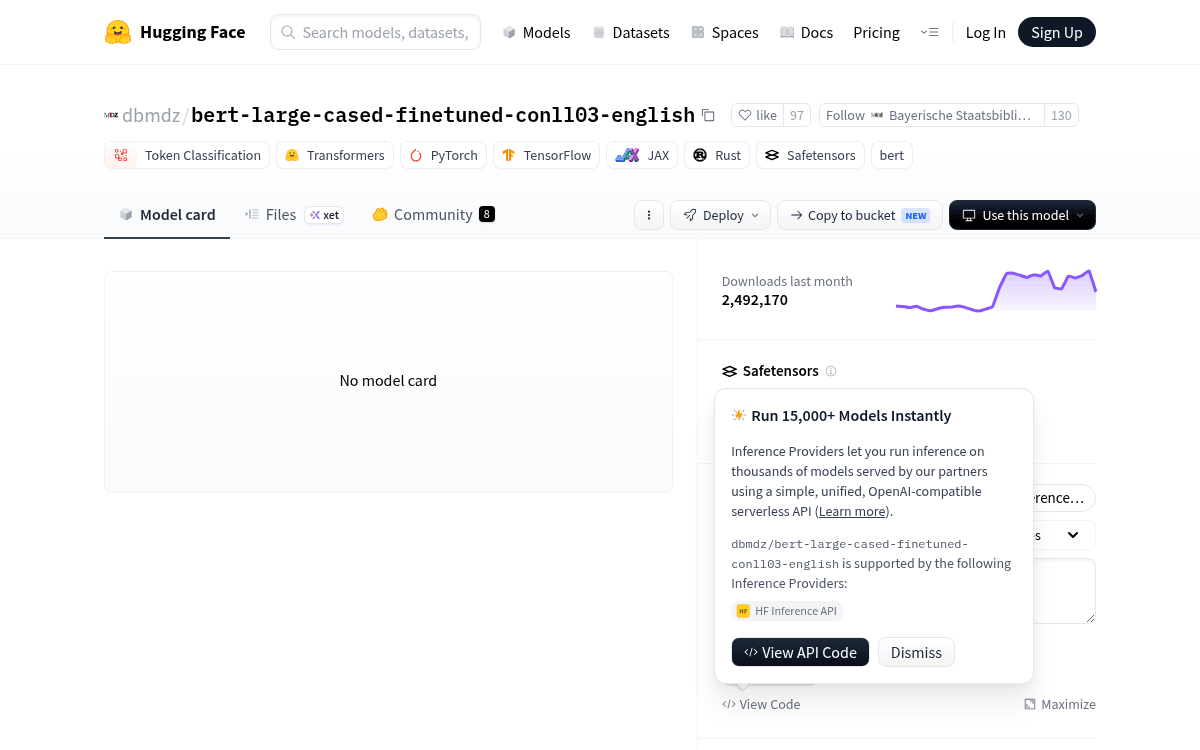
- dbmdz/bert-large-cased-finetuned-conll03-english is pulling 2.49M monthly downloads on Hugging Face.
- BERT-large-cased fine-tuned on CoNLL-03 for four entity types: PER, ORG, LOC, MISC.
- Built by the Bavarian State Library dbmdz team, known for open-source BERTs.
- Ships as the default NER module in Weaviate and as a hosted Azure AI endpoint.
- Roughly 335M parameters, runs in milliseconds on a single GPU, F1 above 90% on benchmark.
- Weak spots: English-only, news-domain bias, only four entity types, no model card.
In an era dominated by billion-parameter language models, a modest 335 million parameter BERT checkpoint continues to quietly rack up traffic on Hugging Face. The dbmdz/bert-large-cased-finetuned-conll03-english model has crossed 2.49 million downloads in the past month alone, making it one of the most heavily used token classification models in production despite being a fine-tune of the original BERT-large architecture.
The model was published by the MDZ Digital Library team (dbmdz) at the Bavarian State Library in Munich, the same group behind popular German, Turkish, and historic language BERTs. The team open sources checkpoints under the dbmdz namespace, and this English NER variant has become a default across tutorials, vector databases, and hosted inference platforms.
What it actually does
The checkpoint is a specialized version of BERT-large-cased fine-tuned for Named Entity Recognition (NER) on the CoNLL-03 English dataset. It identifies and classifies named entities in text, covering persons, organizations, locations, and a miscellaneous bucket for everything else. Predictions come out as BIO tags per token, using the standard nine-label scheme from the training set: O, B-PER, I-PER, B-ORG, I-ORG, B-LOC, I-LOC, B-MISC, I-MISC.
Because the tokenizer is cased, capitalization matters, which is one of the strongest signals for detecting proper nouns in English. The training corpus is a collection of newswire articles from the Reuters Corpus, so the model has essentially memorized the vocabulary and style of financial and general news reporting.
Dropping it into a pipeline
Usage is about as simple as Hugging Face gets. Loading the model through the pipeline abstraction takes three lines:
from transformers import pipeline
pipe = pipeline("token-classification", model="dbmdz/bert-large-cased-finetuned-conll03-english")
print(pipe("Apple Inc. was founded by Steve Jobs in Cupertino, California."))
The pipeline returns a list of entity spans with a label, a confidence score, and character offsets. For production, most users pass aggregation_strategy="simple" to merge subword tokens back into full entity mentions like Steve Jobs instead of Steve plus ##Jobs.
Why it still wins on volume
The model solves a very specific and very common problem: extracting structured entities from unstructured English text without paying per-token LLM fees. It runs on a single mid-range GPU, returns results in milliseconds, and requires no prompt engineering or output parsing. On the CoNLL-2003 benchmark, models of this class typically clear an F1 of 90% on the standard entity types.
It has also become embedded in downstream tooling. Weaviate, for example, ships an NER module that wraps it directly, and the dbmdz checkpoint is the flagship of the three NER modules Weaviate exposes from Hugging Face. It is also available as a hosted endpoint through Azure AI, which explains the deploy:azure tag on the repo.
Where it falls short
The limitations line up with what you would expect from a CoNLL-03 fine-tune:
- Only four entity types. For dates, money, products, or biomedical entities, reach for something else. Domain-specific checkpoints like d4data/biomedical-ner-all handle those cases; general-purpose CoNLL-2003 models tend to struggle outside their training distribution.
- News-domain bias. Reuters newswire from 2003 does not resemble tweets, chat logs, code comments, or legal filings.
- English only. Multilingual users typically reach for Babelscape/wikineural-multilingual-ner, which supports over 40 languages.
- No model card. The repository has no documented evaluation metrics, training hyperparameters, or bias analysis, which is a real gap for regulated use cases.
- Case sensitivity cuts both ways. Lowercased or all-caps input degrades performance significantly.
When to reach for it
This checkpoint is the right pick when you need cheap, fast, deterministic entity extraction from clean English text and you only care about people, places, organizations, and miscellaneous proper nouns. Concrete use cases include indexing news articles for search, populating knowledge graphs, redacting PII from customer support transcripts, or pre-filtering documents before sending a smaller subset to a more expensive LLM.
If your text looks like Reuters, this model will keep punching well above its weight. If it looks like anything else, treat the 2.5 million monthly downloads as a signal that it is worth benchmarking, not as a guarantee it will work on your data.