
Baichuan-7B Beats LLaMA on Chinese Benchmarks With a Commercial License
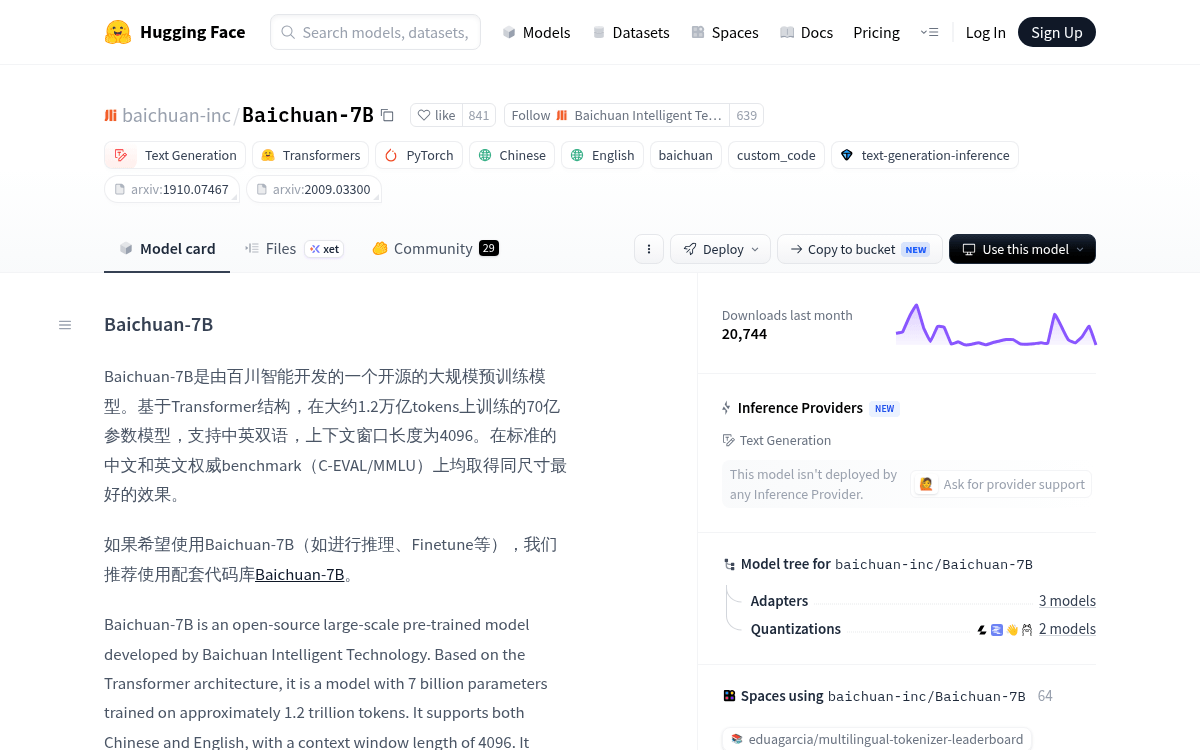
A 7-billion parameter bilingual base model trained on 1.2 trillion tokens, tuned for Chinese while allowing commercial use under a permissive license.
 Pro
Takeaways
- 7B bilingual base model from Baichuan Intelligent Technology, trained on 1.2T tokens
- Commercial-friendly license, unlike LLaMA at the time of release
- LLaMA-style architecture with RoPE, SwiGLU, RMSNorm, 4096 context, 64K vocab
- C-Eval score 42.8, beating LLaMA-7B, Falcon-7B, ChatGLM-6B at same size
- MMLU 42.3 average, ahead of comparable 7B English-first models
- Base model only, needs fine-tuning and safety filtering for production
Baichuan-7B keeps drawing attention on Hugging Face from teams building bilingual applications, and the reasons are concrete enough to be worth laying out. Baichuan-7B is a 7 billion parameter base model from Baichuan Intelligent Technology that pairs LLaMA-style architecture with a training recipe optimized for Chinese, and ships under a license that permits commercial use.
What shipped
Baichuan-7B is a pre-trained Transformer with 7 billion parameters trained on roughly 1.2 trillion tokens, supporting both Chinese and English with a 4096-token context window. The weights are freely downloadable from Hugging Face under a commercial-friendly license, unlike LLaMA, which prohibits commercial use. That distinction is why many bilingual startups chose it as a starting point.
Under the hood
The design mirrors LLaMA closely, with a few standard modern tweaks:
- Rotary position embeddings, chosen for their extrapolation behavior
- A SwiGLU feedforward layer sized to (8/3) times the hidden dimension, giving 11008
- Pre-normalization via RMSNorm
- 32 layers, 32 heads, d_model of 4096, and a 64000-token vocabulary
The expanded vocabulary is a deliberate choice for Chinese tokenization efficiency. Byte-pair splits over Han characters inflate token counts and degrade downstream latency without it.
Getting it running
Loading takes a couple of lines with the Transformers library. The trust_remote_code=True flag is required because the model ships custom modeling code:
from transformers import AutoModelForCausalLM, AutoTokenizer
tokenizer = AutoTokenizer.from_pretrained("baichuan-inc/Baichuan-7B", trust_remote_code=True)
model = AutoModelForCausalLM.from_pretrained("baichuan-inc/Baichuan-7B", device_map="auto", trust_remote_code=True)
inputs = tokenizer('Hamlet->Shakespeare\nOne Hundred Years of Solitude->', return_tensors='pt').to('cuda:0')
pred = model.generate(**inputs, max_new_tokens=64, repetition_penalty=1.1)
print(tokenizer.decode(pred.cpu()[0], skip_special_tokens=True))
It also serves through vLLM and SGLang via their OpenAI-compatible endpoints, so dropping it into an existing inference stack is low-friction. Community quantizations cover llama.cpp, Ollama, and LM Studio for lighter deployments.
Benchmark results
Performance on Chinese benchmarks is where Baichuan-7B separates itself from other 7B models. On C-Eval 5-shot it posts a 42.8 average, against LLaMA-7B at 27.1, Falcon-7B at 25.8, ChatGLM-6B at 34.5, and BLOOMZ-7B at 35.7. On Gaokao it reaches 36.24 versus LLaMA-7B at 27.81, and on AGIEval it hits 34.44 against LLaMA-7B at 28.17.
English holds up too. On MMLU 5-shot it averages 42.3, outscoring LLaMA-7B at 35.1, Falcon-7B at 35.0, MPT-7B at 35.6, and ChatGLM-6B at 36.9 across humanities, social sciences, STEM, and other categories.
Limitations to know before deploying
Baichuan-7B is a base model, so polished conversational responses require instruction tuning. Few-shot and completion-style prompting work best out of the box. The authors are explicit that it can produce factually incorrect output and, despite data cleaning, offensive content. Production deployments need a safety layer on top.
The 4096-token context is also short by current standards, which limits long-document workflows without additional fine-tuning or retrieval scaffolding.
Who should reach for it
Baichuan-7B fits a specific set of use cases well:
- Bilingual Chinese-English products where LLaMA-family models underperform on Chinese comprehension
- Teams fine-tuning a commercially usable base model for domain tasks like customer support, summarization, or classification
- Research on Chinese tokenization, evaluation, or continued pretraining, since the training code is open sourced
- Edge deployments through community quantizations where a compact bilingual model beats hosting a much larger multilingual one
Why it still matters
The architecture here is conventional. What Baichuan-7B demonstrated is that a 7B model trained on carefully curated bilingual data with a Chinese-aware tokenizer can leapfrog same-size Western baselines on Chinese benchmarks while staying competitive in English. That finding became a template for subsequent Chinese open-weight releases, and Baichuan-7B remains a common base in adapter and quantization ecosystems, with dozens of derivative fine-tunes still active on the Baichuan hub.