
BAAI's bge-small-zh-v1.5 Beats OpenAI's Ada on Chinese Search at 24M Parameters
BAAI's compact Chinese embedding model packs 24M parameters into a 512-dimensional vector, delivering strong retrieval performance for RAG pipelines on modest hardware.
 Pro
Takeaways
- BAAI/bge-small-zh-v1.5 is a 24M-parameter Chinese embedding model producing 512-dim vectors under an MIT license.
- Scores 57.82 average on C-MTEB with 61.77 on retrieval, beating multilingual-e5-large despite being far smaller.
- The v1.5 update fixes the compressed similarity distribution and removes the need for a query instruction.
- Pretrained with RetroMAE reconstruction, then contrastively fine-tuned on large-scale query-document pairs.
- Works out of the box with sentence-transformers, LangChain, FlagEmbedding, and text-embeddings-inference.
- Best paired with bge-reranker for two-stage retrieve-then-rerank RAG pipelines.
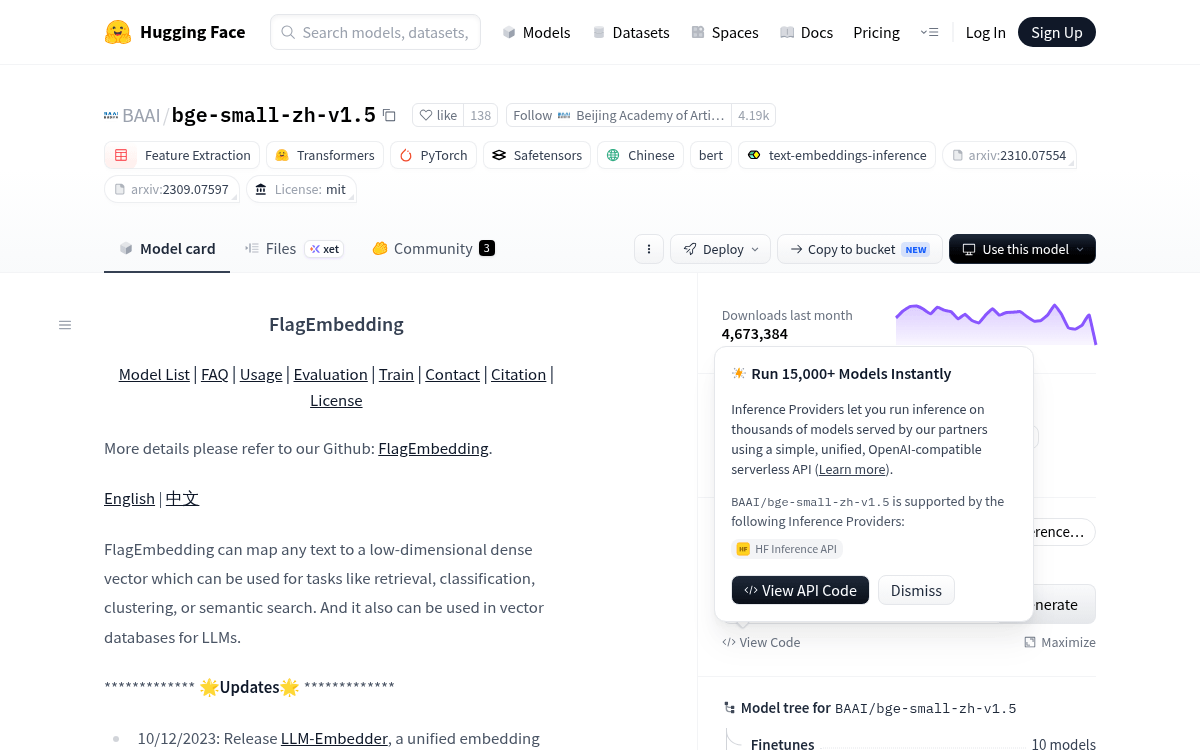
If you're building a Chinese-language search or retrieval-augmented generation pipeline and don't want to pay per-token API fees or spin up a GPU cluster, BAAI/bge-small-zh-v1.5 continues to be one of the most-downloaded options on Hugging Face, with nearly 4.9 million pulls and counting. It's a tiny BERT-based encoder from the Beijing Academy of Artificial Intelligence that maps Chinese text into a dense vector suitable for retrieval, clustering, classification, or feeding a vector database.
A small model with a specific job
The architecture is a 24-million-parameter BERT that emits 512-dimensional embeddings with a 512-token context window. FlagEmbedding maps text to a low-dimensional dense vector usable for retrieval, classification, clustering, or semantic search, and it slots into vector databases behind LLMs. In practice it fills the same role as OpenAI's text-embedding-ada-002, but locally, in Chinese, and at a footprint small enough to run comfortably on CPU.
The v1.5 release exists to fix a specific complaint about the original BGE checkpoints. The bge-*-v1.5 line was tuned to improve retrieval without instruction prompts and to spread out the similarity distribution, and it remains a strong balance between embedding quality and model size. If you ever noticed BGE v1 scores clustering awkwardly in the 0.6 to 1.0 range even for unrelated sentences, v1.5 is the answer.
How it stacks up on C-MTEB
BAAI evaluates on C-MTEB, a Chinese text embedding benchmark that spans 31 datasets across 6 tasks. The small variant lands well below its larger siblings but ahead of most multilingual alternatives at a similar size:
| Model | Params | Dim | Avg | Retrieval | Reranking |
|---|---|---|---|---|---|
| bge-large-zh-v1.5 | 326M | 1024 | 64.53 | 70.46 | 65.84 |
| bge-base-zh-v1.5 | 102M | 768 | 63.13 | 69.49 | 65.39 |
| bge-small-zh-v1.5 | 24M | 512 | 57.82 | 61.77 | 60.92 |
| multilingual-e5-large | 560M | 1024 | 58.79 | 63.66 | 56.00 |
| text-embedding-ada-002 | N/A | 1536 | 53.02 | 52.00 | 54.28 |
You give up roughly 7 points of average score compared with bge-large, but the model is more than 10x smaller and cheap enough to embed millions of documents on a laptop.
How it was built
The training recipe is standard BGE: pre-training with RetroMAE, then contrastive fine-tuning on large-scale pair data. The pre-training objective reconstructs text and cannot be used for similarity directly, so fine-tuning is required. RetroMAE is a masked auto-encoder setup where the encoder sees a lightly corrupted sentence and a shallow decoder has to reconstruct a heavily corrupted version, forcing the encoder to pack semantics into the CLS token. The contrastive stage then aligns query-document pairs. Details are in the C-Pack paper.
Using it in three lines
The path of least resistance is sentence-transformers:
from sentence_transformers import SentenceTransformer
model = SentenceTransformer('BAAI/bge-small-zh-v1.5')
embeddings = model.encode(["样例数据-1", "样例数据-2"], normalize_embeddings=True)
similarity = embeddings @ embeddings.T
For short-query-to-long-passage retrieval, prepend an instruction to queries only. Passages get no instruction, and neither do symmetric tasks like clustering or STS. The Chinese instruction string ships in the model card. One gotcha worth internalizing:
- Similarity scores live in a compressed range because the models are fine-tuned by contrastive learning with a temperature of 0.01, so the distribution sits roughly in the interval 0.6 to 1.
- For downstream retrieval, what matters is the relative order of the scores, not the absolute value.
- If you need a hard threshold for deduping or filtering, calibrate on your own data rather than assuming 0.5 means "different."
Where it fits, and where it doesn't
This checkpoint is a good default for Chinese RAG indexes, semantic caches, FAQ matchers, and clustering pipelines where latency and memory matter more than the last few points of recall. The MIT license permits commercial use free of charge, so it's safe to ship in a product without licensing overhead.
It is the wrong pick for long-document embeddings beyond 512 tokens, multilingual coverage, or the absolute best recall on hard retrieval sets. For those cases, BAAI recommends a two-stage setup: retrieve top-k with bge-small, then rerank with a cross-encoder such as bge-reranker-base. Cross-encoders run full attention over the query-document pair, which is more accurate than a bi-encoder embedding model but slower, so they are best reserved for re-ranking the top-k candidates. A typical pipeline uses bge-small to fetch 100 candidates and the reranker to pick the final three.
The persistent download numbers tell their own story. Even with newer entrants like bge-m3 and multilingual instruction-tuned models on the scene, the small-zh checkpoint remains the pragmatic choice when you want a Chinese encoder that is fast, free, well-benchmarked, and boring in all the right ways.