
BAAI's bge-reranker-v2.5 Cuts RAG Compute by 60% Without Losing Accuracy
BAAI shipped bge-reranker-v2.5-gemma2-lightweight, a Gemma-2-9B based reranker that tops BEIR and MIRACL while cutting FLOPs by 60 percent.
 Pro
Takeaways
- BAAI released bge-reranker-v2.5-gemma2-lightweight, a 9B multilingual cross encoder based on Gemma-2-9B.
- New SOTA on BEIR with 63.67 mean nDCG@10 and on MIRACL with 77.3 average across 18 languages.
- Supports layerwise cutoff (layers 8 to 42) and token compression ratios of 1, 2, 4, or 8.
- Reference config saves 60 percent of FLOPs while dropping BEIR score by less than 0.6 points.
- Ships under the Gemma license via FlagEmbedding with a new
LightWeightFlagLLMRerankerclass. - Older MIT-licensed bge-reranker-base and bge-reranker-large remain the go-to for cheap, fast reranking.
Retrieval augmented generation pipelines almost always need a reranker sitting between the vector search and the language model, and the Beijing Academy of Artificial Intelligence just pushed the state of the art forward with a new open weights model. Their bge-reranker-v2.5-gemma2-lightweight release is the latest addition to the BGE family, and it introduces knobs for cutting compute at inference time without giving up ranking quality.
What shipped
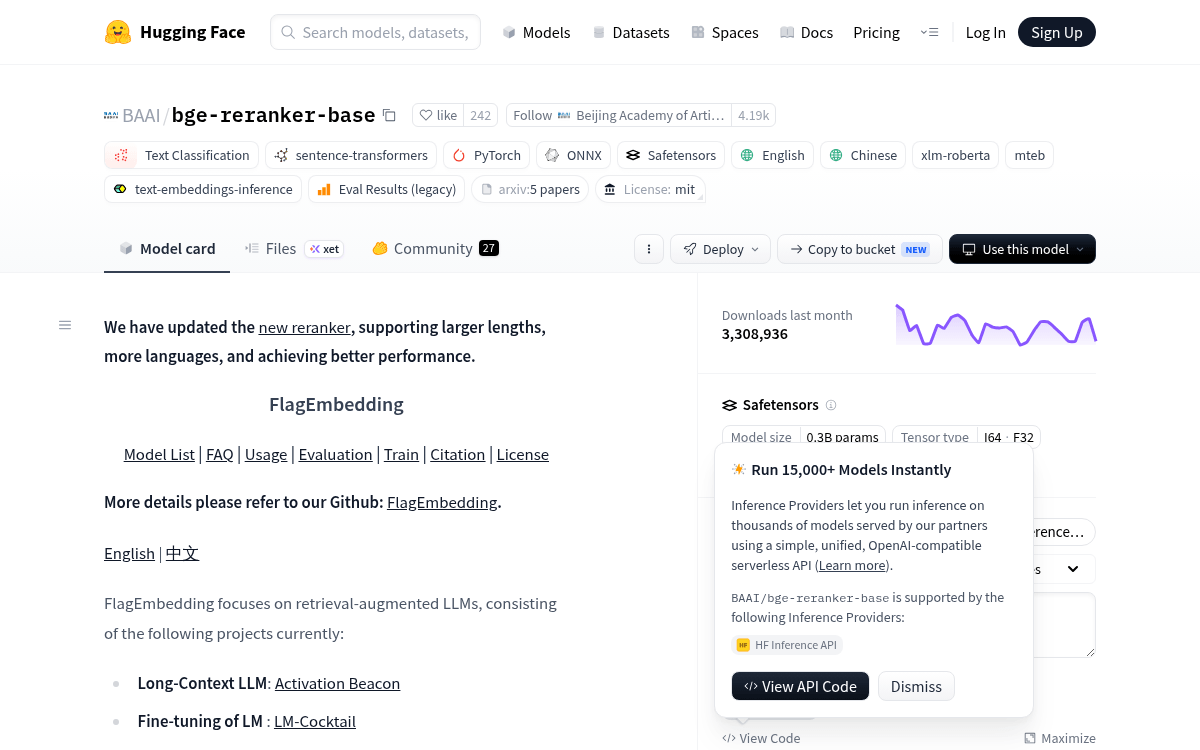
BAAI released new rerankers built on M3 and LLM backbones like Gemma and MiniCPM, supporting multilingual processing and larger inputs with sizable gains on BEIR, C-MTEB Retrieval, and MIRACL. The v2.5 variant is the newest tier. It is a cross encoder that takes a query and a passage and directly outputs a relevance score, and the weights are on Hugging Face under the Gemma license.
Why a new reranker matters
Rerankers exist because bi-encoder embedding models are fast but coarse. A cross encoder performs full attention over the input pair, which is more accurate than a bi-encoder but slower, so it typically re-ranks the top-k documents returned by the embedding model. That extra cost is exactly what has kept large LLM-based rerankers out of many production stacks. The v2.5 release attacks that cost head on.
Two dials for saving compute
The model is built on google/gemma-2-9b and exposes two mechanisms for shrinking inference cost on the fly:
- Layerwise cutoff. You can stop forward computation at an intermediate layer (the model supports cutoffs from layer 8 through 42) and read the score from there.
- Token compression. You can set a compression ratio of 1, 2, 4, or 8 at specified layers, so the sequence gets shorter as it flows deeper into the network.
Combined, these let you dial down FLOPs dramatically. In the reported configuration that saves 60 percent of compute, the model uses compress_ratios=2, compress_layer=[8], and cutoff_layers=[25]. In code, running it with the FlagEmbedding library looks like this:
from FlagEmbedding import LightWeightFlagLLMReranker
reranker = LightWeightFlagLLMReranker(
    'BAAI/bge-reranker-v2.5-gemma2-lightweight', use_fp16=True)
score = reranker.compute_score(
    ['query', 'passage'],
    cutoff_layers=[28],
    compress_ratio=2,
    compress_layer=[24, 40])
The benchmark numbers
On BEIR, the standard English retrieval benchmark suite, the new model posts a mean nDCG@10 of 63.67 across 15 tasks, compared with 60.71 for bge-reranker-v2-gemma and 55.36 for bge-reranker-v2-m3. Even with the 60 percent FLOPs saving turned on, the score only drops to 63.1, still ahead of every prior BGE reranker. Highlights include 86.16 on ArguAna, 94.69 on FEVER, and 87.89 on HotpotQA.
MIRACL, the 18-language retrieval benchmark, tells a similar story. The lightweight model averages 77.3 nDCG@10 across 18 languages, versus 75.0 for bge-reranker-v2-gemma and 74.4 for bge-reranker-v2-m3. Running with 60 percent FLOPs saved still yields 77.1, essentially free efficiency.
Prompts, sizes, and other fine print
The model targets multilingual reranking and works with several prompt templates beyond passage ranking, including semantic similarity and stance detection style comparisons. You can prompt it to predict whether passage B answers query A, whether A and B mean the same thing, whether two queries ask the same thing, or whether an argument and counterargument are contradictory.
The trade-offs worth knowing:
- Size. At 9B parameters and around 11 GB on disk, it is not something you casually drop next to an
xlm-roberta-basereranker. - Latency vs quality. BAAI itself advises picking based on your constraints. For efficiency they still recommend bge-reranker-v2-m3 or the low layers of bge-reranker-v2-minicpm-layerwise, and they emphasize testing on your real use case to find the right speed and quality balance.
- License. The weights ship under the Gemma license inherited from the base model, which is more restrictive than the MIT license used by the older bge-reranker-base and bge-reranker-large.
Where it fits in the BGE lineup
BAAI now offers a full ladder of rerankers, and picking one is mostly about matching resource budget to quality target. bge-reranker-v2-m3 is a lightweight multilingual cross encoder with fast inference, v2-gemma is a heavier multilingual option strong in English, v2-minicpm-layerwise lets you pick output layers to accelerate inference, and v2.5-gemma2-lightweight extends that with selectable layers plus compression ratio and compression layers.
For teams already running a BGE pipeline, the practical takeaway is that you can now trade compute for quality on a slider rather than swap models. If you are building a multilingual RAG system and have room for a 9B cross encoder, this is currently the strongest open weight option on BEIR and MIRACL. If you cannot fit that, the older MIT-licensed rerankers remain excellent defaults for cheap, fast reranking on top of any embedding model. A technical report with more training details is promised from the BAAI team, which should clarify how the token compression module was trained end to end.