
BAAI's bge-large-zh-v1.5 Beats OpenAI ada-002 by 18 Points on Chinese Retrieval
BAAI's Chinese embedding model tops C-MTEB with a 64.53 average, offering a fixed similarity distribution and instruction-free retrieval under MIT license.
 Pro
Takeaways
- BAAI's bge-large-zh-v1.5 tops C-MTEB with a 64.53 average, best among open Chinese embedders.
- v1.5 fixes the tight similarity distribution and improves retrieval when no instruction is used.
- 1024-dim embeddings, 512-token max length, CLS pooling with L2 normalization.
- MIT licensed and free for commercial use, with 1.3M+ downloads on Hugging Face.
- Trained via RetroMAE pre-training plus large-scale contrastive fine-tuning at temperature 0.01.
- For multilingual or long-context needs, BAAI points users to BGE-M3 instead.
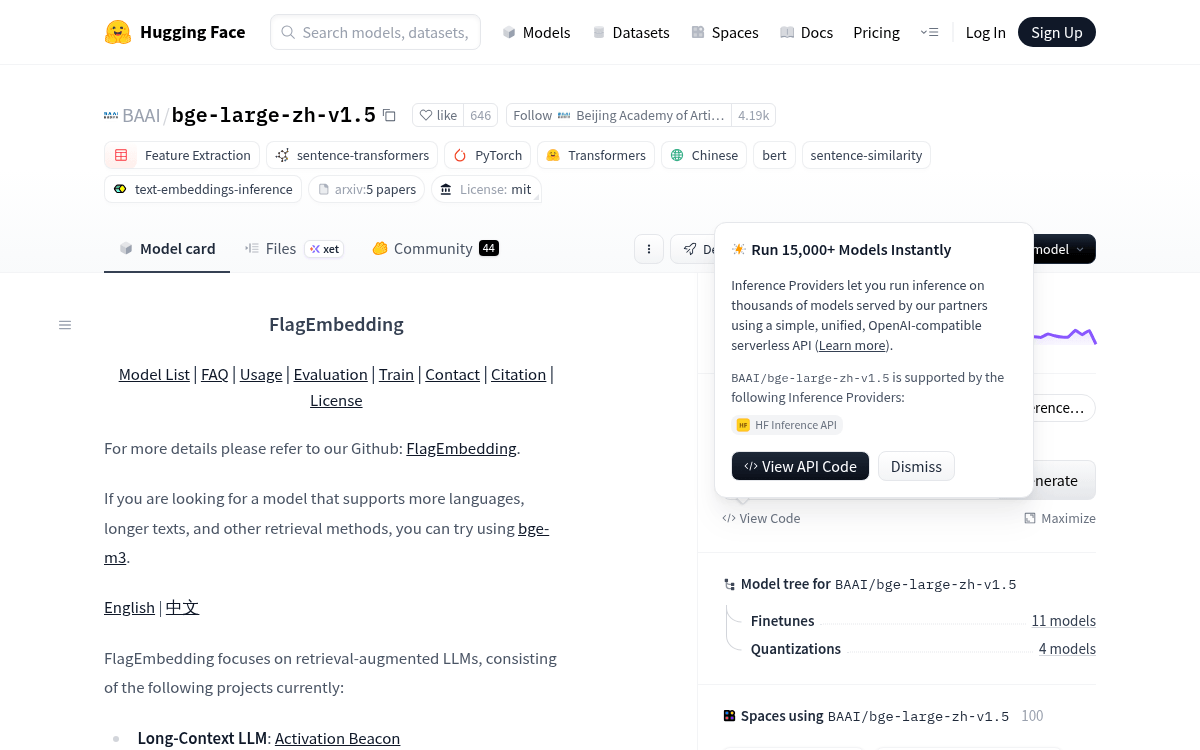
BAAI's bge-large-zh-v1.5 is the Chinese-language flagship of the BGE (BAAI General Embedding) family, and it has quietly become one of the most-downloaded embedding models on the Hub, clocking over 1.3 million downloads. The v1.5 release fixes a nagging issue with the original BGE checkpoints, where similarity scores clustered awkwardly between 0.6 and 1.0 and made thresholding painful for anyone running Chinese retrieval in production.
What changed in v1.5
The v1.5 update reshapes the similarity distribution so scores spread more usefully across the range, and it improves retrieval quality when queries are passed without an instruction prefix. In the original BGE, you had to prepend a Chinese instruction string to every query to get good retrieval scores. With v1.5 that step becomes optional, which simplifies inference code and reduces token overhead.
Under the hood, the model is a BERT-style encoder producing 1024-dimensional embeddings with a maximum sequence length of 512 tokens. It uses CLS pooling followed by L2 normalization, so cosine similarity reduces to a dot product.
Where it lands on the leaderboard
On the Chinese Massive Text Embedding Benchmark (C-MTEB), bge-large-zh-v1.5 ranked first overall at release, with strong numbers across retrieval, semantic similarity, and classification tasks. The reported averages from BAAI's own evaluation:
| Model | Dim | C-MTEB Avg | Retrieval | STS | Reranking |
|---|---|---|---|---|---|
| bge-large-zh-v1.5 | 1024 | 64.53 | 70.46 | 56.25 | 65.84 |
| bge-base-zh-v1.5 | 768 | 63.13 | 69.49 | 53.72 | 65.39 |
| multilingual-e5-large | 1024 | 58.79 | 63.66 | 48.44 | 56.00 |
| text-embedding-ada-002 | 1536 | 53.02 | 52.00 | 43.35 | 54.28 |
The gap over OpenAI's ada-002 on Chinese tasks is roughly 11 points on average and 18 points on retrieval, which explains why so many Chinese RAG stacks defaulted to BGE.
How it was trained
BAAI took a two-stage approach that has since become a template for open embedding models, and released the technical report and training data alongside the weights. The team pre-trains a BERT backbone with RetroMAE, a masked auto-encoding objective designed to produce reconstruction-friendly representations, then fine-tunes on large-scale text pairs using contrastive learning with a temperature of 0.01. That low temperature is what pushes similarity scores into the tight [0.6, 1.0] band, so BAAI explicitly warns that relative order matters, not the absolute value. Pick your threshold based on the distribution you observe in your own data (0.8, 0.85, or 0.9 are common starting points).
Using it in practice
Integration is a one-liner in any of the major stacks, and the model ships under an MIT license that permits commercial use. A minimal sentence-transformers workflow:
from sentence_transformers import SentenceTransformer
model = SentenceTransformer('BAAI/bge-large-zh-v1.5')
queries = ['北京的天气怎么样?']
passages = ['北京今天晴天,气温 25℃。', '上海今天下雨。']
q = model.encode(queries, normalize_embeddings=True)
p = model.encode(passages, normalize_embeddings=True)
scores = q @ p.T
For short-query-to-long-passage retrieval, BAAI still recommends prepending the instruction 为这个句子生成表示以用于检索相关文章: to queries only. Passages never get an instruction. If you skip it, the accuracy hit is minor in v1.5.
When to reach for it
- Chinese RAG pipelines where you need a strong dense retriever without paying per-token API fees
- Semantic search over Chinese product catalogs, knowledge bases, or documentation
- Clustering and deduplication of Chinese user content, reviews, or support tickets
- Cross-encoder reranking setups where BGE handles the top-100 recall and bge-reranker-large re-scores the top-k
Where it falls short
The model is Chinese-only. For multilingual coverage or documents longer than 512 tokens, BAAI itself points you to BGE-M3, which supports dense, sparse, and multi-vector retrieval in one model, posts SOTA numbers on multilingual (MIRACL) and cross-lingual (MKQA) benchmarks, and accepts inputs up to 8192 tokens. One other caveat: because pre-training uses a reconstruction objective, the raw pre-trained checkpoint cannot be used for similarity directly, and has to go through the contrastive fine-tune stage. If you plan to continue pre-training on domain data, budget for that second stage.
For teams shipping Chinese search or retrieval today, bge-large-zh-v1.5 remains the pragmatic default: a strong benchmark position, a well-behaved similarity distribution, permissive licensing, and drop-in support across sentence-transformers, LangChain, and the HuggingFace text-embeddings-inference server.