
BAAI's bge-base-zh-v1.5 Fixes Chinese Similarity Scores That Broke RAG Filters
BAAI's updated Chinese embedding model fixes skewed similarity scores and boosts retrieval without instruction prompts, hitting 63.13 on C-MTEB.
 Pro
Takeaways
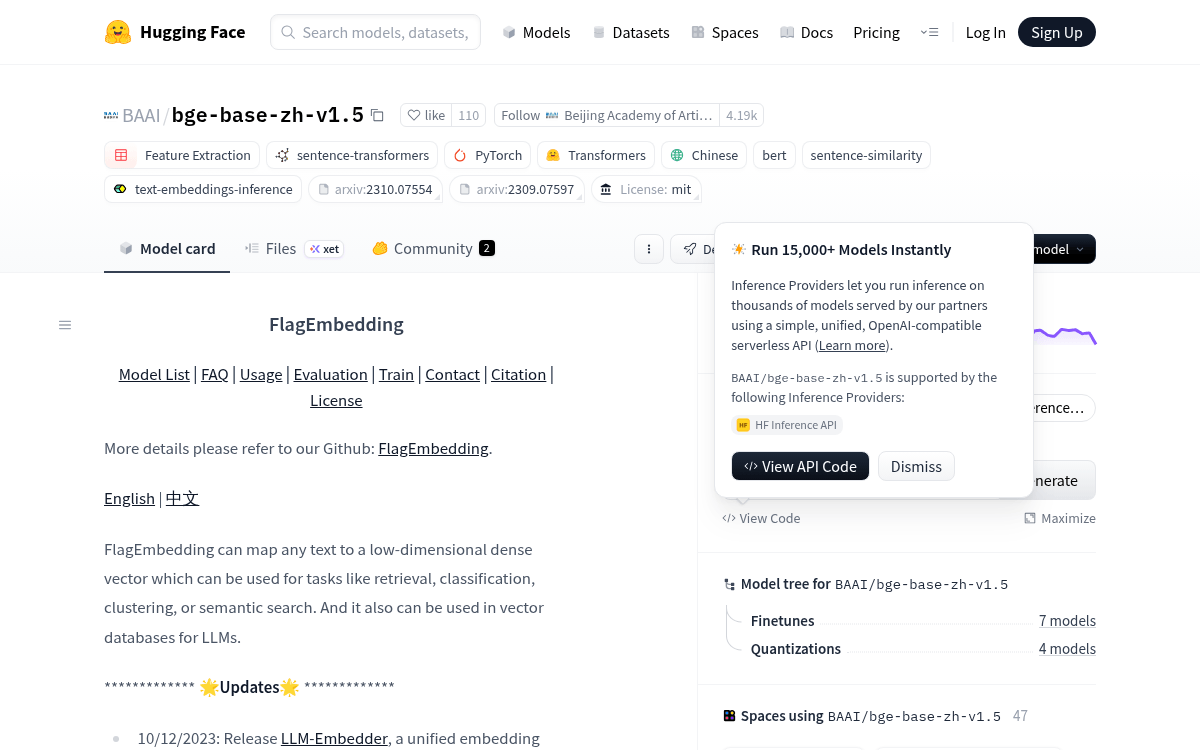
- BAAI's bge-base-zh-v1.5 is a 768-dim Chinese embedding model with over 1.17M downloads
- v1.5 fixes the compressed [0.6, 1] similarity distribution that plagued the original BGE models
- Retrieval works well without the Chinese instruction prefix, unlike earlier versions
- Scores 63.13 average on C-MTEB, beating multilingual-e5-large and OpenAI's ada-002 on Chinese
- Trained via RetroMAE pre-training plus contrastive learning, detailed in the C-Pack paper
- MIT licensed for free commercial use, pairs with bge-reranker for two-stage retrieval
Chinese language retrieval has quietly become one of the busier corners of the embedding ecosystem, and the bge-base-zh-v1.5 release from the Beijing Academy of Artificial Intelligence is a big reason why. The model has crossed 1.17M downloads on Hugging Face, making it one of the most widely deployed Chinese text encoders in production RAG stacks and vector databases.
It is a 768-dimensional, BERT-base sentence encoder tuned specifically for Chinese, distributed under an MIT license that permits commercial use at no cost. The v1.5 tag ships a targeted retraining that fixes two specific pain points from the original bge-base-zh rather than a fresh architecture.
What v1.5 actually changes
The original BGE models had a well-known quirk. Because they were fine-tuned by contrastive learning with a temperature of 0.01, the similarity distribution ended up compressed into roughly the [0.6, 1] interval. Two totally unrelated Chinese sentences could easily score 0.7 cosine similarity, which broke naive threshold-based filters and confused a lot of downstream users.
The v1.5 update was explicitly released to spread that distribution out and to boost retrieval quality when no instruction prefix is used. In practice that means two things for anyone building with it:
- Similarity scores spread across a more usable range, so absolute thresholds behave more like you would expect.
- You no longer need to prepend the Chinese instruction prefix
为这个句子生成表示以用于检索相关文章:to every query to get strong retrieval numbers.
The instruction is still supported and still helps slightly on short-query to long-passage retrieval, though it is no longer required for competitive performance.
Numbers on C-MTEB
BAAI evaluates on C-MTEB, their Chinese counterpart to MTEB covering 31 datasets across retrieval, STS, classification, reranking, pair classification, and clustering. On that benchmark, bge-base-zh-v1.5 posts an average of 63.13, with 69.49 on retrieval and 65.39 on reranking. For context, that puts it comfortably ahead of multilingual-e5-large (58.79 average) and OpenAI's text-embedding-ada-002 (53.02) on Chinese tasks, while running at base BERT size.
The larger sibling bge-large-zh-v1.5 pushes the average to 64.53 at 1024 dimensions, though the base model is the sweet spot for most workloads: 768-dim vectors, 512 token context, and inference cheap enough to run on a single GPU or even CPU for smaller corpora.
How it was built
The training recipe follows the two-stage approach described in the C-Pack paper. The encoder starts from a standard transformer, is pre-trained using RetroMAE, then fine-tuned with contrastive learning on large-scale paired data. RetroMAE is a masked auto-encoding objective designed specifically to produce retrieval-friendly representations, and the contrastive stage uses mined hard negatives to sharpen the boundary between similar and dissimilar pairs.
Using it in code
The model is a drop-in with sentence-transformers, LangChain's HuggingFaceBgeEmbeddings, or BAAI's own FlagEmbedding library. A minimal example:
from sentence_transformers import SentenceTransformer
model = SentenceTransformer("BAAI/bge-base-zh-v1.5")
docs = ["人工智能作为一门学术学科成立于1958年。",
        "艾伦·图灵出生于伦敦的梅达维尔。"]
query = "人工智能是什么时候成立的?"
doc_emb = model.encode(docs, normalize_embeddings=True)
q_emb = model.encode([query], normalize_embeddings=True)
scores = q_emb @ doc_emb.T
print(scores)
Normalizing embeddings matters here since the model is trained for cosine similarity, and passages should be encoded without any instruction prefix even when queries use one.
Where it fits, and where it does not
Good fits are Chinese semantic search, RAG retrieval over Chinese knowledge bases, deduplication, clustering, and classification via nearest-neighbor lookup. The model does not do reranking, and BAAI is explicit that if first-stage recall falls short, you should pair it with bge-reranker-base or bge-reranker-large as a cross-encoder second stage. The pattern they recommend is retrieve top-100 with the bi-encoder, then rerank to top-3 with the cross-encoder, which pushes reranking scores from 65.39 up to 66.09 on C-MTEB.
Two other caveats are worth flagging. The model is Chinese-focused, so mixed-language corpora are better served by the multilingual BGE-M3 line. Similarity scores also remain relative rather than absolute: BAAI's own guidance is that for retrieval tasks the ordering of scores is what matters, and no instruction needs to be added to passages. If you need a hard threshold for near-duplicate detection, calibrate it on your own data rather than trusting a fixed number like 0.8.
For teams already running an English BGE model and expanding into Chinese content, v1.5 is the version to standardize on. The similarity distribution fix alone removes a class of subtle bugs that plagued the original release, and the MIT license means there is no friction moving it into a commercial product.