
AWS Quietly Adds all-MiniLM-L12-v2 to SageMaker for Faster RAG Search
AWS adds the compact all-MiniLM-L12-v2 sentence encoder to SageMaker JumpStart, giving teams one-click deployment for semantic search and retrieval workloads.
 Pro
Takeaways
- AWS added all-MiniLM-L12-v2 to SageMaker JumpStart for one-click deployment.
- Encodes text into 384-dim vectors, roughly 5x faster than all-mpnet-base-v2.
- Fine-tuned from microsoft/MiniLM-L12-H384-uncased on over 1 billion sentence pairs.
- Best for English semantic search, clustering, deduplication and paraphrase detection.
- Capped at 128 tokens; long documents require chunking or a different encoder.
- Ships alongside Sentence Transformers v6.0 with new MultiVectorEncoder and multimodal support.
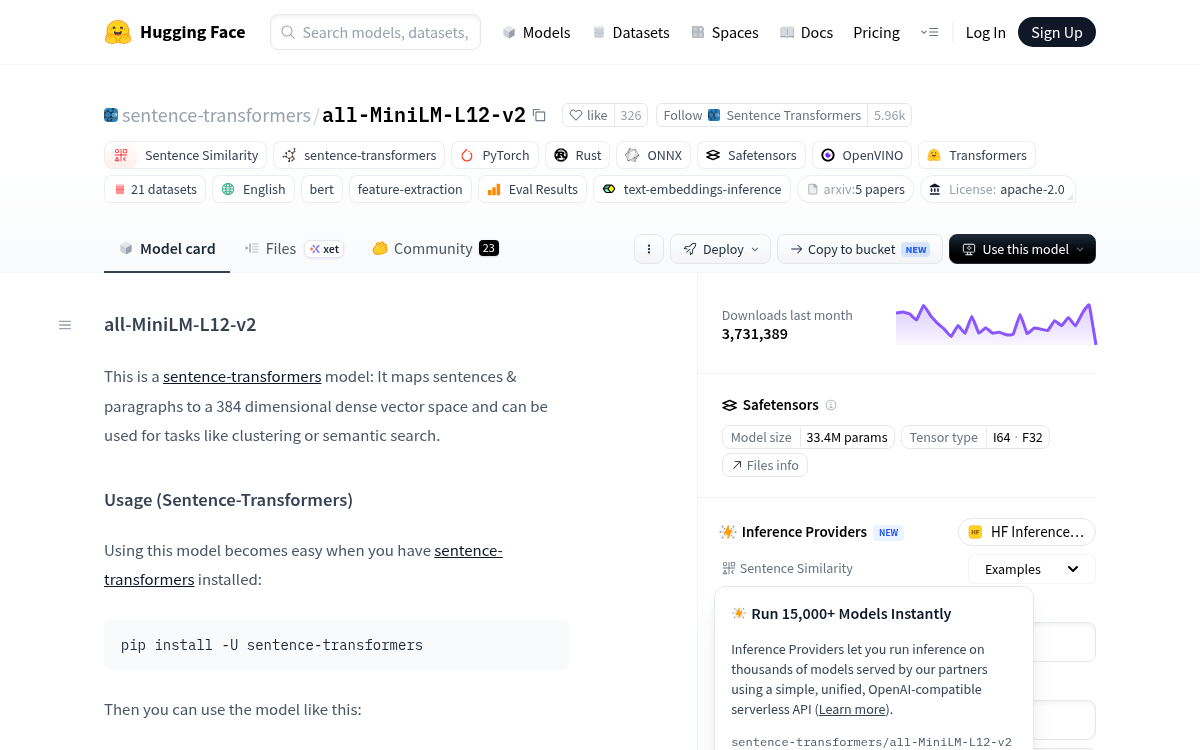
AWS has quietly added an old workhorse to its JumpStart model catalog: the all-MiniLM-L12-v2 sentence encoder from Sentence Transformers. The model maps sentences and paragraphs into a 384-dimensional dense vector space, which is enough to power semantic search, clustering, and similarity scoring on AWS infrastructure. The weights themselves are not new. What changes is the path from a notebook prototype to a managed endpoint sitting behind a production RAG system.
What actually shipped
all-MiniLM-L12-v2 is now available in Amazon SageMaker JumpStart, joining the existing portfolio of hosted models. The deployment path is intentionally boring: open the Models section of SageMaker Studio and click through the JumpStart flow, or drive it from the SageMaker Python SDK. There is no separate licensing dance, since the underlying weights remain Apache 2.0.
Why this model, and why now
The MiniLM family has been the default cheap embedder for years, and JumpStart already carried larger encoders. Adding L12-v2 fills the slot for teams that want quality closer to all-mpnet-base-v2 without paying its latency bill. The model is fine-tuned from microsoft/MiniLM-L12-H384-uncased and runs roughly 5x faster than mpnet-base while holding onto most of the retrieval quality.
Concretely, it is a 12-layer, 384-hidden BERT variant. The 384-dimensional output is half the size of mpnet-base embeddings, so your vector database index shrinks proportionally and cosine similarity scans get cheaper. For applications where every millisecond of retrieval latency is billed back to a user request, that ratio has kept L12-v2 on the shortlist despite the flood of newer embedding models.
Where it fits
The model is well suited to information retrieval, semantic search, document clustering, duplicate detection, and paraphrase identification. Typical deployments look like:
- Retrieval for RAG pipelines where the corpus is English and documents are short passages.
- Deduplication of user-generated content, support tickets, or product listings.
- Clustering large text collections before running a heavier LLM for labeling.
- Nearest-neighbor lookups inside recommendation systems.
The rough edges
L12-v2 is English-only and was trained on sequences capped at 128 tokens, which limits long-document use without chunking. Training ran on a TPU v3-8 for 100k steps with a batch size of 1024, a 500-step learning rate warmup, and AdamW at 2e-5. Anything longer than a paragraph gets truncated, so if your documents are contracts or research papers you will still need a long-context encoder or a chunking strategy.
The model also predates instruction-tuned embedders like the E5, BGE, and Nomic families, which now dominate the MTEB leaderboard. Workloads that demand multilingual coverage, long context, or task-conditioned embeddings should look elsewhere.
How the model was built
The team started from microsoft/MiniLM-L12-H384-uncased and fine-tuned it on a corpus of over 1 billion sentence pairs using a contrastive objective: given one sentence from a pair, the model predicts which of a batch of randomly sampled candidates was its true partner. The training mix concatenates multiple sources sampled with weighted probability configured in data_config.json, including Reddit, S2ORC, Stack Exchange, MS MARCO, Natural Questions, SNLI, and MultiNLI.
A minimal usage example, unchanged from the reference implementation:
from sentence_transformers import SentenceTransformer
model = SentenceTransformer("sentence-transformers/all-MiniLM-L12-v2")
sentences = ["This is an example sentence", "Each sentence is converted"]
embeddings = model.encode(sentences)
print(embeddings.shape)  # (2, 384)
The broader context
The JumpStart addition lands while the Sentence Transformers library itself is going through a rapid expansion. Version 6.0 recently introduced the MultiVectorEncoder, a fourth model family for ColBERT-style late-interaction retrieval using token-level embeddings, covering both text retrieval and ColPali-style visual document retrieval, with existing ColBERT, PyLate, and ColPali checkpoints loading out of the box. The v5.4 release added multimodal support, letting you encode and compare text, images, audio, and video through the same API, with reranker models scoring relevance across mixed-modality pairs.
Against that backdrop, a plain 384-dim English text encoder feels almost quaint. Most production retrieval systems still run something in this weight class, because the accuracy delta at the top of the leaderboard rarely justifies the latency and index-size tax at scale. Promoting the model to a first-class citizen in JumpStart is an acknowledgment that the default choice for a lot of teams has not really moved.
 Aws all-MiniLM-L12-v2 for semantic search and sentence similarity is now available in Amazon SageMaker JumpStart