
AutoGluon's Chronos-Bolt Beats Trained Models at Zero-Shot Forecasting 250x Faster
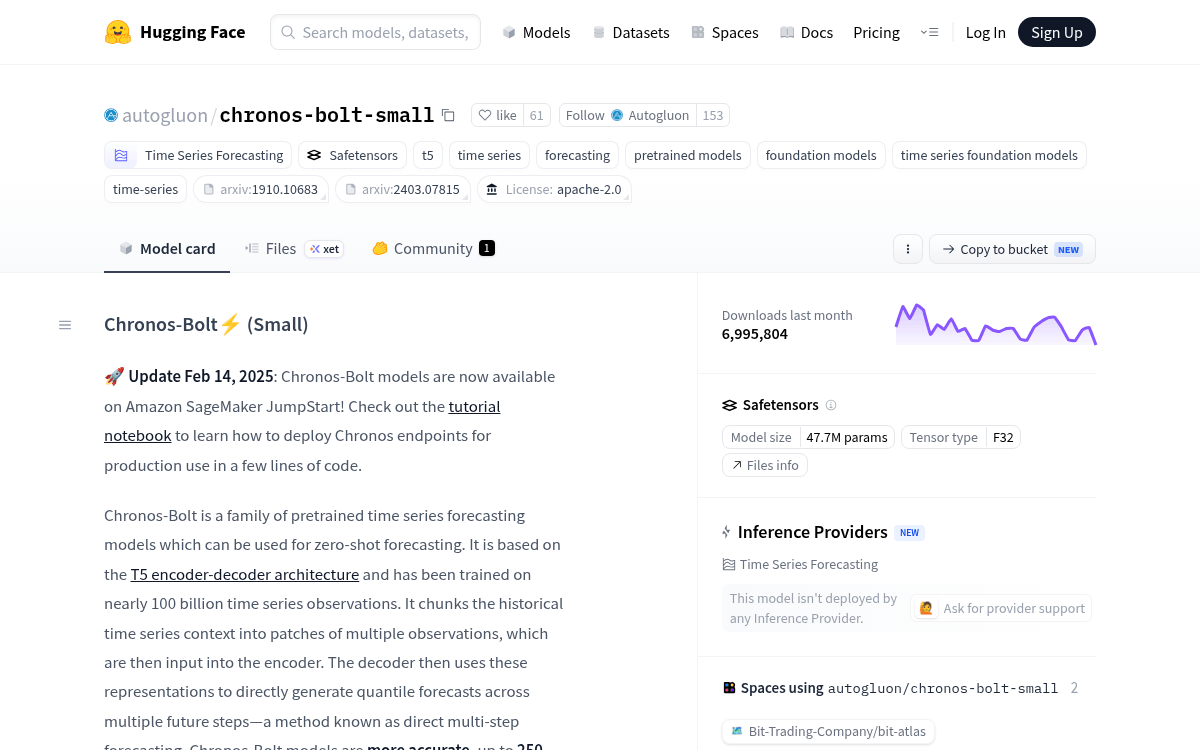
Chronos-Bolt Small packs a 48M-parameter T5 into a zero-shot forecaster that runs on CPU and beats models trained directly on your data.
 Pro
Takeaways
- Chronos-Bolt Small is a 48M-parameter T5-based zero-shot time series forecaster from AutoGluon.
- Up to 250x faster and 20x more memory-efficient than the original Chronos at the same size.
- Outperforms statistical and deep learning models trained directly on 27 benchmark datasets.
- Runs on CPU or GPU, deployable via AutoGluon or Amazon SageMaker JumpStart.
- Available in Tiny (9M), Mini (21M), Small (48M), and Base (205M) sizes under Apache 2.0.
- Univariate by default, with covariates supported through an add-on tabular regressor.
Time series forecasting has quietly become one of the most active corners of the foundation model race, and Chronos-Bolt Small helps explain why. The 48M-parameter model from AutoGluon has crossed several million downloads on Hugging Face, and it produces zero-shot forecasts that beat many purpose-built statistical and deep learning baselines while running on a laptop CPU.
A T5 that speaks in time steps
Chronos-Bolt is a family of pretrained forecasters built on the T5 encoder-decoder architecture, trained on roughly 100 billion time series observations. It chunks historical context into patches of multiple observations, feeds those patches to the encoder, and lets the decoder generate quantile forecasts across many future steps in one shot, a method known as direct multi-step forecasting.
That direct multi-step design is the key architectural bet. The original Chronos treated forecasting like language modeling, tokenizing values and autoregressively sampling future trajectories. Bolt skips the token-by-token sampling and emits the entire horizon of quantiles in a single decoder pass. The payoff: Chronos-Bolt models are up to 250 times faster and 20 times more memory-efficient than the original Chronos models of the same size.
Small model, big benchmark numbers
The Small checkpoint sits in the middle of a four-tier lineup on Hugging Face: Tiny (9M), Mini (21M), Small (48M), and Base (205M). All four run on CPU, ship under Apache 2.0, and use the corresponding t5-efficient backbones.
Despite having no prior exposure to the evaluation datasets during training, the zero-shot Chronos-Bolt models outperform commonly used statistical models and deep learning models that were trained directly on those datasets. They also beat other foundation models that saw some of the benchmark data during pretraining and are therefore not entirely zero-shot. Chronos-Bolt (Base) even surpasses the original Chronos (Large) on forecasting accuracy while running over 600 times faster.
Independent benchmarks tell a similar story. On the recent fev-bench evaluation, Chronos-Bolt posts a 67% average win rate on probabilistic forecasting with a median runtime of 0.3 seconds per 100 series, beating trained transformers like TFT and PatchTST that take hundreds of seconds. It gets edged out only by the newer Chronos-2 and a handful of larger foundation models.
Two lines of code to a forecast
The intended entry point is AutoGluon-TimeSeries, which wraps the model behind the same predictor API used for classical baselines:
from autogluon.timeseries import TimeSeriesPredictor, TimeSeriesDataFrame
df = TimeSeriesDataFrame("https://autogluon.s3.amazonaws.com/datasets/timeseries/m4_hourly/train.csv")
predictor = TimeSeriesPredictor(prediction_length=48).fit(
    df,
    hyperparameters={"Chronos": {"model_path": "autogluon/chronos-bolt-small"}},
)
predictions = predictor.predict(df)
For production, Amazon SageMaker JumpStart offers real-time endpoints on CPU or GPU, and the AutoGluon docs cover fine-tuning and covariate support for teams that need it.
Where it fits and where it does not
Chronos-Bolt is designed for the case where you have a lot of series and not much time to model each one. Good fits include:
- Demand and inventory forecasting across thousands of SKUs where per-series ARIMA fitting is painful.
- Cold-start forecasting on new products, customers, or sensors with limited history.
- Rapid prototyping before deciding whether a bespoke model is worth building.
- Probabilistic forecasting, since the model natively emits quantiles rather than point predictions.
The limits are worth flagging too. Chronos is univariate, so predictions rely solely on the historical values of the target series. Real-world workloads usually come with exogenous signals like holidays, promotions, weather, or price changes that can sharpen accuracy. AutoGluon-TimeSeries handles this through covariate regressors that layer a tabular model on top of a univariate forecaster like Chronos-Bolt, so exogenous features are supported through an add-on rather than natively inside the transformer.
Chronos-2, a newer sibling, was released with zero-shot support for univariate, multivariate, and covariate-informed forecasting, and posts the best pretrained-model scores on fev-bench, GIFT-Eval, and Chronos Benchmark II. Bolt Small remains attractive when memory, latency, or CPU-only deployment matters more than squeezing out the last few percent of accuracy.
Why this one keeps trending
The broader shift is that time series forecasting is following NLP and vision into the pretraining era. A single 48M-parameter checkpoint, small enough to bundle inside a container image, now produces calibrated probabilistic forecasts on data it has never seen, and does so faster than fitting an AutoARIMA on the same series. That collapses a whole class of forecasting pipelines into a model download and a call to predict, which is why Bolt Small is showing up in trading dashboards, capacity planning tools, and anomaly detection stacks across Hugging Face Spaces.
