
audEERING's wav2vec2 Hits 1.2M Downloads Reading Raw Emotion From Voice
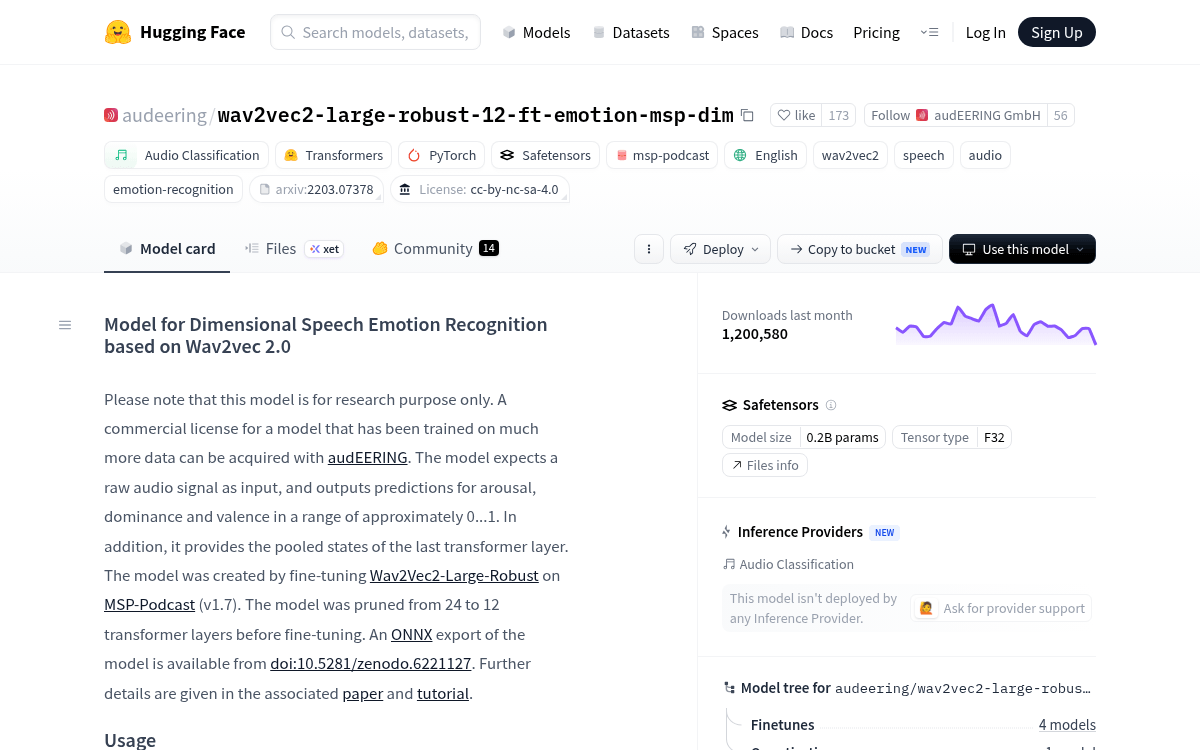
A wav2vec2 model fine-tuned on MSP-Podcast predicts arousal, dominance, and valence from raw audio, crossing 1.2 million downloads on Hugging Face.
 Pro
Takeaways
- audEERING's wav2vec2 emotion model surpassed 1.2M downloads on Hugging Face.
- Predicts arousal, dominance, and valence as continuous values from raw 16 kHz audio.
- Built by pruning wav2vec2-large-robust from 24 to 12 layers, then fine-tuning on MSP-Podcast v1.7.
- TPAMI paper reports 0.638 CCC on valence without any text input.
- Licensed CC BY-NC-SA 4.0 for research; commercial use requires an audEERING license.
- Model is robust across sex groups but not calibrated per-speaker, per authors' own analysis.
A speech emotion recognition model from German audio AI firm audEERING has quietly become one of the most-used audio classification checkpoints on Hugging Face. The audEERING checkpoint has surpassed 1.2 million downloads, and it keeps trending because it solves a problem the newer LLM-centric audio stack still handles poorly: reading emotional tone directly from a voice signal, without transcription.
Rather than classifying speech into buckets like happy, sad, or angry, the model predicts three continuous values from a raw audio signal: arousal, dominance, and valence, each in a range of roughly 0 to 1. It also exposes the pooled states of the last transformer layer, which double as a general-purpose paralinguistic embedding you can feed into downstream classifiers.
The dimensional emotion trick
Categorical emotion labels are messy. Two annotators can disagree on whether a clip is frustrated or angry, and every dataset invents its own taxonomy. The dimensional approach sidesteps this by placing every utterance in a 3D space:
- Arousal: how activated or energetic the voice sounds, from calm to excited.
- Valence: how positive or negative the emotional tone is.
- Dominance: how in-control or submissive the speaker sounds.
An audEERING engineer explained the intuition in a community thread: categorical emotions can be thought of as points inside a unit 3D cube, so a label like "relaxed" maps to roughly arousal=0.1, dominance=0.1, valence=0.99. Because MSP-Podcast is already annotated on these axes, the model was trained as a regression problem end to end.
How it was built
The checkpoint was produced by fine-tuning Wav2Vec2-Large-Robust on MSP-Podcast (v1.7), with the backbone first pruned from 24 to 12 transformer layers. That halving is why the weights come in at roughly 200M parameters instead of the full 300M+ of the original wav2vec2-large. On top of the backbone sits a small regression head: a dense layer, tanh activation, dropout, and a linear projection to three outputs.
The accompanying paper, Dawn of the transformer era, published in IEEE TPAMI, is where the interesting research finding lives. Valence has historically been the hard dimension because sarcasm, context, and word choice matter more than pitch or energy. The authors report a concordance correlation coefficient of 0.638 on MSP-Podcast for valence without any explicit text input, and argue the transformer is implicitly learning linguistic content during fine-tuning, which is why it matches multimodal systems that rely on ASR transcripts.
Using it
The high-level path is a one-liner through the Transformers pipeline:
from transformers import pipeline
pipe = pipeline("audio-classification",
                model="audeering/wav2vec2-large-robust-12-ft-emotion-msp-dim")
For production use you probably want the custom regression head from the model card, which returns both the emotion vector and the pooled embedding. On a 1-second dummy signal at 16 kHz, the model returns an array like [0.546, 0.606, 0.404] for arousal, dominance, valence. An ONNX export is also available if you want to skip PyTorch entirely for edge deployment.
Cost and licensing caveats
The weights are free to download, though the license is the sharp edge. The checkpoint is released for research purposes only under CC BY-NC-SA 4.0, which rules out most product deployments without a separate agreement. audEERING sells a beefier commercial variant, trained on more data, through its devAIce product line.
Where it fits and where it breaks
Practical use cases include call center analytics, voice agent quality monitoring, dubbing and TTS evaluation, mental health research, and use as a frozen feature extractor for downstream paralinguistic tasks. The pooled embeddings are especially useful when you have a small labeled dataset and need a strong pretrained audio representation that already encodes affect.
Known rough edges show up regularly in the community tab. Users have reported that the Hugging Face audio-classification pipeline sometimes returns unexpected values because it may not attach the correct classification head, which is why the manual loading pattern with the custom EmotionModel class is the safer route. The paper itself flags that while the model is robust to small perturbations and fair across biological sex groups, it is not fair across individual speakers, so per-speaker calibration is often necessary for longitudinal analysis.
For anyone building voice interfaces or audio analytics pipelines, this checkpoint remains the default open baseline for dimensional speech emotion recognition, and the sustained download growth suggests nothing in the newer generation of audio foundation models has meaningfully displaced it yet for this specific task.