
Apple's OpenELM Beats OLMo With 2x Fewer Training Tokens on Device
Apple's fully open 1.1B parameter instruction model uses layer-wise parameter scaling to beat OLMo with half the training tokens.
 Pro
Takeaways
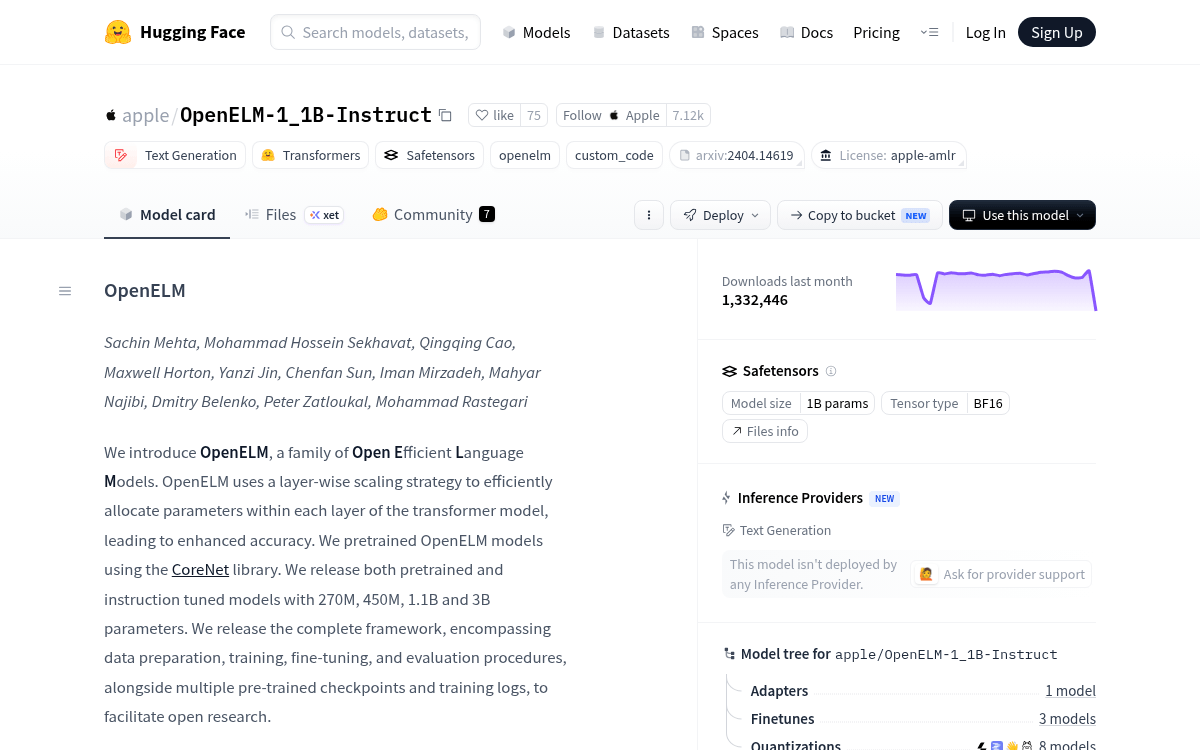
- Apple's OpenELM-1_1B-Instruct passes 1.3M downloads on Hugging Face
- Layer-wise scaling gives 2.36% accuracy gain over OLMo with half the training tokens
- Family spans 270M, 450M, 1.1B, and 3B parameters, base and instruct variants
- Trained on 1.8T tokens from RefinedWeb, PILE, RedPajama, and Dolma subsets
- Full pipeline open sourced via CoreNet, including logs and checkpoints
- Weak MMLU (25.65) makes it unsuitable for knowledge-heavy production chatbots
Apple's machine learning research team has been quietly building a reputation on Hugging Face, and one of the clearest signs is OpenELM-1_1B-Instruct, a compact instruction tuned language model that has racked up over 1.3 million downloads. The release matters less for raw benchmark supremacy than for how completely it opens up the recipe behind a modern small LLM, and it lands in a sweet spot for on-device inference.
A smarter way to spend parameters
OpenELM is a family of four checkpoints at 270M, 450M, 1.1B, and 3B parameters, each shipping in a base and instruction tuned flavor. The core idea is a layer-wise scaling strategy that allocates parameters non-uniformly across the network. Rather than making every transformer block identical, OpenELM varies the width and attention configuration across depth, spending more capacity where it helps most.
The payoff is measurable. At roughly one billion parameters, OpenELM shows a 2.36% accuracy improvement over OLMo while requiring 2x fewer pre-training tokens. That efficiency is the real headline, since it suggests the community has been leaving performance on the table by treating transformer layers as uniform blocks.
What is under the hood
The 1.1B model is a fairly standard modern decoder stack with the layer-wise twist bolted on. The architecture is decoder-only and incorporates grouped query attention, flash attention, pre-normalization using RMSNorm, rotary positional embeddings, a SwiGLU feed forward network, and the tokenizer from LLaMA. The 1.1B variant specifically has 28 layers, a 2048 embedding dimension, a head dimension of 64, and a context length of 2048.
On the data side, the pre-training corpus combines RefinedWeb, deduplicated PILE, a subset of RedPajama, and a subset of Dolma v1.6, totaling approximately 1.8 trillion tokens. The instruction tuned variants were then aligned on the UltraFeedback preference dataset. Training ran on Apple's CoreNet library, which is also open sourced.
Benchmarks in context
OpenELM-1_1B-Instruct posts a 65.50 zero-shot average across seven standard reasoning tasks, and a 54.40 average on the OpenLLM Leaderboard suite. Instruction tuning consistently lifts the base model, with the biggest gains on HellaSwag (71.83 vs 65.71) and TruthfulQA (45.95 vs 36.98). Here is how the family scales:
| Model | Zero-shot Avg | OpenLLM Avg |
|---|---|---|
| OpenELM-270M-Instruct | 55.11 | 46.66 |
| OpenELM-450M-Instruct | 59.95 | 49.25 |
| OpenELM-1.1B-Instruct | 65.50 | 54.40 |
| OpenELM-3B-Instruct | 69.15 | 55.73 |
Independent analysis backs up the story that Apple is competitive at this scale. The 0.45B model beats its MobiLlama 0.5B counterpart, a similar pattern holds for the 1.1B variant, and the 3B tops all other models in the comparison table. MMLU is the obvious weak point. The 1.1B-Instruct scores 25.65, which is barely above chance, so reach elsewhere when you need broad factual knowledge.
Getting it running
The model loads through Hugging Face Transformers with a one-liner, though you need trust_remote_code=True because it ships a custom modeling file. A minimal setup looks like:
from transformers import AutoModelForCausalLM, AutoTokenizer
tok = AutoTokenizer.from_pretrained("meta-llama/Llama-2-7b-hf")
model = AutoModelForCausalLM.from_pretrained(
    "apple/OpenELM-1_1B-Instruct",
    trust_remote_code=True,
    device_map="auto",
)
Note the tokenizer swap. OpenELM reuses the LLaMA 2 tokenizer, and the model card flags that add_bos_token must be set to True when running evaluations through lm-eval-harness. The weights are BF16 and around 2GB, so they fit comfortably on a single consumer GPU or on Apple silicon. Apple's own benchmarking used a MacBook Pro with an M2 Max and 64 GiB of RAM, porting the code and weights to Apple MLX v0.10.0 and using lazy evaluation with 8 tokens at a time to maximize throughput.
Research license, research value
OpenELM ships under the Apple Sample Code License, a research license rather than a permissive commercial one like Apache 2.0. That limits production use, but the deeper value is in the transparency. Apple released both pretrained and instruction tuned models at all four sizes, along with the complete framework covering data preparation, training, fine-tuning, and evaluation, plus multiple pre-trained checkpoints and training logs.
Practical situations where the 1.1B-Instruct is a reasonable pick:
- On-device assistants where latency and memory dominate and you can tolerate weaker knowledge coverage
- Fine-tuning experiments where you want a small, transparent base to iterate quickly
- Research on layer-wise scaling, distillation, or quantization with a fully documented training pipeline
- Educational settings where seeing every ingredient of a modern LLM matters more than SOTA numbers
Where it falls short is anywhere that needs strong world knowledge, multi-turn reasoning, or safety guarantees. Apple ships the models without safety guarantees and warns of possible inaccurate, harmful, biased, or objectionable outputs, so users need thorough safety testing and appropriate filtering. Treat it as a research base rather than a drop-in chatbot and it earns its download count.