
Ant Group's Ling-3.0-tiny Runs Reasoning on a MacBook at 90 tok/s
Ant Group's open-weight 7.9B MoE runs on a MacBook, activates only 1.3B parameters per token, and ships in BF16, FP8, and INT4.
Takeaways
- Ant Group's inclusionAI released Ling-3.0-tiny, a 7.9B MoE with 1.3B active parameters, MIT-licensed.
- Available in BF16, FP8, and INT4 formats on Hugging Face and ModelScope.
- Uses a 3:1 KDA to MLA hybrid attention stack with 128 experts, 8 routed and 1 shared active per token.
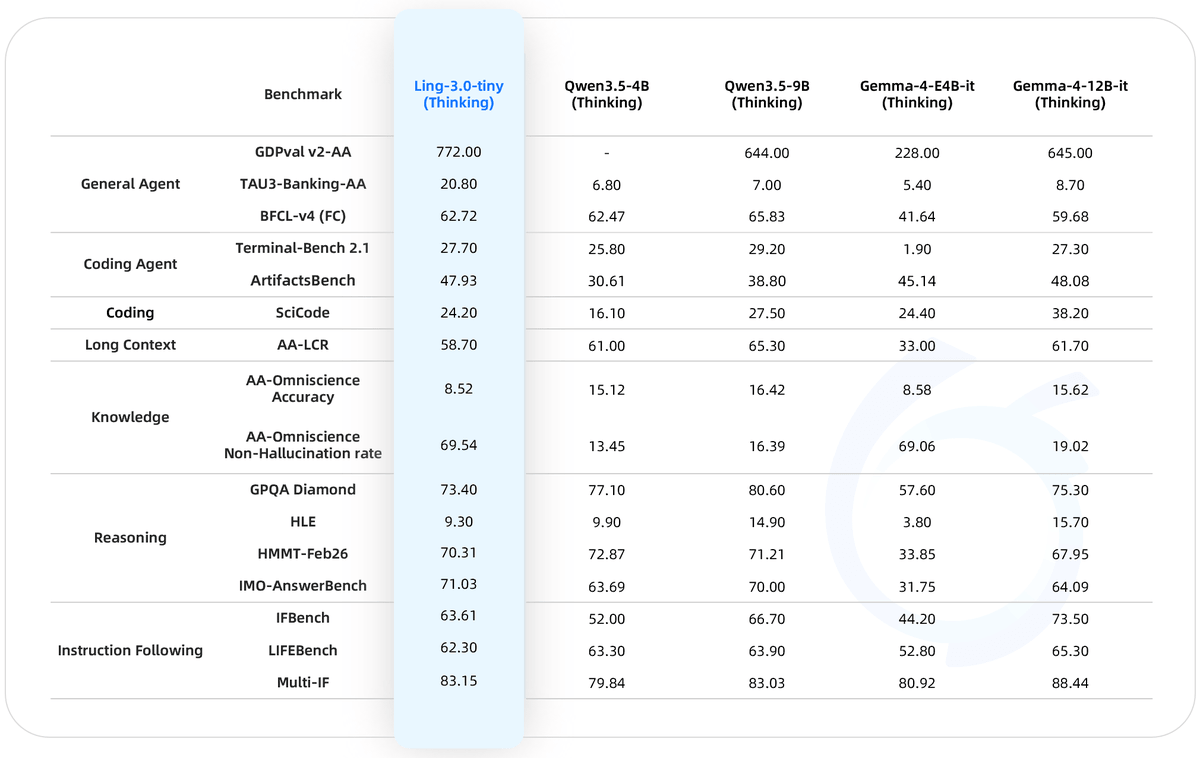
- Scores 25 on Artificial Analysis Intelligence Index, 73.4 on GPQA Diamond, 71.0 on IMO-AnswerBench.
- Runs ~100 tok/s on DGX Spark FP8 and ~86-90 tok/s on an M4 Pro MacBook.
- Supported via SGLang, vLLM, and Ollama for local deployment.
Ant Group's inclusionAI lab has released Ling-3.0-tiny, a compact mixture-of-experts model that fits on consumer hardware without giving up reasoning quality. It packs 7.9B total parameters with only 1.3B activated per token, targets strong reasoning and agentic behavior at low inference cost, and ships in BF16, FP8, and INT4 checkpoints. All three variants are MIT-licensed and live on Hugging Face and ModelScope.
The pitch is straightforward: a hybrid-attention MoE that keeps per-token compute close to a 1B dense model while behaving like something much larger. It interleaves Kimi Delta Attention (KDA) linear-attention layers with gated Multi-head Latent Attention (MLA) full-attention layers on top of a fine-grained MoE feed-forward network, holding per-token inference cost near a ~1B dense model while retaining large-model capacity.
The 3:1 ratio doing the heavy lifting
The core design choice is how often the model uses cheap attention versus expensive attention. Ling-3.0-tiny uses a 3:1 KDA and MLA hybrid attention stack with 128 sparse MoE experts, activating 8 routed and 1 shared expert per token. Three KDA layers run for every one MLA layer inside each 4-layer block.

KDA is a linear-attention variant with roots in Moonshot AI's research that scales cheaply with sequence length. MLA compresses the key-value cache into a smaller latent representation so full attention stays affordable. Mixing them in a 3:1 ratio gives the model three cheap long-range passes for every one precise full-attention pass. KDA offers fine-grained control over long-range memory, while 1/64 expert activation keeps MoE compute lean.