
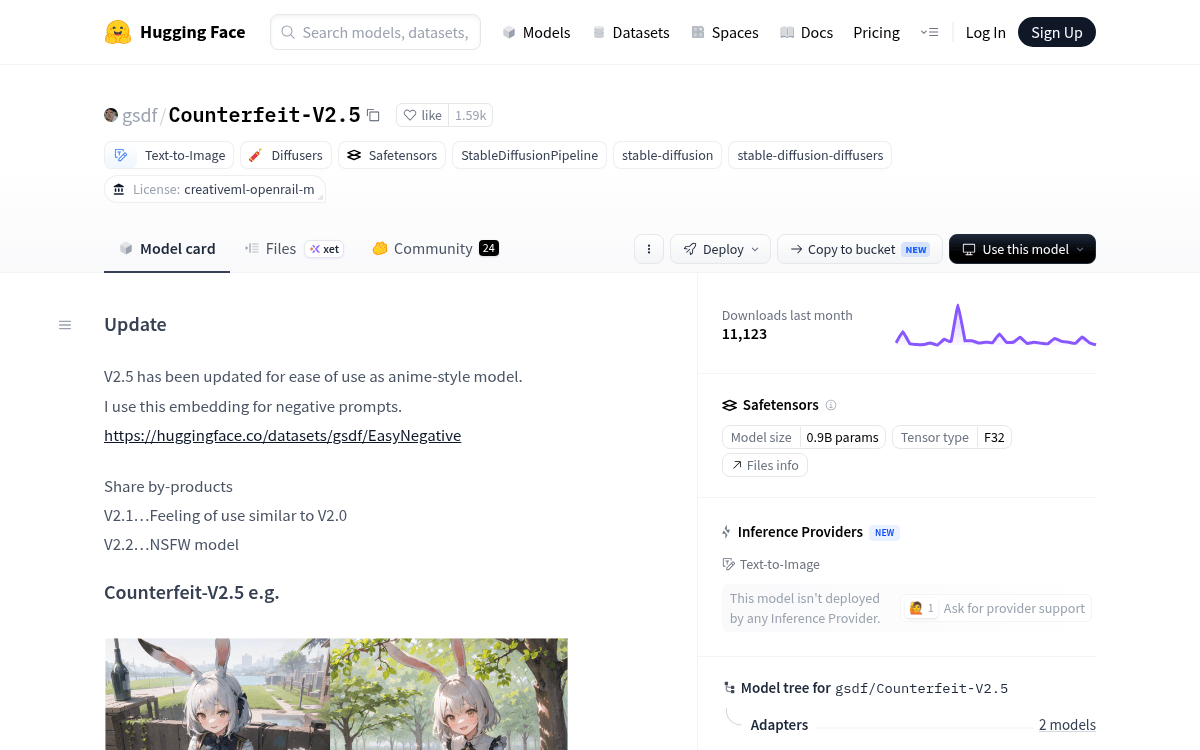
Anime AI Model Counterfeit-V2.5 Surges Back With 1,500 Fans on Hugging Face
A community anime-style Stable Diffusion checkpoint is trending again, powered by EasyNegative embeddings and dialed-in sampler settings for clean illustrations.
 Pro
Takeaways
- Counterfeit-V2.5 is trending again on Hugging Face with over 1,500 likes.
- Anime-focused SD1.5 checkpoint built via DreamBooth, block-weight merges, and LoRA merges.
- Designed to pair with the EasyNegative textual inversion embedding for negative prompts.
- Recommended recipe: DPM++ 2M Karras sampler, 20 steps, CFG 10, 1.8x Latent hires upscale.
- Free under CreativeML OpenRAIL-M, works with Diffusers, Draw Things, DiffusionBee, Colab.
- Best for anime illustrations, character design, and lightweight Spaces on modest GPUs.
A community favorite from the Stable Diffusion 1.5 era is back on Hugging Face's trending list. Counterfeit-V2.5, maintained by user gsdf, is an anime-style text-to-image checkpoint that has quietly accumulated over 1,500 likes and now powers more than 100 public Spaces on the Hub. The resurgence of an older, specialized SD1.5 checkpoint says something about how much creative mileage is still left in well-tuned models from that generation.
Counterfeit-V2.5 is tuned specifically for anime illustration, with a focus on character work: detailed outfits, expressive faces, and the kind of dappled outdoor lighting that shows up in cover art for light novels. It evolves the earlier Counterfeit-V2.0, which combined DreamBooth fine-tuning with Merge Block Weights and LoRA merging to shape its look.
What actually changed in V2.5
V2.5 is not a retraining from scratch. The author describes it as an ease-of-use update, and in practice that means the checkpoint responds better to short, tag-style prompts (the danbooru-flavored comma lists that anime SD users already write) and needs less prompt engineering to land a clean composition. Two by-products ship alongside it: V2.1 for those who preferred the V2.0 feel, and V2.2 as an NSFW-oriented variant.
The EasyNegative trick
The single most important thing to know about running this model is that it is designed to be paired with a textual inversion embedding called EasyNegative. Instead of writing a long negative prompt listing every artifact you want to avoid (bad hands, extra fingers, blurry, watermark, and so on), you drop the EasyNegative token into the negative field and let the learned embedding handle the cleanup. The sample prompts on the model card use nothing more than EasyNegative, extra fingers, fewer fingers as a full negative prompt.
Recommended settings
The model card publishes exact generation parameters for each sample image, which is unusually useful. The published recipe is consistent across samples:
- Sampler: DPM++ 2M Karras
- Steps: 20
- CFG scale: 10
- Hires upscale: 1.8x with the Latent upscaler
- Denoising strength: 0.58 to 0.6
- Resolutions in the 512 to 960 range on the long side
Wiring it up
The checkpoint is distributed as safetensors and is Diffusers-compatible, so you can wire it up in a few lines of Python:
import torch
from diffusers import DiffusionPipeline
pipe = DiffusionPipeline.from_pretrained(
    "gsdf/Counterfeit-V2.5",
    dtype=torch.bfloat16,
    device_map="cuda",
)
prompt = "((masterpiece, best quality)), 1girl, solo, school uniform, cityscape, night"
image = pipe(prompt).images[0]
It also imports cleanly into local apps like Draw Things and DiffusionBee, and there are ready-made Colab and Kaggle notebooks linked from the model page. The license is the standard creativeml-openrail-m, meaning free use with the usual OpenRAIL content restrictions.
Strengths and rough edges
The model excels at single-character portraits with elaborate outfits, kimono and school uniform scenes, and outdoor environments with some architectural detail. The sample gallery leans heavily into this territory, and the results hold together at the recommended settings without much fuss.
The weaknesses are the standard SD1.5 ones. It is a 512-native model, so pushing past roughly 768 on the long side without hires-fix will produce duplicated limbs and warped anatomy. It has no native text rendering, no photorealism, and it will not follow long natural-language prompts the way SDXL or a modern DiT-based model will. Hands remain a coin flip without the negative embedding.
Where it fits in the current stack
There is already a Counterfeit-V3.0, and the broader anime image-gen world has moved on to SDXL-based checkpoints, Pony derivatives, and Illustrious. So why is V2.5 still trending? Two reasons. First, it is small (SD1.5 weights fit comfortably on a 6GB GPU) and fast, which matters for hobbyists and for Spaces running on modest hardware. Second, its aesthetic is distinctive enough that people still use it as a base for LoRA training and merges. Common downstream work includes illustrations for light novels, manga, and web novels, character designs for anime-inspired games, concept art for worldbuilding, and avatars.
If you already work in the modern SDXL or Flux ecosystem for anime, V2.5 will not replace anything in your pipeline. But if you want a lightweight, well-documented SD1.5 checkpoint with a proven prompt recipe and a battle-tested negative embedding, it remains one of the cleanest options in that class.