
Amazon's Chronos-2 Beats Its Predecessor 90% of the Time at Multivariate Forecasting
Amazon's new open-source foundation model brings zero-shot multivariate and covariate-aware time series forecasting into a single 120M-parameter architecture.
 Pro
Takeaways
- Amazon released Chronos-2, a 120M-parameter encoder-only time series foundation model under Apache 2.0.
- Handles univariate, multivariate, and covariate-informed forecasting zero-shot in a single architecture.
- Group attention mechanism enables in-context learning across related series, variates, and covariates.
- State of the art on fev-bench, GIFT-Eval, and Chronos Benchmark II, with over 90% win rate versus Chronos-Bolt.
- Runs 300+ forecasts per second on an A10G GPU; supports 8192 context and 1024 prediction length.
- Available via
chronos-forecasting, AutoGluon, and SageMaker; see the technical report.
Time series forecasting has been the awkward middle child of the foundation model era. LLMs devoured every modality in sight, while the pretrained forecasting models that landed on Hugging Face over the last two years mostly did one thing: predict a single series from its own past. Amazon's Chronos-2 is an attempt to close that gap, and the download counts suggest people were waiting for it.
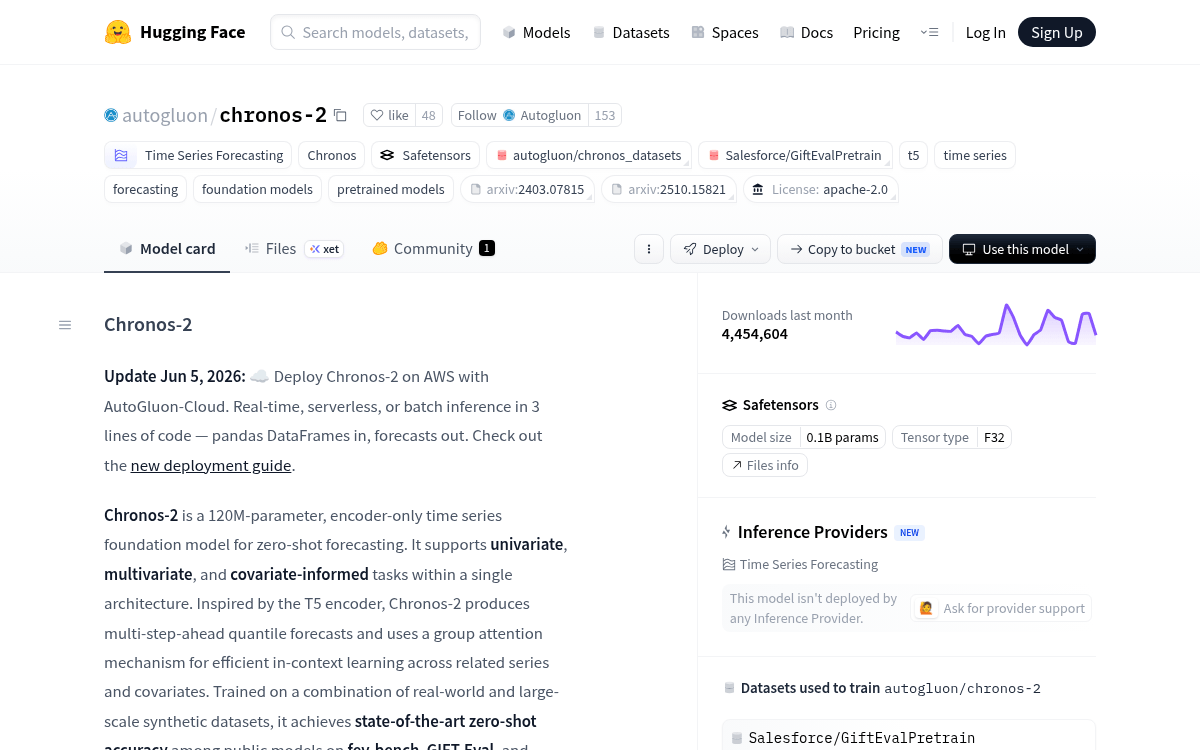
Chronos-2 is a 120M-parameter, encoder-only time series foundation model for zero-shot forecasting that supports univariate, multivariate, and covariate-informed tasks within a single architecture. It ships under Apache 2.0, runs on both CPU and GPU, and is already available through Hugging Face, the chronos-forecasting Python package, and Amazon SageMaker.
From one series to many, without retraining
The limitation the team wants to fix is easy to state. Earlier Chronos releases, along with most other time series foundation models, could only forecast one series at a time from its own history. Real forecasting problems rarely look like that in practice. Cloud CPU, memory, and I/O metrics move together. Retail demand depends on promotions and holidays. Energy load depends on weather.
Chronos-2 is inspired by the T5 encoder, produces multi-step-ahead quantile forecasts, and uses a group attention mechanism for efficient in-context learning across related series and covariates. The same model handles three regimes without task-specific training:
- Univariate: forecast a single series from its history, like the original Chronos.
- Multivariate: jointly predict several coevolving series and capture their dependencies.
- Covariate-informed: condition on external drivers, both past-only (historical traffic) and known-future (scheduled promotions, weather forecasts), including categorical ones like holiday type.
All three modes work zero-shot. You pass in a pandas DataFrame with target columns and optional covariate columns, and the model figures out the structure from context.
Group attention, in plain English
The key architectural piece is what the authors call group attention. Each transformer block alternates between time attention across patches within a single series and group attention across all series within a group at each patch index. A group can be a set of related series, the variates of a multivariate series, or a target with its covariates.
That alternation is what makes in-context learning practical for forecasting. The model does not need to know in advance how many variables you have or how they relate. It infers those interactions from what you provide at inference time, the same way an LLM adapts to a new task from a few examples in the prompt.
The context and horizon budgets also grow substantially over prior Chronos versions:
| Capability | Chronos-2 | Chronos-Bolt | Chronos |
|---|---|---|---|
| Multivariate forecasting | Yes | No | No |
| Past covariates | Yes | No | No |
| Known future covariates | Native | External only | External only |
| Max context length | 8192 | 2048 | 512 |
| Max prediction length | 1024 | 64 | 64 |
Manufacturing the data that did not exist
Universal forecasting has a data problem: high-quality pretraining corpora with multivariate dependencies and informative covariates are scarce. The team's answer was to generate them. They imposed diverse multivariate structures on top of series sampled from base univariate generators, producing synthetic datasets that teach the model to reason about interactions between variables.
The training mix combines a subset of the public Chronos Datasets, a subset of GIFT-Eval Pretrain, and this synthetic multivariate and covariate data. The result is a model that reportedly did not need to see your dataset's specific structure to reason about it.
Benchmarks
Amazon evaluates against three benchmarks that together cover most of the space. Chronos-2 achieves the best performance on fev-bench, GIFT-Eval, and Chronos Benchmark II amongst pretrained models. Two results stand out from the technical writeup:
- On fev-bench covariate tasks, in-context learning delivers large gains, and Chronos-2 beats TabPFN-TS and COSMIC, the only other pretrained baselines that even accept covariates.
- Against its own predecessor Chronos-Bolt, Chronos-2 achieves a win rate above 90% in head-to-head comparisons.
Efficiency has not been sacrificed for the added capability. Chronos-2 delivers over 300 time series forecasts per second on a single A10G GPU and supports both GPU and CPU inference. A smaller 28M-parameter chronos-2-small variant is available for tighter latency or memory budgets.
Using it
The Python API is intentionally boring, which is the point. Install chronos-forecasting, pass in a DataFrame, get quantile forecasts out:
import pandas as pd
from chronos import Chronos2Pipeline
pipeline = Chronos2Pipeline.from_pretrained(
    "amazon/chronos-2", device_map="cuda"
)
context_df = pd.read_parquet("train.parquet")
future_df = pd.read_parquet("test.parquet").drop(columns="target")
pred_df = pipeline.predict_df(
    context_df,
    future_df=future_df,
    prediction_length=24,
    quantile_levels=[0.1, 0.5, 0.9],
    id_column="id",
    timestamp_column="timestamp",
    target="target",
)
The future_df argument is where known-future covariates go, which is the piece older Chronos versions could not do natively. For production use, the AutoGluon-Cloud guide supports real-time endpoints, serverless, and batch inference on SageMaker with a similar pandas-in, forecasts-out API. SageMaker JumpStart provides a lower-level path if you need fine-grained control over the deployment.
Inside AutoGluon-TimeSeries itself, Chronos-2 shows up as Chronos2Model with a cross_learning flag on by default, which makes it produce joint predictions across the series in a batch rather than treating each independently.
Who this is for
The practical use cases the team highlights are exactly the places where univariate forecasting has always felt insufficient:
- Cloud operations: joint forecasting of CPU, memory, and I/O so bottlenecks can be anticipated together instead of one metric at a time.
- Retail demand: incorporating promotions, holidays, and other known-future events into demand predictions to drive inventory.
- Energy: pulling in weather forecasts and other external drivers of load.
- Cold-start scenarios: a new distribution center or store can borrow patterns from existing ones through cross-learning across items.
Where it will struggle is where any pretrained forecaster struggles. Zero-shot inference cannot invent structure that is not in the context, so extremely short histories, regime shifts that never appear in the training distribution, and highly domain-specific dynamics still benefit from fine-tuning. The AutoGluon integration supports that path too, so the model can be treated either as a drop-in zero-shot forecaster or as a starting checkpoint.
What has actually changed
The Chronos and Chronos-Bolt models have collectively been downloaded more than 600 million times from Hugging Face, and Chronos-2 alone has racked up over 4.4 million downloads in a single month on the AutoGluon repository. The interesting shift sits underneath those numbers. Time series foundation models have effectively been treated as clever pattern extrapolators for one variable at a time. Chronos-2 argues that the same in-context learning idea that turned LLMs into general-purpose tools works for forecasting, once the architecture and the training data are built for groups of series rather than individual ones. If that holds up under more independent evaluation, the era of stitching together separate models for univariate baselines, covariate regressors, and multivariate dependencies may be ending.
