
Alibaba's Wan2.1 Beats Closed Video AI With a Free 14B Open Model
Alibaba's Wan team drops an Apache 2.0 text-to-video suite that runs on a 4090, beats closed-source rivals, and renders legible text in Chinese and English.
 Pro
Takeaways
- Wan-AI released Wan2.1-T2V-14B, an Apache 2.0 text-to-video model beating closed-source systems on internal benchmarks.
- The 1.3B sibling runs a 5-second 480P clip on an RTX 4090 in about 4 minutes using 8.19GB VRAM.
- First open video model to render legible Chinese and English text inside generated video.
- Uses Wan-VAE, a 3D causal VAE that encodes and decodes 1080P videos of arbitrary length.
- Architecture is a Flow-Matching DiT with UMT5 cross-attention text conditioning, at 5120 dim and 40 layers.
- Supports Diffusers, ComfyUI, and DiffSynth-Studio with FP8 quantization and LoRA training via the GitHub repo.
Alibaba's Wan-AI team has released Wan2.1-T2V-14B, a 14 billion parameter text-to-video model that beats leading closed-source systems on its internal benchmark suite while shipping under an Apache 2.0 license. Alongside it come smaller siblings (T2V-1.3B, I2V-14B at 480P and 720P), consumer-GPU support, and a video VAE that can compress 1080P clips of arbitrary length. The release includes working inference code, multi-GPU sharding, and Gradio demos out of the box, making it one of the strongest open-weights video generation drops so far.
What actually shipped
The repository publishes weights, inference code, and multi-GPU code for both the 14B and 1.3B text-to-video models, plus a 14B image-to-video model in two resolutions. According to the model card, T2V-14B sets a new SOTA across open and closed systems on their eval suite, handles heavy motion, and is the only video model that can render both Chinese and English characters inside generated frames while supporting 480P and 720P output.
Everything is Apache 2.0, so commercial use is on the table. Four variants are available on Hugging Face and ModelScope:
- Wan2.1-T2V-14B: text-to-video, 480P and 720P
- Wan2.1-T2V-1.3B: text-to-video, 480P, consumer-GPU friendly
- Wan2.1-I2V-14B-720P: image-to-video at 720P
- Wan2.1-I2V-14B-480P: image-to-video at 480P
The consumer-GPU angle
The headline number for anyone without a datacenter: T2V-1.3B needs only 8.19 GB of VRAM, fitting on nearly any consumer-grade card, and can generate a 5-second 480P clip on an RTX 4090 in about four minutes with no quantization or other tricks, at quality comparable to some closed-source systems. The 14B model is heavier, but the repo ships --offload_model True and --t5_cpu flags to squeeze it onto a single 4090, plus FSDP + xDiT USP sharding for multi-GPU inference.

A minimal run on a single GPU looks like this:
python generate.py --task t2v-14B \
  --size 1280*720 \
  --ckpt_dir ./Wan2.1-T2V-14B \
  --prompt "Two anthropomorphic cats in comfy boxing gear fight on a spotlighted stage."
For 8-way inference, the same script runs under torchrun with FSDP flags and --ulysses_size 8, invoking the Ulysses sequence-parallel scheme from xDiT for splitting attention across devices.
Inside Wan-VAE and the flow-matching DiT
Wan2.1 follows the diffusion transformer recipe that has become standard, with two design bets that matter. Wan-VAE encodes and decodes 1080P videos of any length while preserving temporal information, sidestepping the fixed-length latent windows that limit many competing VAEs. It is a 3D causal VAE, meaning it compresses jointly across space and time and only looks at past frames when encoding, so it can stream long clips without losing history.

The generator is a Diffusion Transformer trained with Flow Matching, an objective that learns a straight-line vector field between noise and data rather than the noisier score-matching path used by classical diffusion. Text conditioning runs through a UMT5 encoder that feeds cross-attention inside each DiT block, which is where the bilingual prompt handling comes from. The 14B variant uses a model dimension of 5120, feedforward dimension of 13824, 40 attention heads, and 40 transformer layers.
Benchmark numbers
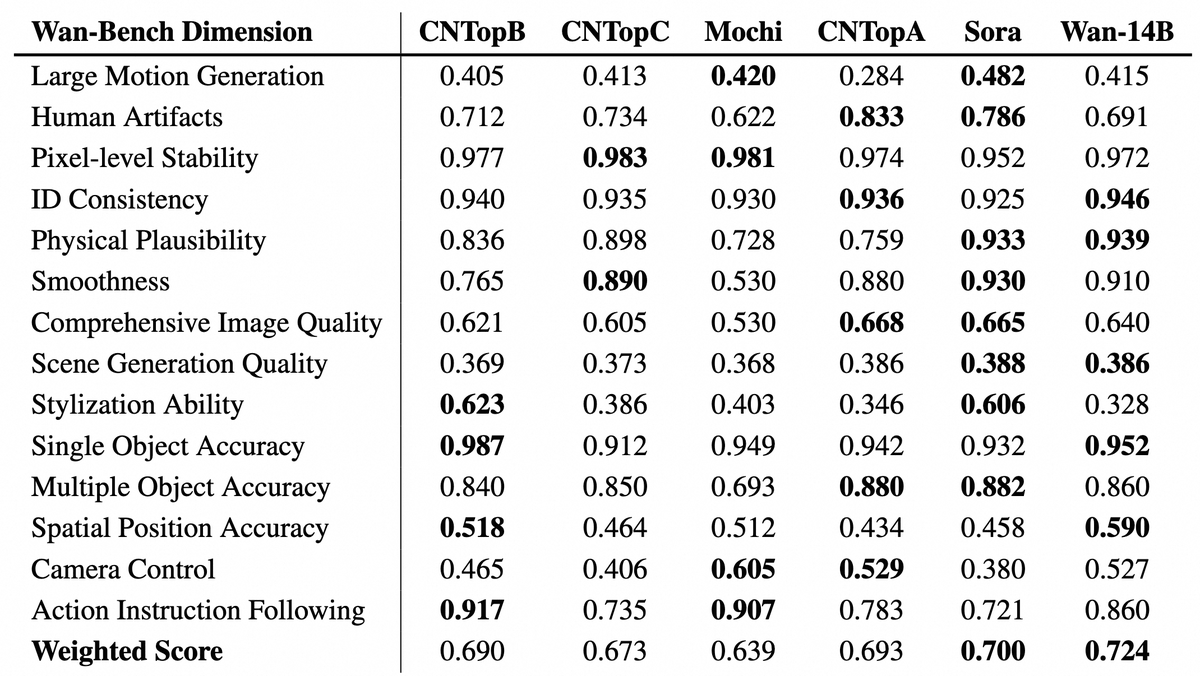
The team built a 1,035-prompt internal evaluation suite covering 14 major dimensions and 26 sub-dimensions, then weighted results by human preferences to produce a total score. On this suite, Wan2.1 outperforms existing open-source models and state-of-the-art commercial systems across multiple axes. Manual head-to-head evaluation with prompt extension enabled also puts it ahead of closed-source Chinese commercial systems (labeled CN-TopA/B/C in the paper) and Runway.

Prompt extension is worth knowing about. The repo ships two paths: calling Alibaba's Dashscope API with qwen-plus, or running a local Qwen2.5-Instruct model to rewrite short user prompts into denser, detail-rich descriptions. The eval numbers assume prompt extension is on, and the quality gap without it is noticeable.
Where it shines and where it stumbles
Strengths, based on the model card and demos:
- Motion dynamics: handles fast, multi-object action better than most open baselines
- Legible on-screen text: the first open video model to render Chinese and English characters inside generated video with reasonable fidelity
- Multiple tasks from one family: text-to-video, image-to-video, video editing, text-to-image, and video-to-audio all share the same VAE and DiT backbone
- Long-form VAE: because Wan-VAE handles arbitrary-length 1080P input, downstream editing and extension pipelines are not capped by fixed context windows
The rough edges are also real. A 720P clip on the 14B model takes minutes, not seconds. The 1.3B model can technically generate 720P, but training at that resolution was limited, so results are less stable than at 480P, which the authors recommend for best quality. And the license, while permissive, still puts responsibility for generated content on the user.
Ecosystem and how to run it
The GitHub repo lists an increasingly complete integration story. Diffusers and ComfyUI integrations landed after the initial release, and DiffSynth-Studio adds video-to-video, FP8 quantization, VRAM optimization, and LoRA training. FP8 support in particular is what makes the 14B model tractable for anyone running a single high-end consumer card.
A minimal Diffusers snippet, once integration lands, follows the pattern the model card advertises:
import torch
from diffusers import DiffusionPipeline
pipe = DiffusionPipeline.from_pretrained(
    "Wan-AI/Wan2.1-T2V-14B",
    dtype=torch.bfloat16,
    device_map="cuda",
)
video = pipe("Astronaut in a jungle, cold color palette, 8k").frames[0]
Why this release matters
Video generation has, until now, been dominated by closed models where you pay per second of output and cannot fine-tune, distill, or inspect what is happening. Wan2.1 puts a competitive stack in the open with weights, training recipe details, a 3D causal VAE that handles arbitrary-length 1080P, and a bilingual text encoder. For anyone building a video pipeline, an image-to-video product, or a fine-tuned character or style LoRA, this is the strongest open foundation currently available. It also sets the baseline that the follow-up Wan2.2 family, which introduces mixture-of-experts routing across denoising steps, has since built on.