
Alibaba's Qwen3-VL Rivals GPT-5-Mini on a Single 24GB GPU
A 4-bit AWQ build of Qwen3-VL-30B-A3B-Instruct shrinks the MoE vision-language model to 17GB while keeping 256K context and full multimodal skills.
 Pro
Takeaways
- QuantTrio released a 4-bit AWQ quantization of Qwen3-VL-30B-A3B-Instruct at 17GB total size.
- MoE architecture with 30B total and 3B active parameters, Apache 2.0 licensed.
- Native 256K context expandable to 1M, with second-level video indexing.
- OCR now covers 32 languages, up from 19 in Qwen2.5-VL.
- Runs on vLLM 0.11+ and SGLang with OpenAI-compatible API, tensor-parallel supported.
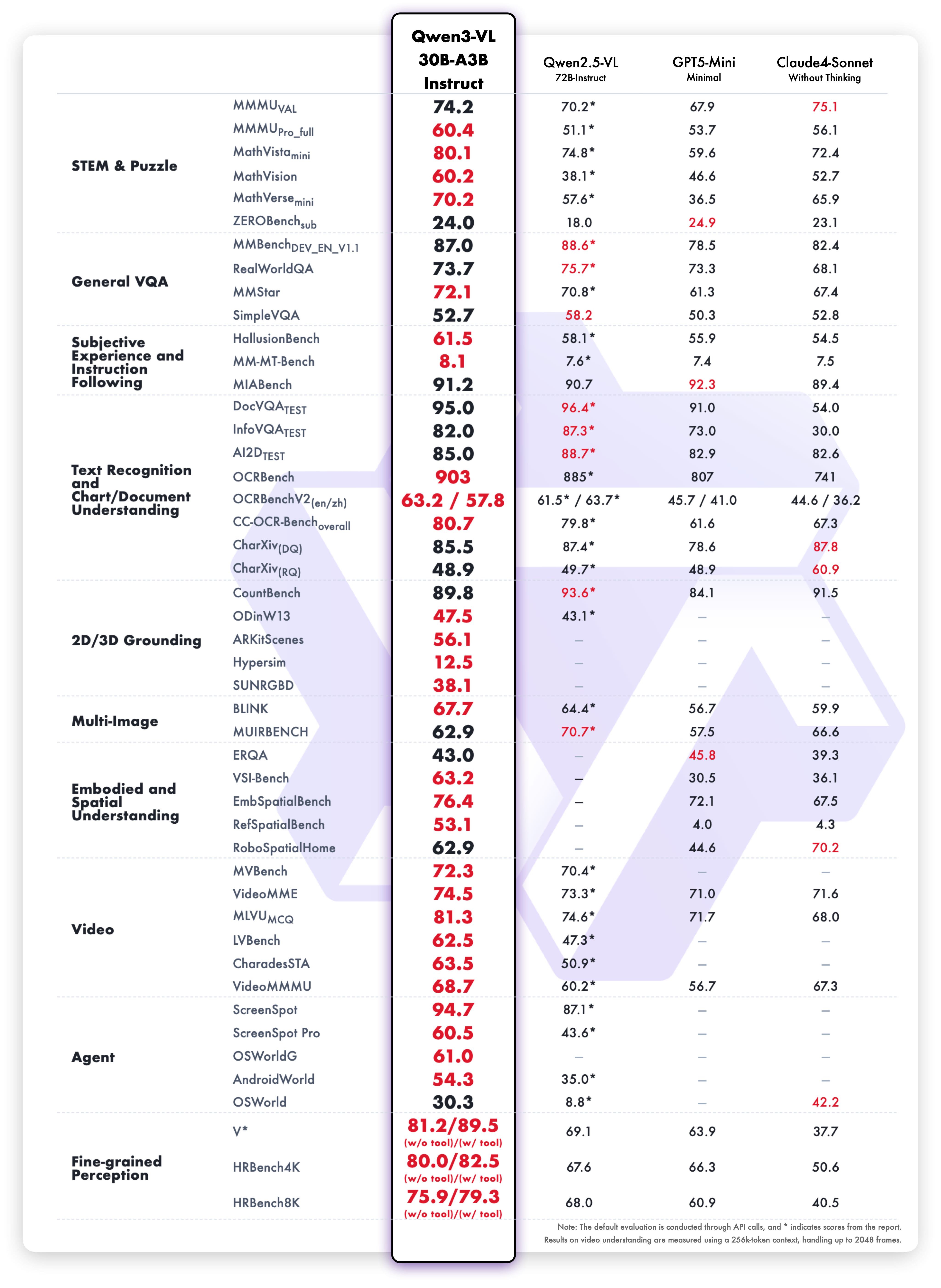
- Base model benchmarks rival GPT-5-Mini and Claude 4 Sonnet on STEM, VQA, OCR, video, and agent tasks.
A 4-bit AWQ quantization of Alibaba's Qwen3-VL-30B-A3B-Instruct is now on Hugging Face, packing the entire mixture-of-experts vision-language model into a 17GB checkpoint that fits comfortably on a single 24GB GPU. The QuantTrio build targets vLLM and SGLang serving stacks, and preserves the base model's full multimodal capabilities including image, video, and long-context reasoning.
Qwen3-VL-30B-A3B-Instruct is a sparse MoE in the Qwen3-VL family, with about 30B total parameters and roughly 3B activated per token. That 3B active-parameter budget is what makes AWQ interesting here: you get flagship-class multimodal quality at roughly the memory and throughput profile of a small dense model.
What the base model actually does
Qwen3-VL is positioned as the strongest VL model Alibaba has shipped so far, with upgrades that reach well past captioning. The headline capabilities include:
- Visual Agent: operates PC and mobile GUIs, recognizes elements, understands functions, invokes tools, and completes tasks.
- Visual Coding Boost: generates Draw.io, HTML, CSS, and JS from images and video.
- Advanced Spatial Perception: judges object positions, viewpoints, and occlusions; provides stronger 2D grounding and enables 3D grounding for spatial reasoning and embodied AI.
- Long context: native 256K expandable to 1M, handling books and hours-long video with second-level indexing.
- OCR: 32 languages, with better handling of low light, blur, tilt, and rare characters.
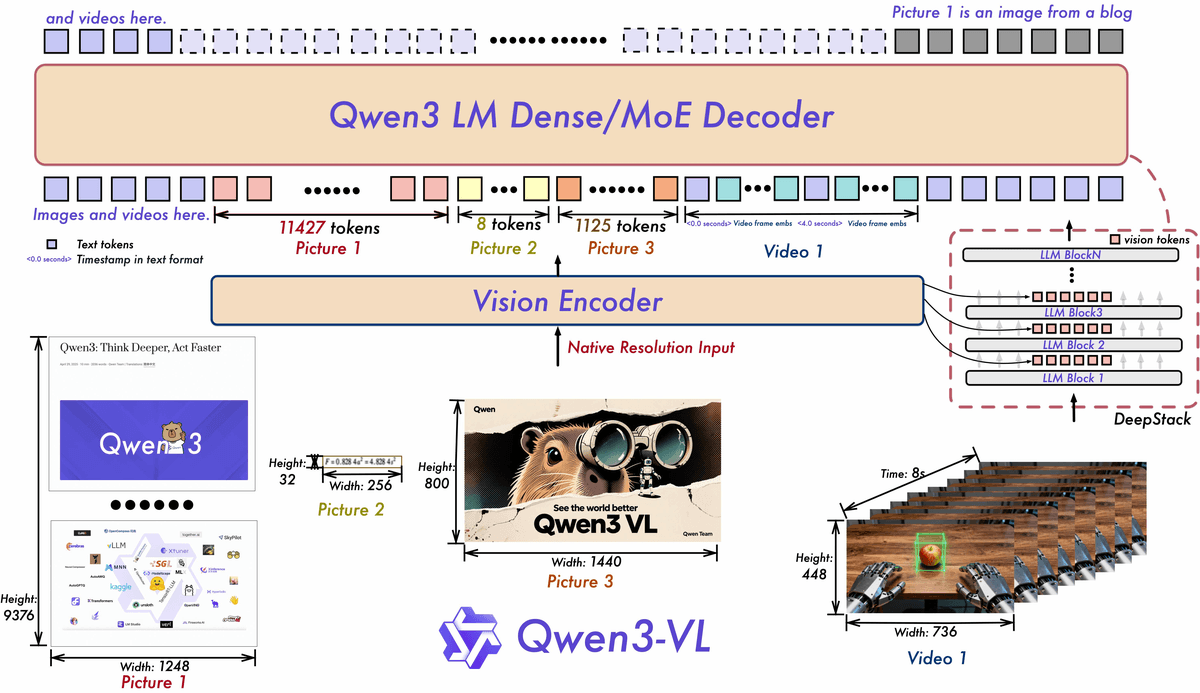
Three architectural changes drive these gains. Interleaved-MRoPE spreads positional embeddings across time, width, and height frequencies for long-horizon video reasoning. DeepStack fuses multi-level ViT features so fine details survive the vision encoder. Text-Timestamp Alignment replaces T-RoPE with timestamp-grounded event localization, which is the piece that makes precise video question answering work.
Benchmarks and the competitive picture
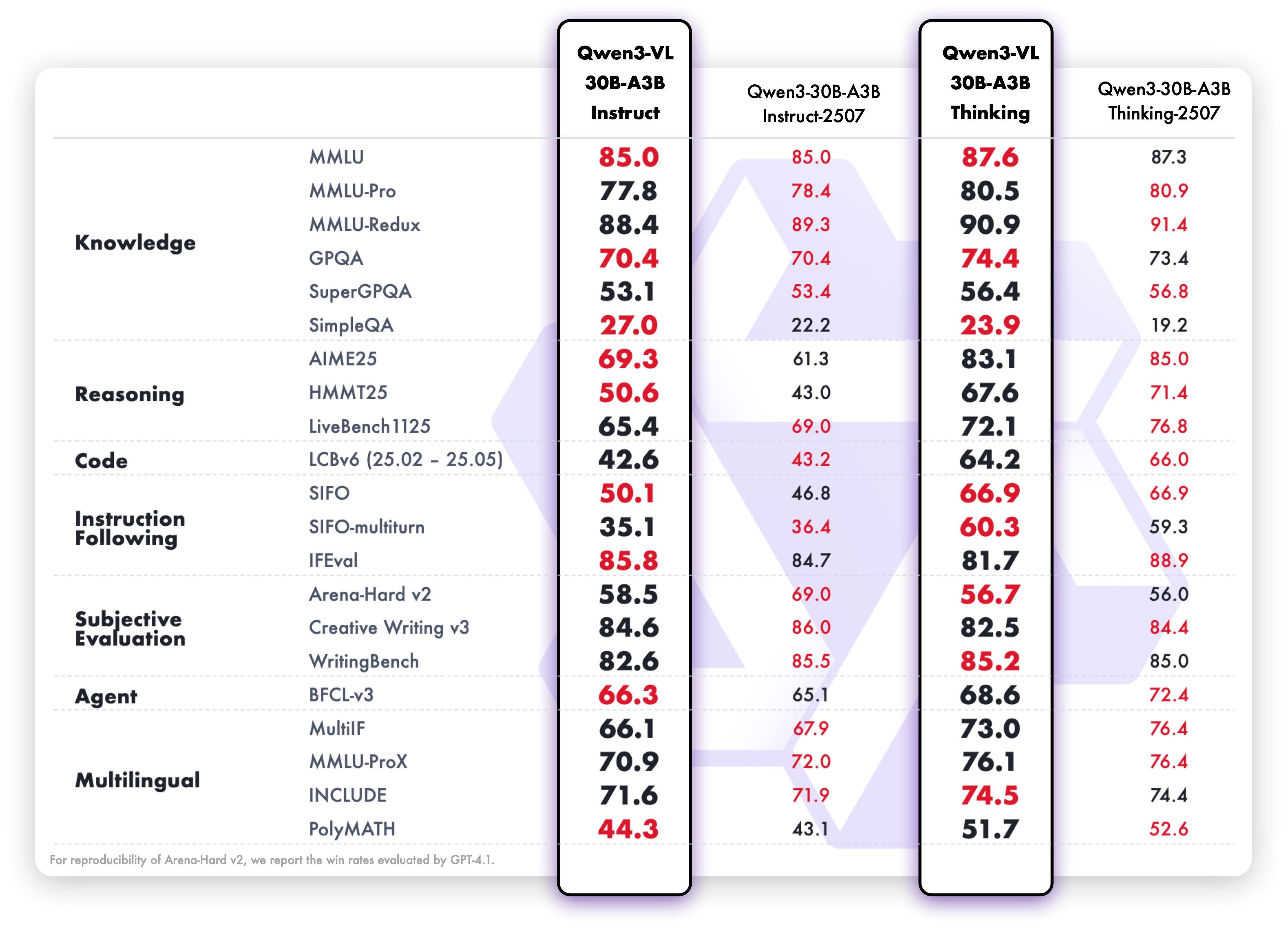
The 30B-A3B tier is being pitched directly against closed frontier models, with Alibaba claiming the Instruct and Thinking variants rival GPT-5-Mini and Claude 4 Sonnet across STEM, VQA, OCR, video, and agent benchmarks. On pure text, Qwen also claims parity with its flagship LLMs, so you do not have to keep a separate text-only model around for reasoning tasks.
OpenRouter lists the full-precision hosted version at $0.13 per million input tokens and $0.52 per million output tokens, with a 262,144 token context window. That gives a useful reference point for deciding whether self-hosting the AWQ build actually saves money for your workload.
Running the AWQ build
The quantized checkpoint is Apache 2.0 and drops into vLLM with a standard serve command. A minimal launch on two GPUs looks like this:
vllm serve QuantTrio/Qwen3-VL-30B-A3B-Instruct-AWQ \
    --max-model-len 32768 \
    --max-num-seqs 8 \
    --gpu-memory-utilization 0.9 \
    --tensor-parallel-size 2 \
    --trust-remote-code
You will need vLLM 0.11.0 or newer and qwen-vl-utils==0.0.14 for offline inference helpers. SGLang works too via sglang.launch_server, and Docker Model Runner can pull the repo directly. Once running, it exposes an OpenAI-compatible /v1/chat/completions endpoint that accepts interleaved image and text content blocks.
Where it earns its keep
The practical sweet spots line up with what the architecture was tuned for:
- Document AI and OCR pipelines across 32 languages, including messy scans and long structured documents.
- GUI agents that click through desktop or mobile interfaces, since the model was trained to recognize UI elements and call tools.
- Video understanding with timestamp-accurate answers, useful for indexing lectures, meetings, or surveillance footage.
- Sketch-to-code and screenshot-to-HTML workflows, thanks to the visual coding training.
- 2D and 3D grounding for robotics or embodied research where you need coordinates back, not just descriptions.
The caveats are the usual ones for 4-bit AWQ. Expect small quality regressions on the hardest reasoning and OCR tasks compared to the full-precision weights, and note that the tag list marks this as Instruct only, so if you want chain-of-thought style responses look at the separate Thinking variant instead. The checkpoint also inherits limitations of any VL system: fine-grained counting, dense scenes with heavy occlusion, and precise measurement tasks remain hard.
Why a 3B-active MoE matters
A MoE with only 3B active parameters, quantized to 4 bits, is now credibly compared against GPT-5-Mini and Claude 4 Sonnet on multimodal benchmarks. If those numbers hold up on your workload, the economics of running a private, on-prem VL agent just shifted. A single consumer-grade card can host something that a year ago would have required a hosted frontier API, and the Apache 2.0 license removes the usual redistribution friction.