
Alibaba's Qwen3-Next Matches a 235B Model at 10x Lower Training Cost
Alibaba's Qwen team ships an 80B hybrid-attention MoE that activates just 3B parameters, matches its 235B sibling, and handles 256K context natively.
 Pro
Takeaways
- Alibaba released Qwen3-Next-80B-A3B-Instruct, an 80B MoE with only 3B active parameters, Apache 2.0.
- Hybrid architecture: 36 Gated DeltaNet linear-attention layers and 12 full-attention layers, in a 3:1 pattern.
- 512 experts with 10 routed plus 1 shared active per token; native 262K context, extensible to 1M with YaRN.
- Matches Qwen3-235B-A22B on many benchmarks using about 10% of the training cost and 10x throughput past 32K.
- Weak spot is tool-heavy agent benchmarks like TAU2-Retail and TAU2-Telecom versus the 235B model.
- Available on OpenRouter at $0.09/$1.10 per M tokens, plus Vertex AI, vLLM and SGLang self-hosting.
Alibaba's Qwen team just released Qwen3-Next-80B-A3B-Instruct, the debut model in an architecture family that rethinks how transformers should scale. It carries 80 billion total parameters but activates only 3 billion per token, uses a hybrid of linear and full attention, natively handles a 262,144 token context, and ships under Apache 2.0. The headline claim: performance on par with Qwen3-235B-A22B-Instruct-2507 on several benchmarks, less than 10% of the training cost, and more than 10x higher throughput on contexts beyond 32K tokens.
Qwen3-Next departs from the mainline Qwen3 series, and the team is treating it as a preview of what the next generation of Qwen will look like. If the numbers hold up in production, the cost curve for serving long-context LLMs shifts substantially.
Three parts linear, one part full
The core innovation is a hybrid attention stack. Rather than running softmax attention on every layer, Qwen3-Next 80B-A3B arranges 48 layers as 12 repetitions of a 3:1 pattern: three Gated DeltaNet blocks followed by one Gated Attention block. That means 36 layers use recurrent linear attention and 12 retain softmax attention.
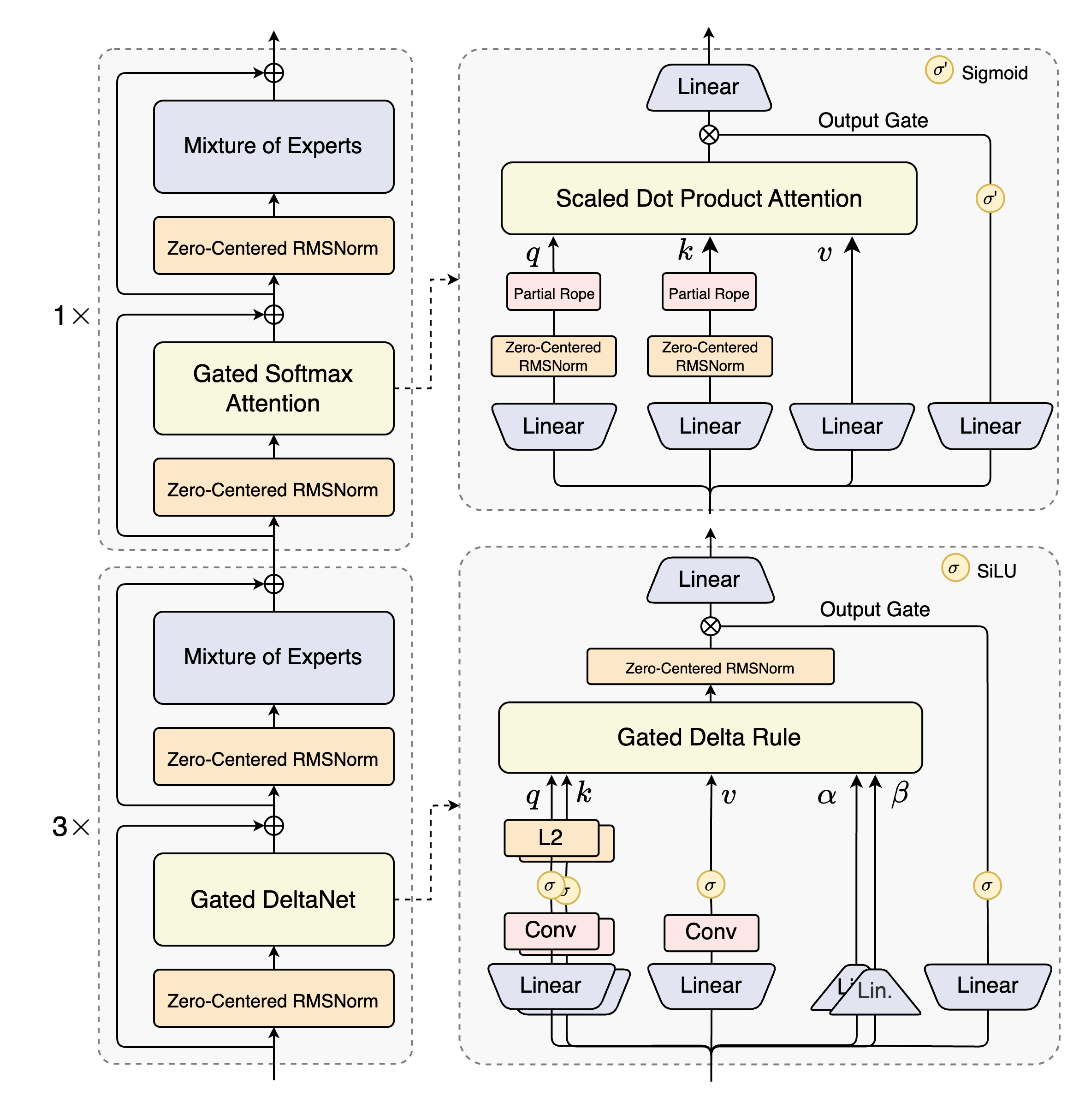
Gated DeltaNet is a linear attention variant. Inside a Gated DeltaNet block, the model computes query, key, and value vectors along with two learned gates, then writes to a small fast-weight memory using a delta-rule update. The resulting state acts as a running summary of the past. One gate controls memory decay; the other controls how strongly the new value overwrites that state. Crucially, the state size does not grow with the sequence.
Full softmax layers stay in the mix for moments when the model actually needs precise token-to-token lookup. A Gated Attention layer runs the familiar attention path and maintains a KV cache, so it remains expensive at long context lengths. Only a quarter of Qwen's layers pay that cost.
The Mixture-of-Experts side is aggressively sparse. Each MoE layer holds 512 experts, of which only 10 are activated per token, plus one shared expert that fires on every token. That is what pulls the effective active parameter count down to roughly 3B despite the 80B total.
Two smaller changes matter too. The team added zero-centered and weight-decayed layer norms for training stability, and baked in Multi-Token Prediction (MTP), where the model predicts several future tokens during pretraining. MTP improves the base model and doubles as a native speculative-decoding head at inference time, speeding up generation without an external draft model.
How it was trained
Qwen3-Next-80B-A3B-Instruct went through pretraining on 15 trillion tokens followed by post-training. The scale is notable given the efficiency claim: the team says the base model beat Qwen3-32B on downstream tasks using roughly 10% of that older model's training compute. Combined with the 10x throughput advantage past 32K context, this is one of the more compute-efficient 80B-class models to date.
This is the instruct variant, so it supports only instruct (non-thinking) mode and does not generate think blocks in its output. A separate Qwen3-Next-80B-A3B-Thinking model handles chain-of-thought workloads.
Benchmark reality check
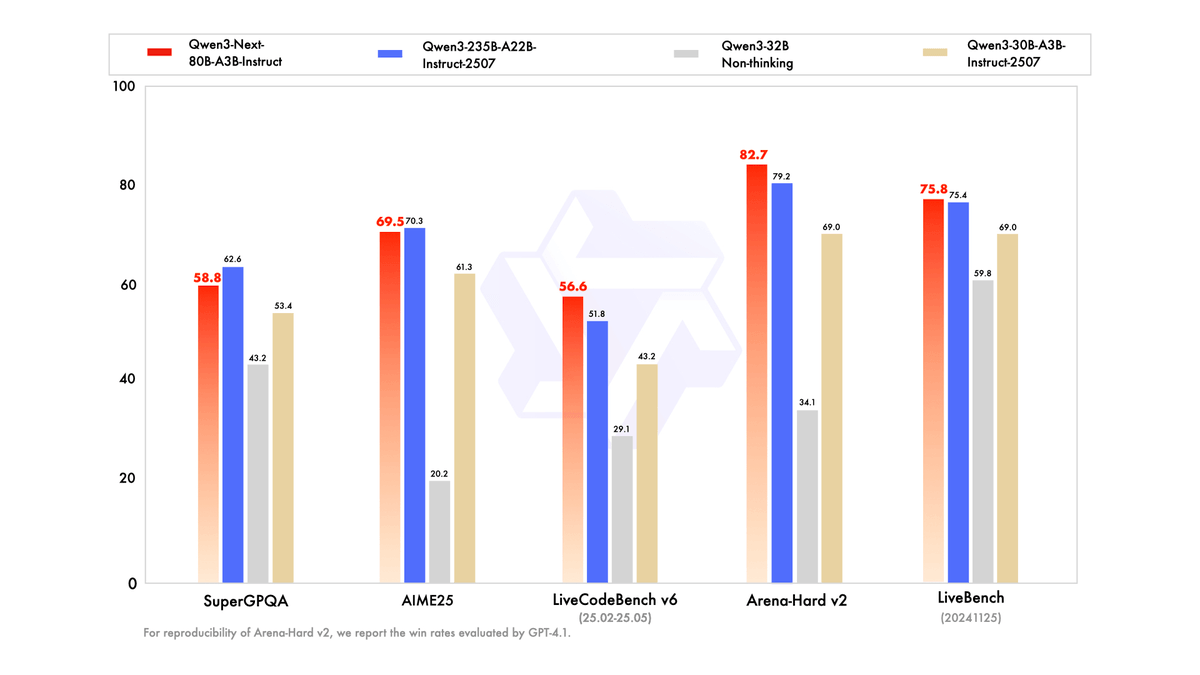
Against the much larger Qwen3-235B-A22B-Instruct-2507, the 80B model punches surprisingly close and even wins on a handful of tasks:
| Benchmark | Qwen3-32B | Qwen3-235B-A22B | Qwen3-Next-80B-A3B |
|---|---|---|---|
| MMLU-Pro | 71.9 | 83.0 | 80.6 |
| GPQA | 54.6 | 77.5 | 72.9 |
| AIME25 | 20.2 | 70.3 | 69.5 |
| LiveCodeBench v6 | 29.1 | 51.8 | 56.6 |
| LiveBench | 59.8 | 75.4 | 75.8 |
| Arena-Hard v2 | 34.1 | 79.2 | 82.7 |
| WritingBench | 75.4 | 85.2 | 87.3 |
Long-context is where the architecture bet pays off. On a 1M-token version of the RULER benchmark, Qwen3-Next-80B-A3B-Instruct averages 91.8, essentially matching the 235B model's 92.5 and comfortably beating Qwen3-30B-A3B-Instruct's 86.8. At the 256K point it scores 93.5, higher than the 235B model's 91.0 at the same length.
Agentic tool use on structured domains is a weak spot. On TAU2-Retail it scores 57.3 versus the 235B model's 74.6, and TAU2-Telecom collapses to 13.2 versus 32.5. For workloads heavy on tool calls with strict schemas, the bigger model is still safer.
Running it
The weights are on Hugging Face and the code is merged into the main branch of transformers. For anything beyond a smoke test, the team strongly recommends dedicated serving stacks. vLLM offers high-throughput, memory-efficient inference and can launch an OpenAI-compatible API server; vllm>=0.10.2 is required for Qwen3-Next. SGLang is the other supported path, and both stacks expose speculative decoding via MTP.
A minimal 4-GPU vLLM launch with the full 256K window looks like this:
vllm serve Qwen/Qwen3-Next-80B-A3B-Instruct \
  --port 8000 \
  --tensor-parallel-size 4 \
  --max-model-len 262144 \
  --speculative-config '{"method":"qwen3_next_mtp","num_speculative_tokens":2}'
To push past the native window toward the advertised 1M tokens, enable YaRN RoPE scaling. The team validated performance up to 1,010,000 tokens using that method, but warns that static YaRN degrades quality on short inputs, so it should be turned on only when needed.
For teams that would rather not manage GPUs, hosted access is already broad. Five providers serve Qwen3 Next 80B A3B Instruct on OpenRouter: DeepInfra, Alibaba Cloud, Parasail, Google Vertex, and NovitaAI, at $0.09 per million input tokens and $1.10 per million output tokens. Google also lists it as generally available on Vertex AI.
What to update in your mental model
Activated-parameter count is now decoupled from total-parameter count in a way that meaningfully changes serving economics. A 3B-active model that competes with a 22B-active model on quality implies a very different cost structure, especially at long contexts where MoE savings compound with linear attention's KV savings.
The pure-transformer era is also quietly ending at the frontier. Hybrid stacks that mix linear-recurrent layers with periodic full attention are becoming the default answer to the long-context question, and Qwen3-Next is the clearest, best-benchmarked open-weight statement of that direction so far. For anyone building RAG pipelines, code agents on large repos, or other workloads that routinely blow past 32K tokens, this is the model to benchmark next.