
Alibaba's Qwen3-32B Ships One Open-Weight Model With Two Thinking Modes
Alibaba's dense 32.8B open-weight model runs reasoning and chat inside one checkpoint, with a hard switch between deep thinking and fast replies.
 Pro
Takeaways
- Alibaba released Qwen3-32B, a dense 32.8B Apache 2.0 model with switchable thinking and non-thinking modes.
- Native 32K context, extendable to 131K tokens with YaRN scaling for long document work.
- Trained on 36T tokens across three pretraining stages plus a four-stage post-training RL pipeline.
- Beats Qwen2.5-72B-Instruct on Arena-Hard, AIME, and creative writing while using under half the parameters.
- Independent benchmarks found the original hybrid design lagged Qwen2.5-72B on agentic tasks.
- Deployable via vLLM, SGLang, Ollama, or hosted APIs from roughly $0.08 per million tokens.
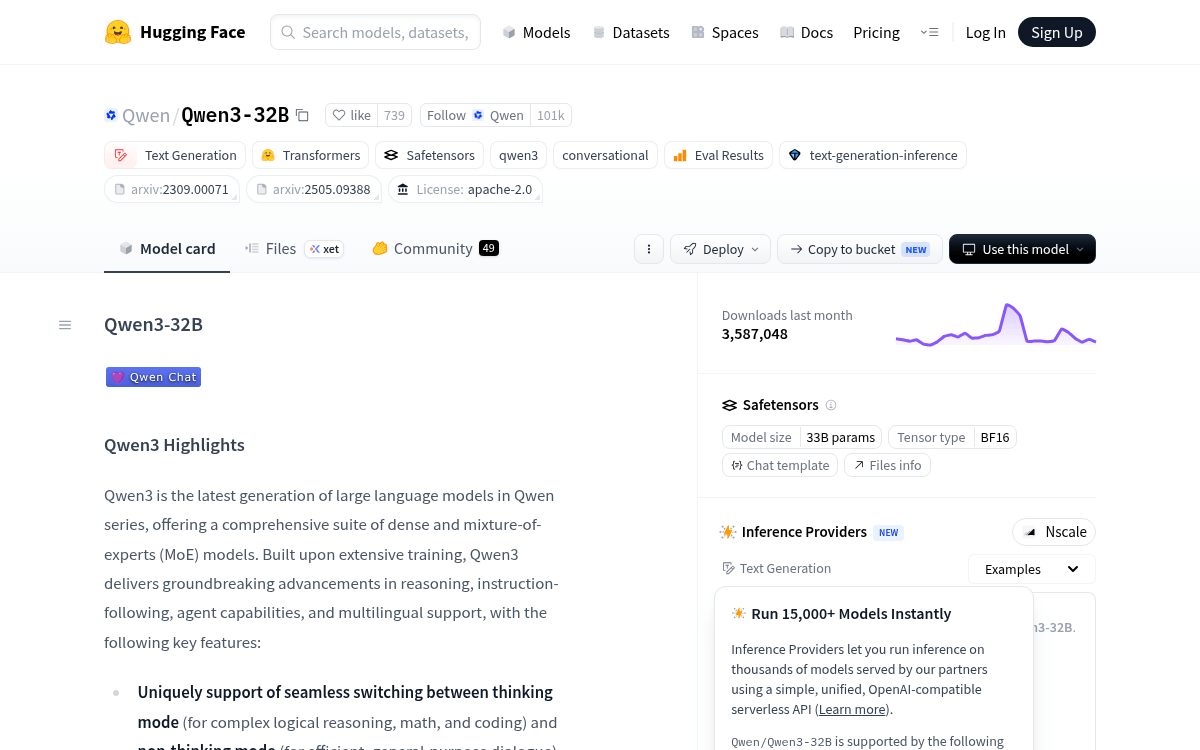
Alibaba's Qwen team shipped Qwen3-32B, a dense 32.8B parameter causal language model that fuses step-by-step reasoning and fast chat into a single checkpoint. It sits in the middle of the Qwen3 lineup, next to smaller dense models and the flagship Qwen3-235B mixture of experts, and targets teams who want a strong open-weight model without paying for a frontier API.
One checkpoint, two modes
The headline trick is a switch inside the chat template. In thinking mode the model emits a <think>...</think> block before the final answer, aimed at math, code, and logical inference. In non-thinking mode it behaves like a normal instruct model with no reasoning trace, optimized for faster general-purpose chat.
You flip the behavior at the tokenizer level with enable_thinking=True or False when calling apply_chat_template. A soft switch also exists: users can drop /think or /no_think tags into a prompt to change modes turn by turn in a multi-turn conversation. The two modes want different sampling settings, temperature 0.6 with top-p 0.95 for thinking, and temperature 0.7 with top-p 0.8 for the fast path.
The spec sheet
- 32.8B total parameters, 31.2B non-embedding, 64 layers, grouped query attention with 64 query heads and 8 key/value heads.
- Context length: 32,768 tokens natively, 131,072 with YaRN.
- Apache 2.0 license, so commercial use is fine.
- Instruction following, agent tool use, creative writing, and multilingual coverage across 100+ languages and dialects.
- Native tool calling, plus structured output through JSON schema when served through compatible runtimes.
How to run it
The weights are on Hugging Face and work with transformers>=4.51.0. For serving, the model card recommends vllm>=0.8.5 or sglang>=0.4.6.post1, both of which honor the thinking switch through the OpenAI-compatible API. A minimal vLLM launch looks like this:
vllm serve Qwen/Qwen3-32B --enable-reasoning --reasoning-parser deepseek_r1Local runtimes including Ollama, LM Studio, MLX-LM, llama.cpp, and KTransformers all support Qwen3, and the community has produced 174 quantized variants for consumer GPUs. Hosted access starts around $0.08 per million input tokens and $0.28 per million output tokens on providers like DeepInfra, Nebius, SiliconFlow, and Groq via OpenRouter.
How it was built
Pretraining used roughly 36 trillion tokens, curated for linguistic and domain diversity. The team finetuned Qwen2.5-VL to extract text from long PDFs, and generated synthetic data with domain-specific models: Qwen2.5-Math for mathematical content and Qwen2.5-Coder for code.
Pretraining ran in three stages. A General Stage (S1) trained on 30 trillion tokens at sequence length 4,096 to build general knowledge. A Reasoning Stage (S2) added 5 trillion tokens of knowledge-intensive data across STEM, coding, and reasoning at the same sequence length, with an accelerated learning rate decay. A final long-context stage extended sequence length to 32,768. Post-training then applied four more stages: long chain-of-thought cold-start fine-tuning, reasoning RL with GRPO on problems with verifiable solutions, thinking mode fusion that integrates the non-thinking mode alongside the thinking mode using the /think and /no_think chat templates, and general RL across instruction following, agent abilities, and preference alignment with various reward signals.
Where the numbers land
In thinking mode, Qwen3-32B is competitive with much larger reasoning models. Against DeepSeek-R1-Distill-Llama-70B, QwQ-32B, and OpenAI o3-mini (medium), the Qwen3 technical report shows Qwen3-32B posting MMLU-Redux 90.9, GPQA-Diamond 68.4, LiveBench 74.9, Arena-Hard 93.8, MATH-500 97.2, AIME'24 81.4, AIME'25 72.9, BFCL v3 70.3, and LiveCodeBench v5 65.7. Non-thinking mode is meant to replace a plain instruct model, and beats Qwen2.5-72B-Instruct on Arena-Hard, AIME, and creative writing while running with less than half the parameters.
Where the hybrid falls down
Independent reviewers have been less enthusiastic about the hybrid design. One enterprise agentic benchmark found that even in thinking mode, none of the dense Qwen3 models from 4B to 32B outperformed Qwen2.5 72B Instruct, and most Qwen3 dense models underperformed even Qwen2.5 14B Instruct. In the July 2025 refresh, the Qwen team dropped hybrid thinking entirely and shipped dedicated Instruct and Thinking variants, which boosted scores.
Other reported limitations from the model card and the technical report:
- In thinking mode, retrieval performance for long-context tasks can degrade because reasoning content is interleaved with the answer.
- Hybrid mode fusion and general RL can reduce performance on specialized benchmarks such as AIME'24 and LiveCodeBench.
- Static YaRN context window extensions, as currently supported in most open-source libraries, can negatively affect short-text processing.
- Safety alignment weakens with reasoning on. A separate study reports harmful compliance on Qwen3-32B jumps from 7.6 percent with thinking off to 23.1 percent with thinking on across a standard misuse benchmark.
Who should actually use it
Qwen3-32B fits a specific slot: a single set of weights that can run agent workflows, code assistants, and multilingual chat, and can be pushed into deeper reasoning when a task calls for it. Concrete use cases where it holds up:
- Self-hosted coding copilots, where a 1977 CodeForces rating puts it near o3-mini and QwQ.
- Math and STEM tutoring, given 97.2 on MATH-500 and 81.4 on AIME'24 in thinking mode.
- Tool-calling agents through Qwen-Agent and MCP, with tool schemas honored in both modes.
- Multilingual assistants covering 100+ languages, useful for teams building outside English-only markets.
- A cost-efficient long-context worker after enabling YaRN scaling to 131K tokens for document analysis.
If you were waiting for a permissively licensed dense model that could stand in for both a chat model and a light reasoning model, Qwen3-32B is a strong default. For agent-heavy production workloads, benchmark the newer split Instruct 2507 and Thinking 2507 variants from the same family against this original release before committing.