
Alibaba's Qwen3-30B-A3B Thinks Like a 30B but Runs Like a 3B
Alibaba's new Qwen3-30B-A3B ships a 30B mixture-of-experts model that activates just 3B parameters per token, with a built-in thinking mode toggle.
 Pro
Takeaways
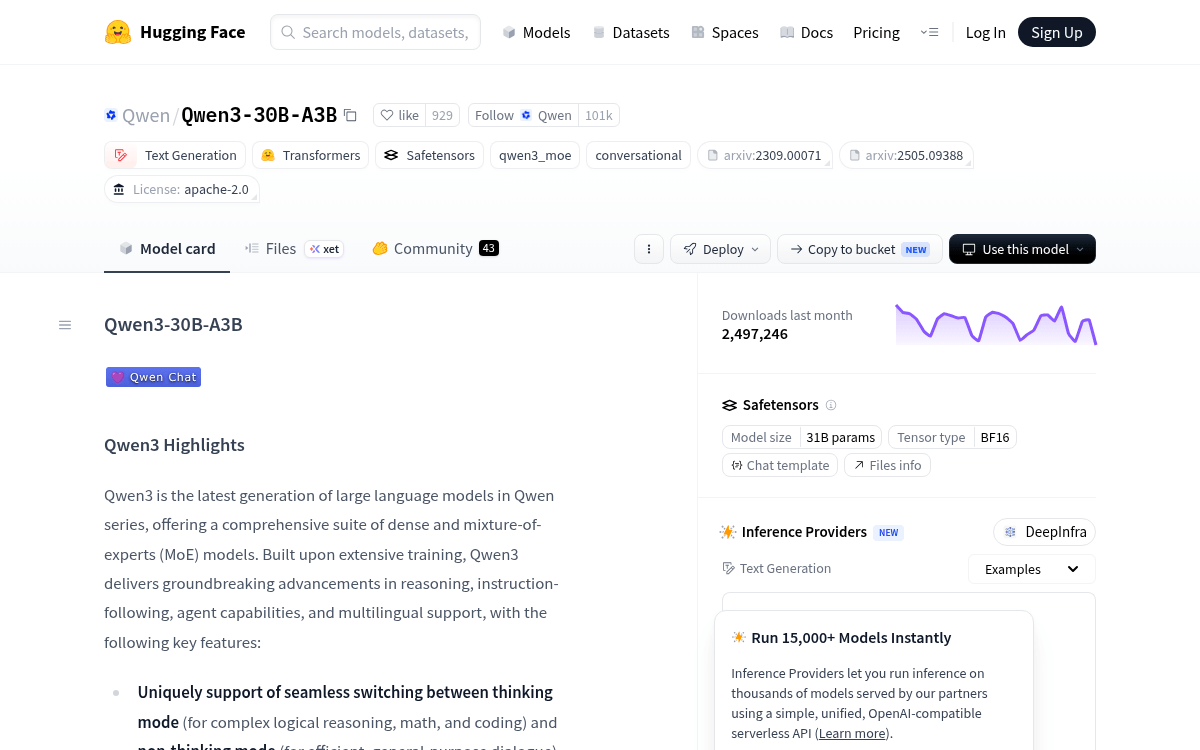
- Alibaba released Qwen3-30B-A3B, a 30.5B MoE with 3.3B activated parameters under Apache 2.0.
- Reportedly beats QwQ-32B despite activating roughly one-tenth the parameters per token.
- Single model toggles between thinking and non-thinking modes via
/thinkand/no_thinktags. - 128 experts with 8 active, 48 layers, 32K native context extendable to 131K with YaRN.
- Hosted pricing around $0.12/$0.50 per million input/output tokens; supported in vLLM, SGLang, Ollama, llama.cpp.
- Full architecture and training details in the Qwen3 Technical Report.
Alibaba's Qwen team has released Qwen3-30B-A3B, a mixture-of-experts model that packs 30 billion parameters but only fires 3 billion of them per token. The headline claim from the team is that this small MoE outcompetes QwQ-32B with roughly 10x the activated parameters, and that a tiny model like Qwen3-4B can rival Qwen2.5-72B-Instruct. If that holds up in your workloads, it changes the math on what you need to serve a strong reasoning model.
Sparse where it counts
The architecture is where most of the interesting design choices live. Qwen3-30B-A3B has 30.5B total parameters with 3.3B activated, 48 layers, grouped-query attention with 32 heads for Q and 4 for KV, 128 experts with 8 active per token, and a native context length of 32,768. YaRN extension pushes context to 131,072 tokens for long-document work, using the RoPE scaling technique from the 2023 YaRN paper.
The practical implication of activating only 8 of 128 experts per token is that inference cost and latency track a 3B dense model, while the parameter capacity the router can pull from is closer to a 30B one. For anyone who has tried to fit QwQ-32B on a single GPU, that ratio is the whole point.
One model, two modes
Qwen3 ships with a runtime switch between deliberate reasoning and fast chat. Set enable_thinking=True in the chat template and the model emits a <think>...</think> block before the answer, similar to QwQ or DeepSeek-R1 style behavior. Thinking mode is aimed at complex logical reasoning, math, and coding; non-thinking mode handles efficient general-purpose dialogue.
The soft switch is genuinely useful: drop /think or /no_think into any user message and the model flips behavior mid-conversation. One deployment can serve both a code-review agent that reasons for 20 seconds and a customer-facing chatbot that responds instantly, without swapping model weights.
text = tokenizer.apply_chat_template(
    messages,
    tokenize=False,
    add_generation_prompt=True,
    enable_thinking=True  # emits <think>...</think> then final answer
)
Sampling guidance is specific: temperature 0.6, top-p 0.95, top-k 20 in thinking mode, with an explicit warning against greedy decoding because it triggers endless repetitions. Non-thinking mode wants temperature 0.7 and top-p 0.8.
What it is actually good at
The Qwen team positions this release around four axes of improvement, all worth reading with a critical eye:
- Reasoning that beats the previous QwQ preview in thinking mode and Qwen2.5-Instruct in non-thinking mode on math, code, and commonsense logic
- Agent and tool-calling behavior, with first-class support for MCP servers through Qwen-Agent
- Human preference alignment on creative writing, role-play, and multi-turn dialogue
- Multilingual coverage spanning more than 100 languages and dialects
Independent takes are more measured. Artificial Analysis, which tracks non-reasoning variants separately, places the later Qwen3 Coder 30B A3B Instruct at 14 on its Intelligence Index, well above the median of 6 for open-weight non-reasoning models of similar size. Reviewers comparing the base 30B-A3B against newer siblings note it now trails the family's most recent updates, and describe it as best for simple classification, basic drafting, or lightweight automation where cost matters more than depth of reasoning. Strong for its activated-parameter budget, then, without approaching frontier performance.
How it was built
Two training-side decisions stand out. Qwen3 ran comprehensive scaling law studies across a three-stage pre-training pipeline, tuning critical hyperparameters like learning rate scheduler and batch size separately for dense and MoE models. Splitting the sweep between dense and sparse regimes is a small detail with large downstream consequences, since MoE training is notoriously twitchy and reusing dense recipes tends to leave capacity on the table.
Second, the thinking and non-thinking behaviors are fused into a single model rather than distilled into two checkpoints. Post-training had to align the model to obey a mode switch, which is a harder alignment problem than either mode in isolation. Full details are in the Qwen3 Technical Report.
Running it and paying for it
Because activated compute is only 3.3B, you can serve this model on hardware that would choke on a dense 30B. Quantized GGUFs from bartowski and unsloth land it comfortably on a 24GB consumer GPU, and the model ships day-one support in vLLM, SGLang, Ollama, LM Studio, MLX-LM, llama.cpp, and KTransformers.
Basic deployment with vLLM:
vllm serve Qwen/Qwen3-30B-A3B --enable-reasoning --reasoning-parser deepseek_r1For hosted API access, Qwen3 30B A3B on OpenRouter costs $0.12 per million input tokens and $0.50 per million output tokens, with a 131,072 token context window and up to 16,384 completion tokens. The weights themselves are Apache 2.0, so commercial use is unrestricted.
Why the sparse-activation trend matters
Qwen3-30B-A3B fits a broader shift in the open weights ecosystem toward MoE models with tiny active-parameter counts. DeepSeek-V3 pushed the pattern at frontier scale; Qwen3 brings it into the range where a small team can actually self-host. The bet is that routing a token to 8 of 128 specialized experts gives you better answers per FLOP than sending it through a smaller dense transformer.
Sizing models by total parameter count no longer works as a reflex. A 30B MoE that costs like a 3B dense model at inference but reasons like something much larger breaks the old rule of thumb, and capacity planning, quantization strategy, and fine-tuning recipes all have to be reconsidered for the sparse case. A follow-up Qwen3-Coder variant already extends the same recipe to a 30.5B MoE with 128 experts (8 active per forward pass) aimed at advanced code generation, repository-scale understanding, and agentic tool use, with a native 256K context extendable to 1M via YaRN. The architecture is going to keep showing up in specialized flavors.
For most teams the practical question is simple: does a 3B-active MoE with a thinking-mode toggle replace two of the models you currently run? If yes, benchmark it against your existing stack this week.