
Alibaba's Qwen3-30B-A3B Beats GPT-4o on Reasoning With 3.3B Active Parameters
Alibaba's refreshed 30B mixture-of-experts model activates only 3.3B parameters per token, ships with a 256K native context, and stretches to 1M with sparse attention.
 Pro
Takeaways
- Qwen3-30B-A3B-Instruct-2507 refreshes Alibaba's 30.5B MoE with 3.3B active parameters, Apache 2.0 licensed.
- Native 262,144-token context, extendable to 1M tokens via Dual Chunk Attention and MInference sparse attention.
- Non-thinking only, no hybrid mode; a separate Thinking-2507 checkpoint handles chain-of-thought workloads.
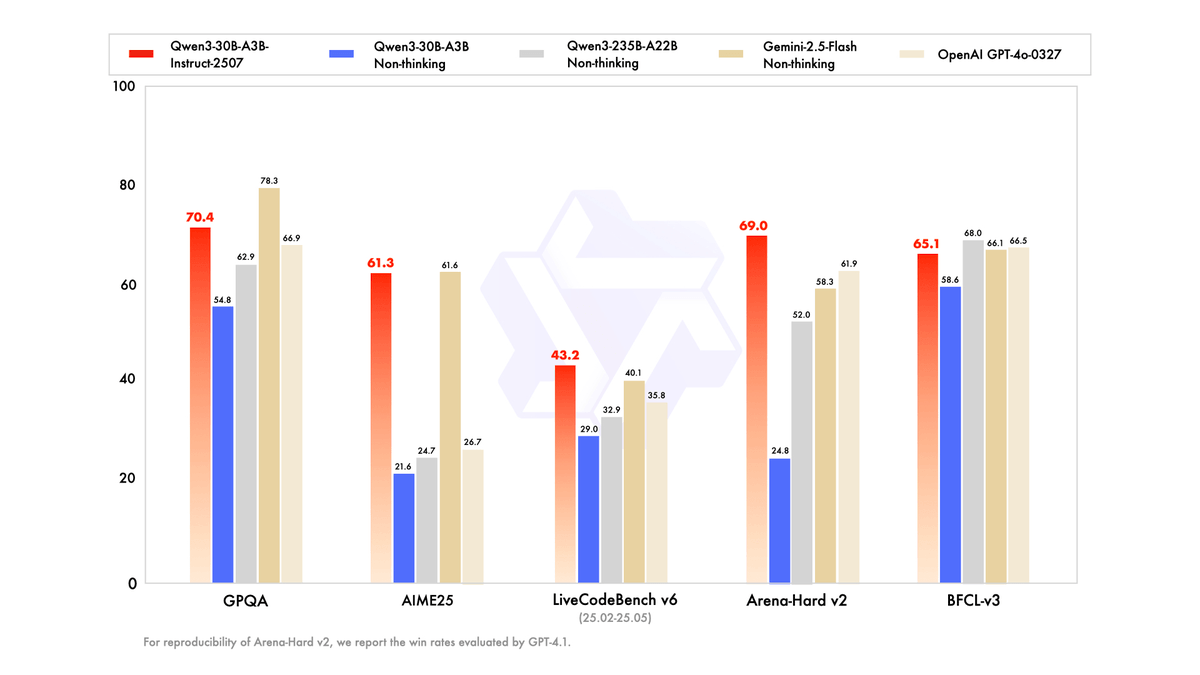
- Strong benchmarks: ZebraLogic 90.0, Arena-Hard v2 69.0, AIME25 61.3, WritingBench 85.5.
- Weak on Aider-Polyglot (35.6) and TAU2-Telecom (12.3); not ideal for complex agentic coding.
- Runs on vLLM, SGLang, Ollama, LM Studio, llama.cpp; hosted around $0.05/$0.19 per M tokens.
Alibaba's Qwen team has pushed a substantial refresh to its mid-size mixture-of-experts model, and the numbers are hard to ignore. Qwen3-30B-A3B-Instruct-2507 keeps the same 30.5B total and 3.3B active parameter budget as its predecessor while posting double-digit jumps across reasoning, coding, alignment, and long-context benchmarks. It ships under Apache 2.0 on Hugging Face with native support for a 262,144-token window, plus an optional configuration that stretches context to roughly one million tokens.
Reasoning and instruct, now split cleanly
The original Qwen3 line used a hybrid mode where a single checkpoint could toggle between chain-of-thought reasoning and direct answering. That is gone here. This release supports only non-thinking mode, does not generate think blocks, and no longer needs an enable_thinking=False flag. A separate Qwen3-30B-A3B-Thinking-2507 checkpoint handles reasoning-heavy workloads, formalizing the Qwen team's split between reasoning and non-reasoning lines.
Practically, you pick the model based on the workload instead of flipping a flag. Instruct-2507 is tuned for direct responses, tool calls, and long-context retrieval where you do not want the model burning tokens on internal monologue.
Architecture at a glance
Under the hood, it is a fairly standard sparse MoE with grouped-query attention:
- Total parameters: 30.5B, with 3.3B activated per token
- Layers: 48
- Attention: 32 query heads, 4 KV heads (GQA)
- Experts: 128 total, 8 activated per token
- Native context: 262,144 tokens
The 3.3B activated figure is what governs inference cost. Even though the weights come in at 31B on disk, each forward pass only routes through a small slice of experts, which is how it can serve interactive workloads on a single high-memory GPU while punching well above its active-parameter class.
Where the numbers moved
Against the previous Qwen3-30B-A3B non-thinking checkpoint, the gains are broad: instruction following, logical reasoning, text comprehension, mathematics, science, coding, and tool use all improve, alongside better long-tail multilingual knowledge, stronger alignment on subjective and open-ended tasks, and improved 256K long-context understanding. The delta is large enough that on several axes it now competes with much bigger closed models.
Some of the more striking scores against DeepSeek-V3-0324, GPT-4o-0327, and Gemini-2.5-Flash Non-Thinking:
| Benchmark | Qwen3-30B-A3B-Instruct-2507 | Best competitor listed |
|---|---|---|
| ZebraLogic | 90.0 | 83.4 (DeepSeek-V3) |
| Arena-Hard v2 | 69.0 | 61.9 (GPT-4o) |
| WritingBench | 85.5 | 80.5 (Gemini-2.5-Flash) |
| AIME25 | 61.3 | 61.6 (Gemini-2.5-Flash) |
| PolyMATH | 43.1 | 41.9 (Gemini-2.5-Flash) |
| IFEval | 84.7 | 84.3 (Gemini-2.5-Flash) |
The AIME25 result is worth pausing on. A 3.3B-active model landing at 61.3 on a competition-math benchmark, in non-thinking mode without chain-of-thought scaffolding, was not something open-weights checkpoints were doing a year ago.
The weak spots
Agentic tool-use benchmarks are mixed. TAU2-Telecom drops to 12.3, well below DeepSeek-V3's 34.0, and Aider-Polyglot lands at 35.6 compared to 55.1 for DeepSeek-V3 and 59.6 for Qwen's own 235B non-thinking model. Multilingual coverage on MMLU-ProX and INCLUDE trails Gemini-2.5-Flash by 6 to 12 points. Third-party evaluations rank it lower on the totem pole too, with the checkpoint sitting in the Efficient tier at #177 of 544 published models on one aggregator's overall-intelligence leaderboard.
So it is not a drop-in replacement for a frontier closed model on hard multi-turn coding or complex telecom-style tool orchestration. For creative writing, instruction following, math, and single-shot reasoning, it is very competitive.
Stretching context to 1M tokens
The 262K native window is already generous, and the model card documents how to extend it. Two techniques stack. Dual Chunk Attention is a length extrapolation method that splits long sequences into manageable chunks while preserving global coherence. MInference is a sparse attention mechanism that only computes the most important token interactions during prefill. Together they yield up to a 3x speedup over standard attention implementations on sequences approaching 1M tokens.
Enabling it takes a config swap and a specific launch command. For vLLM:
VLLM_ATTENTION_BACKEND=DUAL_CHUNK_FLASH_ATTN VLLM_USE_V1=0 \
vllm serve ./Qwen3-30B-A3B-Instruct-2507 \
  --tensor-parallel-size 4 \
  --max-model-len 1010000 \
  --enable-chunked-prefill \
  --max-num-batched-tokens 131072 \
  --enforce-eager \
  --gpu-memory-utilization 0.85
The catch is memory. Running a 1M token context requires roughly 240 GB of total GPU memory across model weights, KV cache, and peak activations, so this is a multi-GPU deployment. On the 1M-token RULER benchmark, the sparse-attention configuration holds up remarkably well, averaging 86.8 accuracy across lengths from 4K to 1M versus 72.0 for the previous 30B-A3B checkpoint.
Getting it running
Deployment options are broad. The model works with transformers 4.51 or newer, and both vLLM and SGLang expose OpenAI-compatible endpoints out of the box. For local experimentation, Ollama, LMStudio, MLX-LM, llama.cpp, and KTransformers have added Qwen3 support. Recommended sampling settings from the Qwen team are Temperature=0.7, TopP=0.8, TopK=20, and MinP=0, with a suggested output length of 16,384 tokens for most queries.
For hosted access, OpenRouter routes to five providers at around $0.048 per million input tokens and $0.193 per million output tokens, with a 262,144-token context window. Function calling and JSON-schema structured outputs are both supported via the standard OpenAI API surface.
Who this is actually for
The sweet spot is any workload where you want frontier-adjacent quality without paying frontier prices or accepting closed-weights lock-in:
- Long-document analysis and RAG: RULER scores hold up past 500K tokens, which is unusual at this size.
- Creative and long-form writing: WritingBench 85.5 and Creative Writing v3 86.0 are the highest in the comparison set.
- Math and structured reasoning: AIME25 and ZebraLogic rival Gemini-2.5-Flash and beat GPT-4o Non-Thinking.
- Cost-sensitive agent backends: 3.3B active parameters translates to low inference cost per token when self-hosted.
- Multilingual assistants: Solid IFEval and MultiIF scores across languages, though not best-in-class.
What it is not built for: pair-programming across large codebases, where Aider-Polyglot is weak, or complex multi-tool agentic workflows in specialized domains, where DeepSeek-V3 or a thinking-mode model will do better. For everything else in the mid-size open-weights tier, this checkpoint sets a new bar for what 3.3B active parameters can do.