
Alibaba's Qwen3-235B Beats GPT-4o and Rivals Claude Opus 4 Open-Source
Alibaba's updated 235B mixture-of-experts model drops hybrid thinking, adds a 256K context window, and posts benchmark gains across math, coding, and agents.
 Pro
Takeaways
- Qwen released Qwen3-235B-A22B-Instruct-2507, a 235B MoE with 22B active parameters under Apache 2.0.
- Hybrid thinking mode dropped; instruct and reasoning models will be trained separately going forward.
- Native 256K context, extendable to 1M via Dual Chunk Attention and MInference sparse attention.
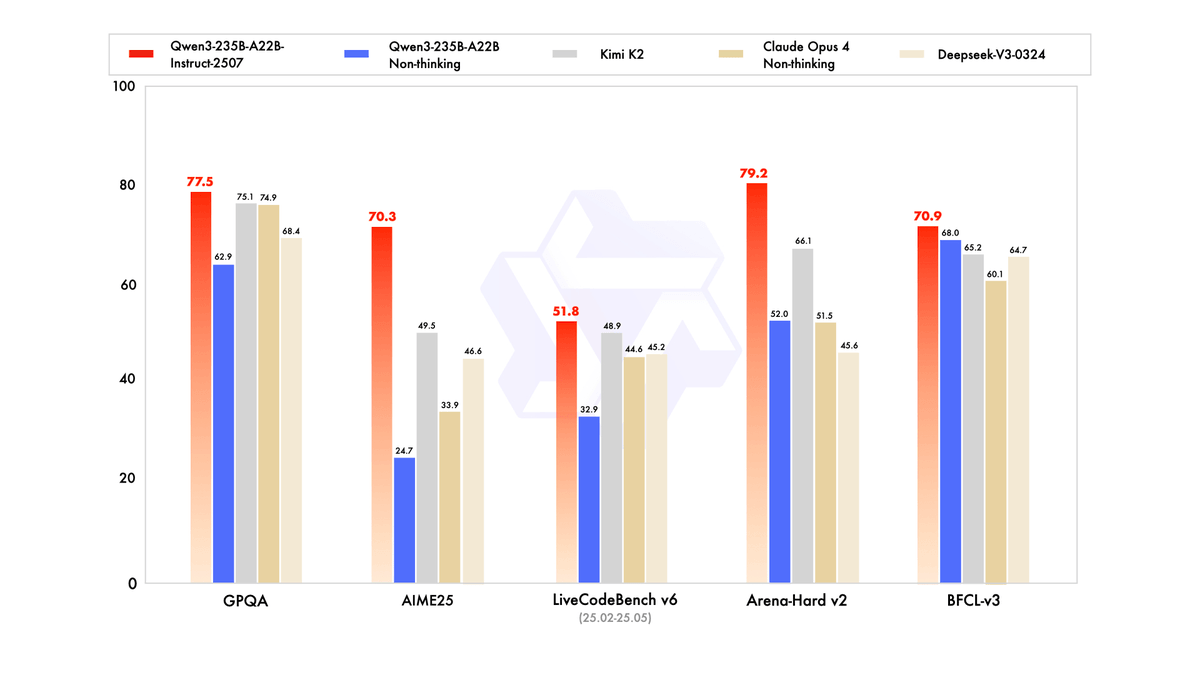
- Beats DeepSeek-V3 and Kimi K2 on most benchmarks; 70.3 on AIME25, 77.5 on GPQA, 79.2 Arena-Hard v2.
- Priced around $0.0875/M input and $0.35/M output tokens on OpenRouter.
- Runs on vLLM, SGLang, Ollama, and llama.cpp; strong tool-calling with Qwen-Agent and MCP.
Alibaba's Qwen team has released Qwen3-235B-A22B-Instruct-2507, a substantial refresh of its flagship open-weights model. The update splits the previous hybrid into a dedicated instruct variant, extends the native context window to 262,144 tokens, and posts benchmark numbers that put an Apache-licensed model alongside Claude Opus 4 and GPT-4o.
The most significant structural change: the model no longer emits <think></think> chains. Instruct and thinking checkpoints are now trained separately, so specifying enable_thinking=False is no longer needed. Separating the two objectives appears to produce cleaner, more consistent outputs than gating them behind a runtime flag.
Architecture and specs
The model is a sparse mixture-of-experts (MoE) transformer. Of its 235B total parameters, only about 22B activate per token, keeping inference cost closer to a mid-sized dense model while retaining the capacity of a much larger one.
- 94 layers with grouped-query attention (64 query heads, 4 key/value heads)
- 128 experts, 8 activated per token
- 234B non-embedding parameters
- Native 262,144-token context, extendable to roughly 1M
- Apache 2.0 license, BF16 weights
Benchmark numbers
On knowledge and reasoning tasks, the 2507 build scores 83.0 on MMLU-Pro, 77.5 on GPQA, and 70.3 on AIME25, up sharply from 24.7 on the previous non-thinking Qwen3-235B. ARC-AGI jumps from 4.3 to 41.8, and ZebraLogic reaches 95.0. Those figures put it ahead of Kimi-K2 and DeepSeek-V3-0324 on general benchmarks and above Claude Opus 4's non-thinking variant on several tasks.
Coding results are more mixed. LiveCodeBench v6 lands at 51.8, ahead of Kimi K2 and DeepSeek-V3, but Aider-Polyglot comes in at 57.3 against Claude Opus 4's 70.7. Agent evaluations follow a similar pattern: strong on BFCL-v3 (70.9) and competitive on TAU2-Retail, but weaker on airline and telecom task suites.
Stretching context to 1M tokens
The native 262K window can be pushed toward 1M tokens using two techniques the team ships as a separate configuration:
- Dual Chunk Attention (DCA): Splits long sequences into manageable chunks while preserving global coherence, letting the model generalize past its trained context length without retraining.
- MInference: A sparse attention scheme that reduces computational overhead by focusing on critical token interactions, avoiding full quadratic cost on million-token prompts.
On sequences approaching 1M tokens, this configuration achieves up to a 3x speedup over standard attention. On the RULER benchmark at 1,000K tokens, it holds 82.5 accuracy versus 68.0 for the older Qwen3-235B non-thinking build. The catch is hardware: the 1M configuration requires roughly 1,000 GB of total GPU memory across weights, KV cache, and activation peaks. Most teams will work within the native 256K window.
Running it
Transformers 4.51 or later is required; earlier versions throw a KeyError: 'qwen3_moe'. The recommended serving path is vLLM or SGLang with tensor parallelism across 8 GPUs:
vllm serve Qwen/Qwen3-235B-A22B-Instruct-2507 \
  --tensor-parallel-size 8 \
  --max-model-len 262144
Ollama, LMStudio, MLX-LM, llama.cpp, and KTransformers all support Qwen3, and quantized community builds run acceptably on high-end workstations. Recommended sampling settings: temperature 0.7, top-p 0.8, top-k 20, with a max output around 16,384 tokens.
For hosted access, OpenRouter prices the model at $0.0875 per million input tokens and $0.35 per million output tokens. Fireworks starts at $0.150 per million input and $0.800 per million output. Both are materially cheaper than the proprietary frontier models it benchmarks against.
Tool use and agents
The model accepts tools and tool_choice for function calling and supports structured outputs via JSON schemas. The Qwen team ships Qwen-Agent, which wraps the tool-calling templates and parsers and integrates with MCP configuration files for tools like mcp-server-time and mcp-server-fetch. Outputs are clean non-thinking responses by default, which simplifies agentic pipelines that previously had to suppress chain-of-thought tokens.
Where it fits and where it falls short
- Long-document analysis, retrieval-augmented pipelines, and codebase-scale reasoning where the 256K window eliminates chunking overhead
- Multilingual applications: 79.4 on MMLU-ProX and 77.5 on MultiIF
- Agent workflows needing clean, non-thinking outputs and structured tool calls
- Self-hosted deployments where Apache 2.0 licensing matters for commercial redistribution
Weaknesses remain on complex domain-specific agent benchmarks: TAU2-Telecom and TAU1-Airline still lag Claude Opus 4 and Kimi K2, and some users report that real-world performance on contextually complex tasks falls below what the benchmark scores suggest.
What the release signals
The split between instruct and thinking checkpoints suggests the hybrid single-model approach is losing favor, at least at Qwen. Training the two objectives separately appears to produce better results on both ends than toggling between them at runtime. Meanwhile, the gap between leading open-weights MoE models and closed frontier models on general benchmarks keeps narrowing while the pricing gap widens. A model you can download, fine-tune, and self-host is now trading blows with Claude Opus 4 on GPQA and beating GPT-4o on Arena-Hard v2 by nearly 20 points, which shifts the build-versus-buy calculation for any product bottlenecked on model cost rather than the last mile of capability.