
Alibaba's Qwen3-14B Now Fits on a Single Consumer GPU With Minimal Accuracy Loss
Alibaba's Qwen team ships a 4-bit AWQ build of Qwen3-14B, cutting VRAM needs while keeping thinking-mode reasoning nearly intact.
 Pro
Takeaways
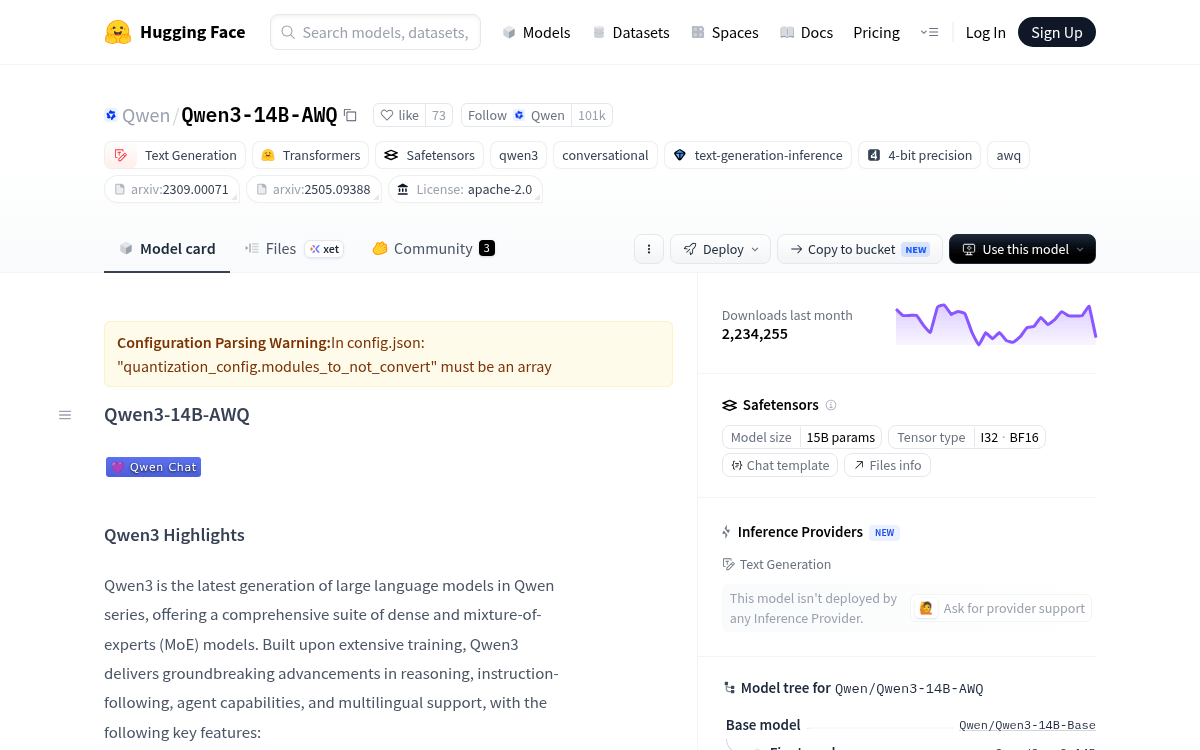
- Qwen released Qwen3-14B-AWQ, a 4-bit weight-only quantized build of the 14.8B reasoning model.
- Apache 2.0 license, 2.2M+ downloads, runs on a single consumer GPU with room to spare.
- Thinking mode loses only 1.3 points on LiveBench and 0.1 on MMLU-Redux versus bf16.
- Supports hybrid
/thinkand/no_thinkswitching, 128K context via YaRN, and MCP tool calling. - One-line deploy via vLLM 0.8.5+ or SGLang 0.4.6+ with reasoning parsers built in.
- Team recommends
presence_penalty=1.5for quantized models to avoid repetition loops.
Alibaba's Qwen team has released an AWQ 4-bit quantized build of Qwen3-14B, squeezing a 14.8B parameter reasoning model into a footprint that fits on a single consumer GPU. The weights are live on Hugging Face under Apache 2.0, have crossed two million downloads, and slot into the existing Qwen3 tooling with almost no code changes.
What actually shipped
This is a weight-only 4-bit quantization of the flagship Qwen3-14B dense model using Activation-aware Weight Quantization (AWQ), a technique that protects the most salient weight channels from precision loss by scaling them based on activation magnitudes. The underlying architecture is a causal language model with 14.8B parameters (13.2B non-embedding), 40 layers, grouped-query attention with 40 Q heads and 8 KV heads, and a native 32,768 token context that extends to 131,072 tokens with YaRN.
The hybrid reasoning switch carries over from the base model. Qwen3 flips between a thinking mode for logical reasoning, math, and coding, and a non-thinking mode for general dialogue, all within a single set of weights. You toggle it per request with enable_thinking=True/False in the chat template, or mid-conversation by dropping /think and /no_think tags into user messages.
How much accuracy survives 4 bits
Qwen's own numbers show the damage is small, especially in thinking mode:
| Benchmark | bf16 (thinking) | AWQ-int4 (thinking) | Delta |
|---|---|---|---|
| LiveBench 2024-11-25 | 71.3 | 70.0 | -1.3 |
| GPQA | 64.0 | 62.1 | -1.9 |
| MMLU-Redux | 88.6 | 88.5 | -0.1 |
| AIME24 | 79.3 | 77.0 | -2.3 |
Independent work reinforces the pattern. An empirical study of Qwen3 quantization found that bigger models consistently showed better quantization robustness, with the 14B variant retaining higher performance under low-bit scenarios than its smaller siblings. MMLU drops only slightly at 4-bit weights. The catch shows up at extreme compression: activation quantization at lower precisions hits accuracy hard, since modern LLMs carry fewer redundant representations to absorb the loss. Sticking with weight-only AWQ at 4 bits, as this release does, is the sweet spot.
Running it
The model drops straight into standard inference stacks. For a production endpoint:
vllm serve Qwen/Qwen3-14B-AWQ --enable-reasoning --reasoning-parser deepseek_r1
# or
python -m sglang.launch_server --model-path Qwen/Qwen3-14B-AWQ --reasoning-parser qwen3
You need vllm>=0.8.5 or sglang>=0.4.6.post1, and transformers>=4.51.0 for local use. One easy-to-miss gotcha: the team explicitly warns against greedy decoding in thinking mode because it triggers endless repetitions, and recommends presence_penalty=1.5 specifically for quantized builds to further suppress loops.
Where it fits in your stack
The practical pitch is fitting a capable reasoning model plus other workloads onto one GPU. Benchmarking on an RTX 5090 with vLLM found the 14B AWQ build hits real-time throughput while leaving roughly 4.8GB VRAM free when co-located with a text-to-speech model, positioning the AWQ variant as the stability-focused choice. Concrete scenarios where this release earns its keep:
- Local coding and math assistants on a single 24GB card, using thinking mode for hard problems and
/no_thinkfor quick lookups - Agent workloads through Qwen-Agent, which supports MCP server configs and tool calling out of the box
- Multilingual pipelines, with 100+ languages supported natively
- Long-context RAG up to 128K tokens via YaRN scaling, configured either in
config.jsonor through vLLM/SGLang CLI flags - Batched offline inference, where the memory savings translate directly into higher throughput per GPU
The bigger picture
Quantization itself is well understood at this point. What's new is that the frontier open-weight reasoning stack now runs on hardware that was, until recently, associated with 7B chat models. A 14B model with a togglable chain-of-thought, native tool calling, and a 128K context, deployable through a one-line vLLM command, closes a lot of the practical gap between local inference and hosted APIs. Teams that were reaching for 70B-class models to get usable reasoning can shrink the hardware bill without giving up much on the benchmarks that matter.
Full details, including the Qwen3 technical report and deployment docs, are linked from the model card. If your current stack is pinned to an older Qwen2.5 quantized model, this is a straightforward drop-in upgrade worth testing against your evals.